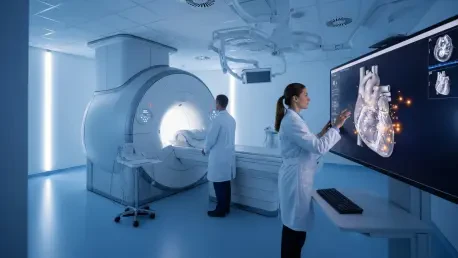

The diagnostic landscape for patients suffering from irregular heart rhythms is undergoing a profound transformation as medical facilities integrate sophisticated artificial intelligence into standard magnetic resonance imaging protocols to ensure clarity where traditional methods often fail. For years, clinicians have struggled to obtain reliable cardiac data from individuals with atrial fibrillation or severe heart failure, as these conditions frequently prevent patients from maintaining the long, steady breath-holds required for high-quality scans. Standard cardiac imaging relies on segmented sequences that gather data over numerous heartbeats, a process that assumes a predictable and rhythmic pulse. When the heart beats erratically, the scanner’s timing mechanism often triggers at the wrong moment, resulting in blurred images that are functionally useless for clinical decision-making. This technological bottleneck has historically left the most vulnerable patient populations without the precise diagnostic insights needed to manage complex cardiovascular diseases effectively.
Overcoming Technical Barriers in Cardiac Imaging
Innovation Through AI-Enhanced Single-Shot Technology
The introduction of Artificial Intelligence-enhanced Compressed Sensing, commonly known as AI-CS, marks a departure from outdated imaging philosophies by enabling a single-shot acquisition that captures the entire cardiac cycle in just two heartbeats. This rapid approach is a significant leap forward because it fundamentally eliminates the need for the repetitive, exhausting breath-holds that many elderly or critically ill patients find impossible to sustain during a traditional twenty-minute examination. By utilizing deep-learning algorithms, the system can reconstruct high-resolution visuals from a fraction of the raw data that would normally be required by standard machines. This efficiency does not come at the cost of detail; rather, the AI component is specifically trained to identify and preserve the structural integrity of the heart’s anatomy while ignoring the “noise” generated by a chaotic pulse. Consequently, the technology provides a stable window into the heart’s behavior regardless of rhythm.
Beyond merely increasing speed, the AI-enhanced single-shot framework addresses the core issue of data inconsistency by using its predictive capabilities to fill in gaps that appear when a patient cannot remain perfectly still. Traditional MRI sequences are like a puzzle that requires every piece to be placed at exactly the right moment; if one heartbeat is out of sync, the entire picture is ruined. In contrast, the AI-CS method acts as an intelligent architect that understands the underlying geometry of the heart, allowing it to synthesize a complete and accurate image even when the input data is fragmented or interrupted by a mistriggering event. This resilience ensures that the resulting cine sequences—the moving images of the heart—are smooth and anatomically precise. For radiologists, this means a dramatic reduction in the number of rescans required, leading to a more streamlined diagnostic process and a significant reduction in the overall time a patient must spend inside the scanner.
Validating Accuracy Through Comparative Analysis
To rigorously test the efficacy of this new technology, researchers conducted a comprehensive study involving seventy participants, carefully divided between healthy volunteers and patients with suspected cardiac arrhythmias. Each individual underwent a dual-protocol examination that included both the conventional balanced steady-state free precession sequence and the newer AI-enhanced single-shot method to allow for a direct head-to-head comparison of performance. This setup was crucial for determining whether the faster AI method could match the granular detail of the established gold standard while operating under less-than-ideal conditions. By subjecting both methods to the same physiological stressors, such as irregular heartbeats and varied breathing patterns, the research team was able to quantify the specific advantages of AI integration. The study prioritized real-world clinical scenarios, ensuring that the results would be applicable to the diverse patient demographics seen in modern hospitals.
The evaluation process involved a highly detailed analysis of several critical health markers, including left ventricular end-diastolic volume, ejection fraction, and various strain parameters that indicate how well the heart muscle is contracting. Three independent cardiovascular radiologists conducted blinded reviews of the data, scoring the images based on the visibility of fine structures like the endocardial borders and the papillary muscles. This blinded approach removed any potential for bias, ensuring that the scores reflected the true diagnostic utility of each imaging sequence. The researchers also focused on the presence of artifacts—visual distortions that can mimic or hide pathology—to see which method produced the cleanest results. By comparing these quantitative measurements against established benchmarks, the study sought to confirm that the AI-CS framework was not only faster but also technically reliable enough to serve as a primary diagnostic tool for assessing complex cardiac function.
Validating Clinical Success and Future Potential
Superior Outcomes for High-Risk Patient Groups
The findings from the clinical trial were striking, revealing that the AI-enhanced single-shot method achieved a flawless one-hundred percent success rate in providing diagnostic-quality images across the entire patient cohort. In sharp contrast, the conventional imaging sequences failed to produce usable data in twelve percent of cases, primarily due to the severe motion artifacts caused by erratic heart rhythms that the older software could not interpret. Radiologists noted that the AI-CS images provided exceptional clarity along the borders of the heart muscle, a region that is notoriously difficult to visualize when a patient is unable to hold their breath. This improvement in image definition allows for a much more accurate assessment of myocardial thickness and wall motion abnormalities, which are vital for diagnosing heart failure. The ability to consistently capture these details in every patient, regardless of their condition, represents a major victory for equitable access to high-tier diagnostics.
Furthermore, the reliability of the AI-CS framework was underscored in cases where traditional MRI had failed completely, as the AI-derived measurements for ejection fraction showed strong agreement with results obtained via echocardiography. This correlation is significant because it proves that the AI-enhanced single-shot method can stand alone as a robust diagnostic platform when other modalities are compromised. By providing a dependable fallback that matches the accuracy of more invasive or less detailed procedures, the technology ensures that clinicians do not have to rely on guesswork or incomplete data sets. The integration of deep learning essentially creates a safety net for the imaging process, catching and correcting errors in real-time before they can affect the final report. This level of technical maturity suggests that AI-enhanced protocols could soon become the standard of care for any patient presenting with symptoms that make traditional, time-consuming MRI sequences a challenge.
Impact on Diagnostic Efficiency and Patient Care
Transitioning to AI-enhanced imaging systems offers substantial benefits for hospital operations by significantly shortening the time required for each cardiac examination and increasing the throughput of radiology departments. In a busy medical environment, the ability to complete a comprehensive scan in a fraction of the traditional time means that more patients can be seen each day, reducing wait times for critical diagnostic services. For the patients themselves, the experience is much less daunting, as the stress of repeated breath-holding and the anxiety of remaining motionless for long periods are largely mitigated. This patient-centric approach not only improves comfort but also reduces the likelihood of movement-related errors that necessitate expensive and time-consuming repeat scans. As the technology continues to mature through 2026 and beyond, the integration of these rapid sequences is expected to lower the overall cost of cardiac care by optimizing resource allocation and equipment usage.
The research established that AI-enhanced single-shot imaging represented a pivotal advancement in overcoming the historical limitations of cardiac MRI for the most challenging patient populations. By decoupling image quality from the requirement of a perfect heart rhythm, the technology ensured that precision diagnostics became accessible to those with severe arrhythmias and respiratory difficulties. Moving forward, medical institutions prioritized the adoption of these intelligent frameworks to modernize their imaging suites and enhance diagnostic accuracy. Future developments focused on refining the contrast levels of AI-reconstructed images and expanding the technology to cover other complex organs that suffered from motion-related data loss. Ultimately, the successful implementation of this AI-CS framework provided a scalable solution that fundamentally altered the clinical approach to cardiovascular assessment, ensuring that treatment paths were guided by the clearest possible view of the heart’s health.