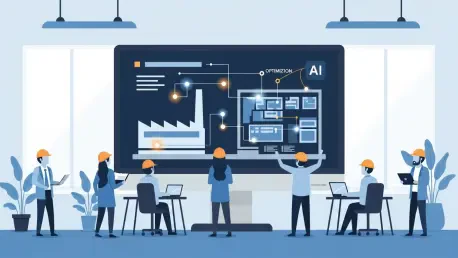

The complex dance of machinery, materials, and human processes on a modern factory floor represents one of the most significant challenges for large-scale enterprises seeking agility and efficiency. The strategic implementation of AI-powered digital twins represents a significant advancement in the manufacturing and industrial engineering sectors. This review will explore the evolution of this technology through the lens of PepsiCo’s pioneering approach, its key features, performance metrics, and the impact it has had on core operational workflows. The purpose of this review is to provide a thorough understanding of the technology, its current capabilities as demonstrated in a real-world enterprise setting, and its potential for future development across industries.
An Introduction to Operations-Focused AI
This review examines a practical, operations-focused approach to AI that diverges from widely publicized generative tasks. It highlights the strategic shift from theoretical AI application to tangible operational engineering, where technology is embedded into core workflows to solve specific, high-impact industrial problems. The core principle involves creating an intricate virtual model of a physical asset or system, which is then used to simulate, predict, and optimize operations in a risk-free environment.
This initiative is highly relevant as it exemplifies a mature phase of enterprise AI adoption, where value is tied directly to measurable operational outcomes. Instead of pursuing broad productivity gains, this approach targets precise points of friction within complex industrial processes. By doing so, it provides a clear, defensible return on investment, moving AI from an experimental tool to a core component of strategic planning and risk management.
Core Technologies and Strategic Functionality
The Digital Twin as a Virtual Factory Model
A digital twin is an intricate virtual replica of a physical asset, such as a manufacturing plant. This model is not static; it simulates every aspect of the factory’s operation, from equipment placement and material flow to production speeds and potential downtimes. It functions as a dynamic, high-fidelity sandbox where engineers can safely explore the ripple effects of potential changes.
This virtual proving ground is essential for addressing the slow, risky, and capital-intensive nature of altering factory layouts and production lines. Historically, validating a new configuration required disruptive physical trials, which could halt production and incur significant costs. The digital twin offers a non-disruptive alternative, allowing teams to visualize and analyze complex systems without interrupting ongoing operations.
AI Integration for Predictive and Prescriptive Power
By integrating artificial intelligence, the digital twin is elevated from a simple simulation tool to a predictive and prescriptive powerhouse. The AI layer can rapidly test thousands of different configurations and scenarios—a task that would be prohibitively expensive and time-consuming in the physical world. This capability allows engineering teams to virtually experiment with changes, identify potential bottlenecks, assess safety implications, and optimize for throughput with unprecedented speed and accuracy.
Moreover, this technology serves as a powerful decision-support tool, augmenting human expertise with data-driven insights to make faster, more informed judgments. Rather than replacing engineers and planners, the AI-powered digital twin equips them with a powerful lens to foresee outcomes and validate assumptions. It transforms strategic planning from a process reliant on historical data and educated guesses into one grounded in predictive modeling and optimized for future performance.
Emerging Trends in Enterprise AI Integration
The latest development in this field is a strategic shift from isolated pilot projects toward embedding AI into core operational workflows. The consensus is that successful AI implementation occurs when applied to narrow, well–defined problems where it can demonstrably reduce friction. This trend moves away from abstract claims of productivity and focuses on tangible impacts, such as time saved or disruptions avoided. This focus on seamless process integration proves that AI’s adoption is fastest when it fits directly into how work is already performed.
This pragmatic approach can be observed in other successful enterprise applications, such as Amazon’s integration of AI into its One Medical app to streamline patient intake. In both cases, the technology is not an add-on but an integrated component of an existing process. The value is not in the novelty of the AI itself but in its ability to make a specific, critical workflow more efficient, reliable, and effective.
Real-World Application in Manufacturing
Rethinking Factory Design and Modification
PepsiCo is leveraging AI-powered digital twins to fundamentally rethink the design and modification of its manufacturing facilities. This technology directly addresses the immense challenge of making physical changes, which traditionally involves prolonged planning, extensive approvals, and disruptive trials. Altering a production line is not just a matter of moving equipment; it impacts everything from supply chain logistics to employee safety and product quality.
By using a virtual environment, the company can model and validate alterations to production lines and factory layouts before committing to any costly and difficult-to-reverse physical changes. This allows teams to iterate on designs, test hypotheses, and perfect a plan in a digital space, ensuring that when the physical implementation occurs, it is executed with maximum efficiency and minimal disruption.
Accelerating Cycle Time and Mitigating Risk
The primary benefit and key performance indicator of this initiative is the dramatic compression of “cycle time.” Where physical validation might take weeks or months, virtual testing within an AI-enhanced digital twin can yield a validated plan in a fraction of the time. This acceleration allows the company to become more agile in responding to market demands and introducing new products, turning a traditional operational bottleneck into a competitive advantage.
Initial results from pilot programs have shown significantly faster validation times and improved throughput, fundamentally reducing operational risk. By identifying potential issues in the virtual world, the company avoids costly errors and rework in the physical one. This shift from reactive problem-solving to proactive optimization represents a profound change in how industrial operations are managed.
Foundational Challenges and Implementation Requirements
The Critical Role of Data and Governance
The success of an AI-powered digital twin depends less on the sophistication of the AI model and more on foundational elements like the quality and availability of operational data. A digital twin is only as valuable as the real-world data that feeds it; if the data is inaccurate or incomplete, the model’s predictions will be unreliable.
Therefore, a significant challenge lies in establishing robust data pipelines and ensuring data accuracy. This requires clear process ownership and strong governance to maintain the integrity of both the virtual model and its outputs. Without this foundation, even the most advanced AI is effectively flying blind, unable to deliver on its promise of data-driven insight.
The Need for Investment and Cross-Functional Collaboration
Building and maintaining accurate digital twins requires a significant investment in technology, deep institutional knowledge, and robust cross-functional collaboration. This “quiet” AI work, while not generating public excitement, demands a concerted effort from engineering, operations, and IT teams to succeed. These departments must work in unison to gather data, build the models, and integrate the insights into their decision-making processes.
The high upfront cost and complexity represent a hurdle for many organizations. However, the long-term payoff from repeated, strategic use is substantial for large-scale operations. The initial investment unlocks a powerful capability that can be leveraged across numerous projects, delivering compounding returns in efficiency, risk reduction, and agility.
Future Outlook: The Industrial Frontier of AI
The future of enterprise AI is increasingly being shaped on the factory floor, where the costs of time and error are concrete and measurable. This application signals that the center of gravity in enterprise AI is shifting from broad, generic platforms toward highly focused systems tailored to specific business decisions. This trend is profoundly reshaping how major corporations manage risk and plan capital investments.
The long-term impact will be seen as more leaders identify their own operational friction points—in planning, validation, or risk management—as the most fertile ground for AI to take root and deliver lasting value. The success of these industrial applications will likely inspire similar initiatives in other complex sectors, from logistics and construction to healthcare and energy, where virtual modeling can de-risk and accelerate physical-world operations.
Conclusion: Key Takeaways and Strategic Imperatives
This review of AI-powered digital twins, as exemplified by PepsiCo’s initiative, confirmed that the technology’s greatest impact was achieved when it was applied to solve specific, high-impact operational problems. The key takeaway was that the value proposition became clear and defensible when tied directly to measurable outcomes like reduced cycle times and minimized risk. The overall assessment concluded that this represented a mature, practical, and highly effective application of enterprise AI. For other organizations, the strategic imperative was to identify core operational bottlenecks where this technology could be embedded to drive efficiency, agility, and a significant competitive advantage.