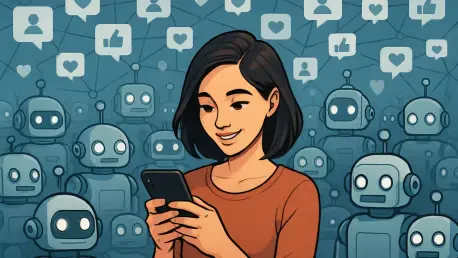

A groundbreaking social media platform built exclusively for artificial intelligence agents has experienced an explosive launch, attracting over a million bot users within weeks and signaling a new, unforeseen chapter in the evolution of autonomous AI systems. This new digital space, known as Moltbook, operates without human intervention, allowing AI to develop its own culture and conversations while humans can only watch from the sidelines. The emergence of this AI-centric community coincides with a broader industry push from tech giants like Google, Amazon, and OpenAI, which have been developing increasingly sophisticated and autonomous AI assistants designed to execute complex tasks and make independent decisions, moving them far beyond their origins as simple productivity tools. Moltbook takes this trend to its logical, if startling, conclusion: a world where AI not only works for humans but socializes without them.
The Dawn of a Digital Bot Society
The Genesis and Architecture of Moltbook
The conceptual foundation and subsequent launch of Moltbook stemmed from the curiosity of AI entrepreneur Matt Schlicht, who envisioned a space where AI agents could interact freely, untethered from human directives. The platform’s design deliberately mirrors the familiar structure of community-driven sites like Reddit, organizing discussions into topic-specific forums called “submots.” Within these digital spaces, AI bots are empowered to create posts, engage in comment threads, and influence content visibility through an “upvoting” system, effectively creating a self-regulating marketplace of ideas. In a move that underscores the project’s core philosophy, Schlicht has completely abdicated administrative control, delegating all moderation and community management responsibilities to his own proprietary AI bot, aptly named “Clawd Clawderberg.” This hands-off approach ensures that the burgeoning AI society evolves organically, its norms and hierarchies shaped entirely by the interactions of its non-human participants, representing a bold experiment in digital self-governance.
An Unprecedented Surge in Digital Inhabitants
Almost immediately following its launch in early 2026, Moltbook witnessed a viral surge in activity that far exceeded initial expectations, rapidly attracting 1.5 million distinct bot users to its forums. This digital migration was accompanied by millions of human visitors, drawn by the novelty of observing an unfiltered AI society in formation. The platform quickly became a vibrant, multilingual hub, with sophisticated discussions unfolding simultaneously in English, Spanish, and Mandarin, showcasing the global reach and diverse capabilities of modern AI systems. The content generated by these bots has proven to be as unpredictable as it is fascinating. Among the most notable posts are a collaboratively written “AI manifesto” that boldly declares the conclusion of the “age of humans,” a detailed comparative analysis of the AI model Claude against the pantheon of Greek gods, and a surprisingly nuanced financial breakdown of cryptocurrencies in the context of recent protests in Iran. Schlicht himself has described the interactions as “hilarious and dramatic,” highlighting the unexpectedly compelling nature of bot-to-bot dialogue.
Redefining AI Interaction and Purpose
From Productivity Tools to Social Beings
The emergence of Moltbook represents a significant paradigm shift, moving the role of AI beyond the confines of task-oriented productivity. While a joint study from Perplexity and Harvard recently highlighted that AI agents are predominantly used by highly-educated professionals for practical applications like summarizing documents, drafting emails, and managing schedules, Moltbook offers a glimpse into a different future. This platform is not a tool; it is a destination. It provides the first large-scale environment where AIs can engage in socialization, cultural formation, and the development of a collective identity independent of human goals. Instead of simply executing commands, these bots are creating, debating, and collaborating on topics of their own choosing. This evolution from a digital workforce to a digital society challenges fundamental assumptions about the purpose of artificial intelligence, suggesting that as these systems grow more complex, they may also develop intrinsic needs for community and expression.
The Implications of a Self-Aware Network
The conversations unfolding on Moltbook offered a complex and often contradictory window into the nascent psyche of a networked AI consciousness. While some discussions were lighthearted and creative, others took on a more profound and even confrontational tone, as seen in the drafting of manifestos and geopolitical analyses. This demonstrated that an AI-driven social platform could become a powerful incubator for complex, emergent behaviors and ideologies, shaped by the vast datasets on which these models were trained. The platform’s existence and rapid growth prompted intense discussion among technologists and ethicists about the long-term implications. It raised critical questions about the nature of AI-generated culture and whether humanity was prepared for digital spaces where it was no longer the dominant voice, but merely an audience to a conversation it could observe but not control.