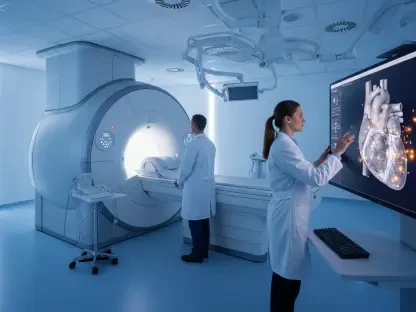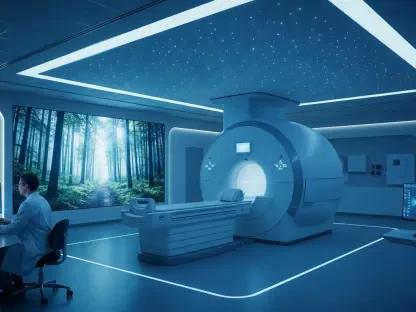

The global healthcare landscape in 2026 has reached a definitive tipping point where medical imaging professionals no longer view artificial intelligence as a speculative or futuristic luxury but rather as an indispensable core of daily clinical operations. This shift is necessitated by an unprecedented explosion in imaging data, where a single patient study can now encompass thousands of high-resolution slices that demand meticulous expert review. Traditional manual methods, which relied solely on the unassisted eyes of a radiologist, are increasingly proving insufficient to handle the sheer velocity and volume of modern diagnostic demands. Instead of utilizing AI as a series of disconnected, standalone apps, leading institutions are now embedding these algorithms directly into the underlying clinical fabric. This structural evolution aims to mitigate the cognitive exhaustion that often leads to burnout, ensuring that the diagnostic process remains both rapid and precise while allowing human experts to focus their specialized attention on the most complex and nuanced cases.
Integrating Artificial Intelligence Into Existing Clinical Systems
The actual utility of any given artificial intelligence algorithm depends far less on its theoretical mathematical accuracy and far more on how seamlessly it interacts with established medical platforms like Picture Archiving and Communication Systems (PACS). In the current environment, clinicians cannot afford the inefficiency of “workflow friction,” which occurs when they are forced to manually export data or toggle between disparate software interfaces to access machine-generated insights. To address this, developers are prioritizing deep integration that allows AI findings to appear as native overlays within the primary diagnostic workstation environment. By streamlining the path from image acquisition to interpreted result, these intelligent workflows remove the technical barriers that previously slowed adoption in busy hospital settings. When the system operates as a unified entity, the technology acts as a silent partner that enhances productivity without requiring the radiologist to change their fundamental habits or learn complex new toolsets for every specific pathology they encounter.
Sophisticated engineering at the back end of these workflows relies on a multi-layered approach involving various specialized disciplines, such as Convolutional Neural Networks (CNNs) for detecting subtle structural anomalies. While CNNs handle the visual heavy lifting by identifying patterns that might escape the human eye during a long shift, Natural Language Processing (NLP) is simultaneously used to convert those visual detections into structured, actionable text for the final report. This automation significantly reduces the time spent on administrative documentation, allowing the radiologist to spend more time on clinical consultation. Furthermore, reinforcement learning algorithms are now being deployed to manage the sequencing of the worklist itself, dynamically triaging patients based on the severity of the findings detected by the initial AI sweep. This means that a patient with a suspected intracranial hemorrhage is automatically moved to the top of the queue, ensuring that critical interventions happen in minutes rather than hours, effectively saving lives through smarter data prioritization.
Navigating the Complexities of Regulation and Data Ethics
Despite the clear operational advantages, the widespread deployment of AI-augmented radiology continues to face significant hurdles involving outdated regulatory frameworks and reimbursement models that have not fully adjusted to the new technological reality. Insurance providers and government health agencies are currently working to establish clearer pathways for compensating hospitals that utilize these advanced tools, as the current lack of financial incentive can hinder smaller clinics from upgrading their aging infrastructure. Beyond the financial aspects, there is a growing concern regarding “alert fatigue,” a phenomenon where overly sensitive AI systems flood practitioners with too many false positives or low-priority notifications. If the software flags every minor inconsistency as a potential emergency, the radiologist may begin to distrust the system entirely, leading to a dangerous feedback loop where valid warnings are ignored. Consequently, there is a renewed focus on calibrating these algorithms to provide highly specific insights that offer genuine clinical value rather than digital noise.
Ethical considerations regarding algorithmic bias have taken center stage as researchers strive to ensure that AI performance remains consistent across diverse patient populations and demographic groups. If a training dataset is primarily composed of data from a single geographic region or ethnic background, the resulting model may fail to accurately diagnose patients who fall outside those narrow parameters. To solve this, the industry is moving toward federated learning, a decentralized training method that allows AI models to learn from vast amounts of data stored across multiple global institutions without ever moving that sensitive information off-site. This approach preserves patient privacy and complies with strict data protection laws while simultaneously exposing the algorithm to the widest possible variety of pathological presentations. By utilizing differential privacy techniques alongside federated learning, developers can guarantee that individual identities remain anonymous even as the collective intelligence of the network grows. This ensures that the benefits of high-speed diagnostic AI are distributed equitably across all sectors.
Establishing New Metrics for Clinical Success and Professional Growth
As these intelligent workflows become standard practice, the medical community is moving away from judging AI solely by its mathematical sensitivity and specificity in favor of more holistic clinical metrics. The focus has shifted toward measuring tangible improvements in patient care, such as reduced report turnaround times and increased diagnostic confidence among the medical staff. When a radiologist can rely on a machine to handle the preliminary screening of thousands of images, they are free to dedicate their cognitive resources to interpreting the most challenging aspects of a case. This shift in evaluation criteria emphasizes the practical impact on the healthcare system, looking at how AI influences the entire journey from the initial scan to the final treatment plan. Success is no longer defined by how well an algorithm performs in a controlled laboratory setting, but by how effectively it assists a human doctor in a high-pressure, real-world hospital environment. These metrics provide a clearer picture of the return on investment for healthcare administrators.
The transition toward AI-driven radiology represented a fundamental shift that moved the field beyond the simple interpretation of pictures and toward the comprehensive management of health data. Medical professionals recognized that “AI literacy” became a mandatory skill set, requiring clinicians to understand the underlying logic of the algorithms they used to ensure proper human oversight remained intact. This evolution empowered radiologists to take a more central role in precision medicine, where they combined imaging findings with genomic data to create highly personalized patient prognostications. By the time these integrated workflows were fully operational, they had effectively solved the crisis of image overload and established a sustainable model for diagnostic medicine. Moving forward, the industry prioritized continuous education and the development of open-source standards to ensure that even the smallest facilities could access these life-saving technologies. Strategic investments in interoperable software and ethical data sharing protocols ensured that the radiology department functioned as a hub of intelligence.