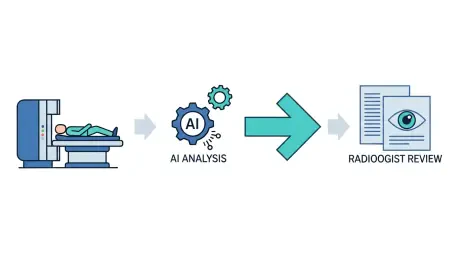

In the high-stakes environment of diagnostic imaging, where radiologists analyze an immense volume of medical scans under intense time pressure, the risk of a critical finding being overlooked is a persistent and significant challenge. This pressure can lead to burnout and, more critically, delayed or missed diagnoses that can profoundly impact patient outcomes. To address this, the healthcare industry has increasingly turned to artificial intelligence platforms designed to act as a second set of eyes, flagging potential abnormalities for immediate review. Within this competitive landscape, Aidoc, a clinical decision support AI company, has emerged as a major player. The company’s platform, which helps radiologists swiftly identify urgent findings and ensures proper follow-up, has achieved widespread adoption. According to Tom Valent, the company’s chief business officer, this success was not accidental but the result of a deliberate, multi-faceted strategy that combined astute market timing, a laser focus on high-impact clinical applications, and a foundational culture built on deep technological innovation and unwavering trust.
Strategic Positioning and Market Entry
A significant factor contributing to Aidoc’s rapid ascent was its strategic market entry as a “second generation” AI company. Unlike the pioneers who had to invest heavily in educating a skeptical medical community about the fundamental value of artificial intelligence, Aidoc arrived when providers were already familiar with the concept. This timing proved to be a powerful advantage, allowing the company to circumvent the lengthy and resource-intensive process of market education and foundational concept validation. Instead of convincing clinicians that AI could work, Aidoc could focus its efforts on demonstrating how its specific solutions worked better. This enabled a more efficient allocation of resources, channeling investment directly into advanced research, product refinement, and seamless integration rather than basic market priming. By building on the groundwork laid by its predecessors, the company was able to enter the conversation at a more sophisticated level, addressing nuanced concerns about workflow integration and clinical efficacy from day one, thereby accelerating its path to market acceptance and large-scale implementation.
Further solidifying its market position, Aidoc made the strategic decision to initially concentrate on acute clinical use cases, where the technology’s impact could be measured in minutes and directly correlated with life-or-death outcomes. By developing algorithms to detect critical conditions like pulmonary embolisms, intracranial hemorrhages, and cervical spine fractures, the company was able to demonstrate clear, immediate, and undeniable clinical value. This approach provided a stark contrast to AI solutions focused on chronic conditions or long-term risk prediction, which often require extensive, multi-year studies to prove their efficacy and return on investment. For a hospital system, the ability to shave critical minutes off the time to diagnosis for a stroke patient provides a tangible and powerful justification for adoption. This focus on high-acuity scenarios allowed Aidoc to rapidly build credibility and trust with frontline clinicians and hospital administrators, as the benefits were not theoretical but were realized in real-time, improving patient care and streamlining emergency department workflows.
Core Philosophy of Innovation and Trust
Internally, the company’s trajectory has been guided by a deeply ingrained R&D-first culture that prioritizes substantive technological innovation over aggressive marketing campaigns. This philosophy manifests in the development of AI tools that are not only algorithmically powerful but are also meticulously designed to integrate into the complex and often fragmented workflows of modern radiology departments. Recognizing that any new technology that adds clicks, opens extra windows, or disrupts a radiologist’s established rhythm is likely to be rejected, Aidoc focused on creating a platform that operates seamlessly in the background. The goal was to augment, not replace, the physician’s expertise, surfacing critical information at the right moment without creating additional cognitive burdens. This commitment to addressing real-world clinical complexities, rather than simply chasing the highest accuracy scores in a lab, has resulted in a product that feels less like an imposition and more like an indispensable co-pilot, a crucial factor in its widespread and sustained adoption by medical professionals.
This foundation of technical excellence is complemented by an unwavering commitment to patient safety, quality, and transparency, which serves as the ultimate pillar of the company’s strategy. Valent emphasizes the critical importance of maintaining a precise balance between sensitivity and specificity in the algorithms. An AI with low sensitivity might fail to detect a life-threatening condition, defeating its purpose, while one with low specificity would generate a high number of false positives. This latter issue leads to “alert fatigue,” a well-documented phenomenon where clinicians become desensitized to frequent, non-actionable warnings and begin to ignore the system altogether. To build and maintain trust, Aidoc has embraced transparency through tools like “model cards,” which provide clear documentation on how its algorithms were trained, their performance metrics, and their known limitations. This transparency, coupled with continuous real-world monitoring to ensure the AI is being used appropriately and is performing as expected post-deployment, has been essential in forging a strong, trust-based partnership with the clinical community.
A Blueprint for Enduring Success
Ultimately, Aidoc’s success was not the result of a single breakthrough but rather the culmination of a cohesive and deliberately executed strategy. The company’s leaders demonstrated a keen understanding of the market’s evolution, positioning their entry to capitalize on existing awareness while focusing their product on areas of immediate and unquestionable clinical need. This market savvy was supported by an internal culture that valued deep technical substance and seamless user integration over superficial promotion, ensuring the tools were both powerful and practical. Layered on top of this was a foundational commitment to safety and transparency, which proved indispensable in earning the trust of a rightfully cautious medical profession. This multi-pronged approach—blending strategic timing, a value-driven focus, a robust R&D engine, and an ethical framework—provided a comprehensive blueprint that addressed the primary obstacles to AI adoption in healthcare, creating a model for how to translate technological potential into tangible, life-saving clinical impact.