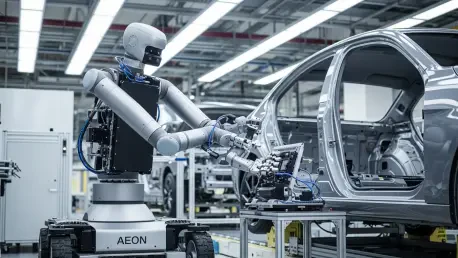

The global automotive landscape is currently undergoing a profound transformation as BMW Group transitions its most advanced robotic initiatives from controlled laboratory environments directly onto the high-pressure production floor of its Leipzig plant in Germany. This strategic move signifies the arrival of Physical AI in the heart of European industry, effectively bridging the gap between theoretical software capabilities and the gritty reality of large-scale vehicle assembly. By integrating the AEON humanoid robot into its daily operations, BMW is demonstrating that mobile, intelligent machines are no longer mere curiosities for technology showcases but are essential tools for maintaining a competitive edge in a rapidly evolving market. This deployment represents a critical milestone for the company, as it shifts the narrative away from experimental prototypes toward functional assets that can navigate complex industrial terrains, interact with human workers, and perform intricate tasks with a level of precision that was previously unattainable for non-stationary automation systems.
The Evolution: From Experimental Trials to Industrial Reality
This significant rollout follows a rigorous and data-driven testing period that took place throughout the previous year at BMW’s Spartanburg facility in South Carolina, where the organization evaluated the performance of the Figure 02 robot. During that intensive trial, the machines were responsible for handling more than 90,000 individual components during the assembly of approximately 30,000 BMW X3 vehicles, proving that humanoid forms could endure the physical demands of ten-hour shifts without compromising quality. The success of the Spartanburg pilot provided the necessary empirical evidence to justify a more permanent and sophisticated deployment in Germany. However, rather than simply replicating the American trial, the Leipzig project introduces the AEON robot, a specialized machine developed by the Zurich-based division of Hexagon Robotics. This shift highlights a strategic pivot toward technology that is specifically engineered for the unique structural and logistical requirements of European automotive manufacturing facilities.
The introduction of AEON represents a broader industry trend where manufacturers are moving away from general-purpose humanoid research toward task-specific industrial platforms. By leveraging the lessons learned from the Spartanburg trials, BMW has refined its approach to automation, focusing on the integration of robots that can seamlessly adapt to existing factory workflows. The move to Leipzig is particularly significant because it marks the first time such technology has been deployed in a facility that produces a diverse range of vehicle types, including electric and combustion engine models. This environment provides a more challenging and representative test for the robots, requiring them to handle a wider variety of parts and assembly processes. Consequently, the Leipzig deployment is not just a continuation of previous efforts but a sophisticated expansion that tests the limits of what Physical AI can achieve in a modern, multi-model production line, setting a new standard for the global automotive sector.
Precision Engineering: AEON for Peak Productivity and Efficiency
The design philosophy behind the AEON robot emphasizes industrial efficiency and operational reliability over the aesthetic pursuit of human-like mimicry often seen in earlier research projects. One of the most striking departures from traditional humanoid design is the choice of a wheeled base instead of bipedal legs, which provides superior stability and energy efficiency on the flat, predictable surfaces of a modern factory floor. Standing at a height of 1.65 meters and weighing a lean 60 kilograms, AEON is optimized for high-speed transit, capable of reaching velocities up to 2.5 meters per second to keep pace with the rhythmic flow of the assembly line. Perhaps its most revolutionary feature for continuous production is the autonomous battery swap system, which allows the robot to replace its own power source in just 23 seconds. This capability effectively eliminates the lengthy charging downtimes that have historically hindered the widespread adoption of mobile robotics in around-the-clock manufacturing environments.
Beyond its mobility, AEON is equipped with a sophisticated array of 22 integrated sensors, including SLAM cameras, infrared modules, and high-fidelity microphones, granting it a 360-degree spatial awareness that rivals human perception. This comprehensive sensor suite allows the robot to operate safely in close proximity to human staff while simultaneously performing high-precision quality inspections and assembly maneuvers. Unlike the rigid, stationary robots that have dominated car factories for decades, AEON’s mobile humanoid torso is designed to accommodate various modular hand elements and specialized scanning tools. This versatility enables it to transition between disparate roles, such as verifying the alignment of interior components or assisting in the installation of complex wiring harnesses. By combining this physical flexibility with advanced onboard computing, the machine can adapt to minor variations in component placement, reducing the need for the expensive, highly structured environments typically required for traditional automation.
Digital Integration: The Role of the Leipzig Plant and Infrastructure
BMW’s selection of the Leipzig plant as the primary site for this deployment was a calculated decision rooted in the facility’s unique status as a highly integrated manufacturing hub. Leipzig serves as a comprehensive ecosystem where high-voltage battery production, injection molding, and final assembly all coexist under a single roof, providing a diverse range of use cases for testing Physical AI. To manage this transition effectively, BMW established the Centre of Competence for Physical AI in Production, a dedicated administrative and technical body designed to centralize robotics expertise and standardize implementation protocols. This institutional infrastructure ensures that the insights gained on the Leipzig floor are not localized but can be systematically scaled across the company’s global production network. By creating a unified framework for evaluating new robotic technologies, BMW is positioning itself to lead the industry in the adoption of autonomous systems, moving beyond isolated experiments.
The physical presence of AEON on the factory floor is only one component of a much larger digital strategy that leverages advanced simulation and unified data platforms. The robot’s core capabilities were refined within the NVIDIA Isaac virtual environment, allowing engineers to simulate thousands of hours of operation and edge-case scenarios in a fraction of the time required for physical testing. This digital twin approach enables the rapid iteration of control algorithms and sensor processing, ensuring that the robot is fully prepared for the complexities of the assembly line before it ever touches a physical part. Onboard, the AEON system utilizes NVIDIA Jetson Orin computing units to process massive amounts of sensor data in real-time, while Microsoft Azure provides the scalable cloud infrastructure necessary for training the underlying AI models. By breaking down traditional data silos and ensuring that every machine has access to a consistent stream of operational intelligence, BMW has created a production environment where hardware work in data-driven harmony.
Strategic Impact: Shaping the Future of Global Automotive Manufacturing
The integration of AEON at the Leipzig plant effectively signaled the end of the experimental era for humanoid robotics, shifting the industry’s focus toward practical, scalable applications. As global reports from 2026 indicated a sharp rise in the adoption of Physical AI, with nearly 60% of major enterprises incorporating similar systems, BMW established a clear blueprint for others to follow. Moving forward, manufacturers should prioritize the creation of standardized data architectures and simulation-first development cycles to ensure that robotic deployments deliver measurable returns on investment. The transition at Leipzig demonstrated that the path to increased productivity lay not in replacing human labor, but in fostering a symbiotic relationship where machines handled repetitive or ergonomically challenging tasks. This shift required a fundamental reimagining of factory logistics and worker training programs, emphasizing the need for a workforce capable of managing and maintaining these intelligent systems.
This successful deployment of robots proved that the automotive sector was ready to embrace a future defined by precision, mobility, and autonomous intelligence. Leaders in the field must now focus on expanding these robotic capabilities into more complex areas of the supply chain, such as logistics and warehouse management, where mobile AI can offer significant advantages. Furthermore, the collaboration between hardware providers like Hexagon and software giants like NVIDIA showcased the importance of cross-industry partnerships in accelerating technological adoption. As other European manufacturers observe the results of the Leipzig pilot, the pressure to modernize will likely lead to an accelerated rollout of similar platforms across the continent. Ultimately, the lessons learned from AEON provided the necessary foundation for a more resilient and efficient manufacturing model, ensuring that human ingenuity remained at the center of the production process while being supported by the most advanced robotic tools available in the modern industrial landscape.