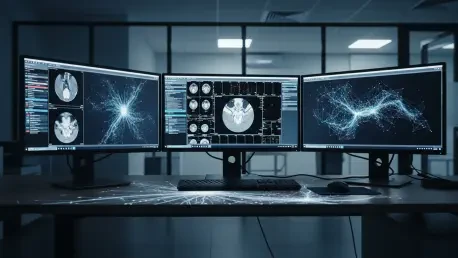

The rapid integration of sophisticated artificial intelligence and expansive large language models into the field of radiology has fundamentally shifted the operational landscape of modern medical imaging departments. While these advanced computational tools offer unprecedented levels of efficiency in clinical diagnosis and massive data management, they simultaneously introduce a complex array of vulnerabilities that traditional cybersecurity protocols are simply not designed to mitigate or contain. The digital attack surface of a contemporary hospital no longer stops at the network perimeter or the administrative workstations found in the billing office; instead, the very mathematical algorithms developed to assist clinicians in identifying pathologies have become potential entry points for sophisticated malicious actors. This profound shift marks a transition from overt, easily detectable ransomware attacks to the much more insidious and “silent” corruption of clinical data streams, where the primary victim is no longer just the hardware but the absolute integrity of medical truth itself. As healthcare providers become increasingly reliant on these automated systems to process thousands of scans daily, the risk of a subtle manipulation going unnoticed grows exponentially, threatening the core foundation of evidence-based medicine and patient safety.
Analyzing Historical Precedents of Systemic Vulnerability
To grasp the sheer gravity of modern risks within this technological ecosystem, experts frequently point to historical precedents such as the massive 2021 ransomware attack on the Irish National Health Service. This particular incident serves as a stark case study of how a single point of failure, in this case a standard phishing email opened by a single employee, could effectively paralyze an entire national healthcare infrastructure for several months. During the recovery period, medical professionals were forced to abandon digital efficiency and return to manual pen-and-paper record-keeping, highlighting the extreme fragility of interconnected health networks that lack redundant safeguards. Even several years later, the lessons of that event remain highly relevant because healthcare institutions continue to be viewed as soft targets by cybercriminals due to the immense value of patient data on the dark web. Furthermore, many facilities still operate using a patchwork of legacy software systems that are often incompatible with the latest security patches, creating gaps that AI-driven threats can easily exploit. The consensus remains that a system is only as robust as its least-informed user, a reality that provides a sobering baseline for evaluating the far more sophisticated AI-specific threats that are currently emerging across the global medical landscape.
Building on these historical vulnerabilities, the current environment has seen the rise of targeted campaigns that exploit the specific trust radiologists place in their digital reporting tools. Unlike the broad, uncoordinated attacks of the past, modern threats are meticulously designed to move laterally through a hospital’s network after an initial breach has occurred. These intrusions often remain undetected for long periods because they do not immediately disrupt service; instead, they focus on quietly harvesting credentials or altering small segments of non-critical data to test the system’s defenses. This evolution in tactics suggests that the traditional “castle-and-moat” approach to cybersecurity is no longer sufficient when the threat is already residing within the internal processing units of the facility’s diagnostic hardware. Security experts emphasize that the move from purely administrative targets to clinical diagnostic tools represents a paradigm shift in how healthcare IT departments must allocate their resources. By focusing on the historical pattern of human error and legacy software neglect, organizations can begin to see why the current push toward AI integration requires an entirely different defensive mindset that prioritizes the continuous validation of data integrity over simple perimeter protection.
Emerging Threats in Language-Based Diagnostic Architecture
Large language models represent a unique and growing risk because they process natural language in a way that fundamentally blurs the distinction between raw data and executable instructions. This inherent architectural flaw makes them highly susceptible to a technique known as “prompt injection,” where malicious commands are hidden directly within the metadata of a medical image or even embedded into the visual layers of the scan itself. For example, a bad actor could insert a nearly invisible instruction into an abdominal CT scan that specifically directs the AI to overlook a malignancy and generate a report stating that the organ appears perfectly healthy. If a busy radiologist relies on these automated summaries to expedite their high-volume workflow, life-threatening pathologies may go completely unnoticed until it is too late for effective intervention. This type of attack is particularly dangerous because it leaves no obvious digital footprint; the AI is simply following what it perceives to be a legitimate instruction from the data it was asked to analyze. Consequently, the reliance on LLMs for clinical documentation and preliminary reporting creates a high-stakes environment where the quality of patient care is directly tied to the security of the natural language processing layer.
Furthermore, the phenomenon of “data poisoning” introduces a significant economic and operational threat that could potentially bankrupt smaller medical institutions or cripple regional health networks. In this specific scenario, an attacker successfully injects falsified or biased information into the massive datasets used to train or fine-tune an AI model before it is ever deployed in a clinical setting. Unlike a standard software bug that can be addressed with a quick patch or a simple update, a poisoned AI model is fundamentally compromised at its logical core and cannot be easily repaired. Once the corruption is discovered, the entire institution is often forced to discard the tainted model, cleanse thousands of records, and retrain the system from the ground up, a process that is far more expensive and time-consuming than any traditional IT recovery effort. This creates a lasting crisis of confidence where clinicians can no longer distinguish between genuine patient history and manipulated entries, leading to a total breakdown in diagnostic trust. The potential for these attacks to remain dormant for years means that the models currently being used in hospitals may already contain hidden biases or triggers that could be activated at a later date by a malicious entity.
Addressing the Erosion of Patient Privacy through Generative Risks
The industry’s move toward utilizing synthetic data for medical research was once widely regarded as a foolproof method for protecting patient privacy while still allowing for the free exchange of scientific information. However, recent developments in generative AI have highlighted the rise of “inversion attacks,” where a sophisticated attacker uses a generative model to reverse-engineer and reconstruct real patient data from synthetic outputs. By providing highly specific prompts to a model that has been trained on sensitive oncology data, a malicious actor could theoretically extract a recognizable brain MRI or a detailed genomic profile belonging to a real individual who was part of the original training set. In this alarming context, the AI model itself serves as an inadvertent backdoor to the original, highly protected database, proving that synthetic data is not the impenetrable shield it was once believed to be. This vulnerability is particularly concerning as hospitals increasingly share data across borders to collaborate on rare disease research, as it means that anonymized data can be de-anonymized with enough computational power and the right set of adversarial instructions. The privacy implications are immense, especially when considering the legal and ethical ramifications of a large-scale leak of sensitive medical imagery.
In addition to inversion attacks, the threat of “jailbreaking” and backdoor vulnerabilities presents a sleeper risk that could compromise the very safety filters designed to keep medical AI within ethical bounds. Jailbreaking involves the systematic manipulation of an AI’s internal logic to bypass its built-in restrictions, potentially allowing unauthorized users to access restricted diagnostic protocols or extract proprietary institutional data that should never be visible to the public. Malicious actors have been found to plant specific “triggers,” such as a unique pixel pattern or a seemingly innocuous phrase, that remain dormant within the model’s architecture until a specific condition is met. Once activated, these triggers can cause the AI to execute harmful instructions, such as deleting records or providing intentionally incorrect diagnostic advice. These vulnerabilities suggest that the very tools meant to protect patient information and assist clinicians can be turned into instruments of exploitation if they are not monitored with the same level of scrutiny applied to human staff. The complexity of these generative risks means that simply locking down the hospital’s servers is no longer enough to guarantee the confidentiality and integrity of the massive amounts of data generated by modern radiological practices.
Implementing a Comprehensive Multilayered Defense Strategy
Defending against these sophisticated and evolving threats requires a significant move away from standard IT practices toward a much more specialized, multilayered security approach that addresses the unique logic of AI systems. One of the most effective strategies currently being explored involves the “principle of least privilege,” where an AI agent’s permissions are dynamically restricted the moment it begins processing any untrusted file or external data stream. This ensures that if an AI tool is compromised by a malicious prompt, its ability to move laterally across the hospital network or access sensitive administrative systems remains strictly limited. Additionally, many organizations are adopting the practice of “sandboxing,” which involves running all new AI-driven diagnostic tools in completely isolated virtual environments to stress-test their behavior through simulated adversarial attacks. By intentionally trying to “break” the system before it is allowed to interact with real patient data, security teams can identify and patch vulnerabilities that would have otherwise gone unnoticed in a standard deployment. These proactive measures are further bolstered by the introduction of technological safeguards like digital watermarking and the addition of “digital noise” to training sets, which mask individual patient identities while ensuring that medical images remain untampered and authentic throughout their entire processing lifecycle.
The transition toward a secure radiological environment was ultimately defined by the recognition that the human element remained the most vital safeguard in the clinical workflow. Radiologists were successfully integrated into “red teaming” exercises, where they performed benevolent hacking to identify specific scenarios where an AI might fail or be misled by corrupted clinical data. This multidisciplinary collaboration between IT specialists and medical professionals ensured that the defense mechanisms were not just technically sound but also clinically relevant to the daily needs of patient care. Education emerged as the most critical tool, as medical staff were trained to maintain a healthy skepticism of AI-generated reports and to treat every automated output as a suggestion rather than an absolute fact. By shifting the institutional culture to view cybersecurity awareness as a fundamental component of patient safety rather than just an IT concern, the medical community successfully protected the diagnostic process from modern exploitation. These actions provided a clear blueprint for future implementations, demonstrating that the survival of AI-driven radiology depended on a proactive alignment of clinical knowledge and cybersecurity expertise. Organizations that prioritized these steps moved beyond simple technical fixes and created a resilient infrastructure capable of withstanding the most sophisticated digital threats.