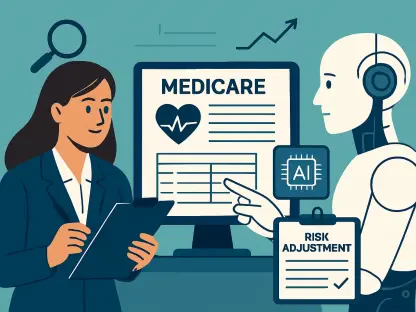

Navigating the landscape of workforce anxiety has become a primary challenge for leaders, as the successful integration of artificial intelligence now defines the trajectory of modern enterprise success. For many organizations, the deployment of AI is less a technical hurdle and more a complex exercise in change management, where the human element ultimately dictates the speed and efficacy of adoption. Data reveals a significant level of concern, with over half of adults worried about the impact of AI and new technologies on their jobs. This widespread anxiety creates a tangible risk to the return on investment that leaders seek, as employee resistance can halt the very innovation that is intended to foster growth and efficiency. This friction often stems from a fundamental misunderstanding of the technology’s true capabilities, a gap that leadership must bridge to move forward.
1. Demystifying the Nature of Artificial Intelligence
A common and critical error in corporate strategy is treating generative AI and Large Language Models (LLMs) as autonomous, thinking agents rather than sophisticated data processors. This tendency to anthropomorphize the technology drives the pervasive fear that machines will soon render human cognition obsolete, creating a dynamic of competition between person and program. The greatest misconception is that AI is as intelligent as its name suggests and can perform nuanced, human-like tasks independently. In reality, AI is primarily a tool for pattern-matching at an immense scale, offering powerful opportunities to help people work smarter, innovate faster, and explore new pathways to growth. Communicating this distinction is an essential first step for any leader. When employees are encouraged to view these tools as advanced pattern-matchers instead of sentient replacements, the entire narrative shifts from one of adversarial competition to one of practical utility and collaboration.
This reframing is crucial for fostering an environment where innovation can thrive. The core message that must be consistently delivered is that AI does not possess the ability to replicate the full spectrum of human intelligence; it exists to augment it. By handling data-intensive and repetitive tasks, AI systems can free up human intellect to focus on areas where it excels: creativity, strategic thinking, and complex problem-solving. Leaders who successfully convey this vision can transform apprehension into curiosity and engagement. The goal is to build a culture where employees see AI not as a threat to their value but as a powerful assistant that enhances their capabilities, allowing them to contribute in more meaningful and impactful ways. This shift in perspective is not merely a communications exercise but a fundamental component of a successful integration strategy, laying the groundwork for a symbiotic relationship between the workforce and the technology designed to support it.
2. Avoiding the Pitfalls of a Cost-Cutting Mindset
Some finance and operations leaders view AI integration primarily through the narrow lens of cost reduction, seeing it as a direct mechanism to reduce salary overheads. This short-sighted approach, however, often leads to significant long-term damage. The tactic of stripping away experienced staff in favor of automation can irrevocably degrade an organization’s institutional memory and erode the deep-seated expertise that drives genuine competitive advantage. Too often, businesses perceive AI as a shortcut to headcount reduction, placing skilled and experienced workers at risk for the allure of immediate savings. This perspective dangerously overlooks the enormous economic and societal cost of losing a seasoned workforce, a cost that far outweighs the short-term financial gains. The knowledge, context, and nuanced understanding held by veteran employees are assets that current AI models cannot replicate, and their loss can leave a company vulnerable and strategically weakened.
This focus on job replacement justifiably puts the workforce on edge. Recent data confirms this anxiety, with a significant percentage of workers citing job losses as their single biggest concern regarding the implementation of AI in the workplace. History, however, offers a more optimistic and nuanced perspective on the impact of technological revolutions. Past integrations of transformative technologies have consistently shown that they tend to expand and evolve the labor market rather than contract it. The reality is that AI is not poised to eliminate jobs indiscriminately but rather to profoundly evolve the nature of work itself. Just as the advent of the personal computer created new industries and roles, AI is set to redefine existing positions and generate novel opportunities. The challenge for leaders is to manage this transition thoughtfully, focusing on reskilling and redeploying talent rather than simply displacing it, thereby turning a moment of potential disruption into one of growth and renewal.
3. Strategically Operationalizing Augmentation
Successful integration of artificial intelligence requires a fundamental shift in how use cases are identified and implemented within an organization. Rather than scanning the workforce for roles to remove, enterprise leaders should instead focus on identifying the high-volume, low-value tasks that act as bottlenecks to productivity and employee satisfaction. These are the mundane, repetitive processes that consume valuable time and energy but contribute little to strategic objectives. AI tools have an unparalleled potential to automate these very tasks, thereby freeing up human labor to concentrate on the more creative, strategic, and interpersonal aspects of their roles where their unique abilities can shine. This approach transforms the implementation of AI from a threat into an opportunity, positioning it as a tool for empowerment that enables employees to engage in more rewarding and impactful work, ultimately boosting both morale and output.
This strategic automation of routine work directly facilitates a crucial transition for the workforce toward higher-value activities. As AI systems handle the repetitive and predictable elements of a job, it creates the time and space for staff to upskill and transition into more complex roles that demand a higher level of critical thinking and emotional intelligence. These distinctly human competencies—such as empathy, ethical decision-making, and the development of complex, multi-faceted strategies—remain firmly outside the grasp of current computational models. By investing in training and development programs that cultivate these skills, leaders can prepare their employees not just to coexist with AI but to thrive in a new work paradigm. This proactive approach ensures that the workforce evolves alongside the technology, creating a more resilient, adaptable, and capable team that can leverage AI to its fullest potential while focusing on the uniquely human contributions that drive true innovation.
4. Overcoming Resistance Through Transparent Leadership
Resistance to the integration of AI is frequently a symptom of a broader organizational issue known as “change fatigue,” a common and understandable response to the relentless pace of digital updates and transformations. With a notable portion of the workforce explicitly worried about AI’s impact on their current job security, a reactive or opaque approach from leadership will only amplify these fears. The solution lies in establishing a framework of transparent governance and open, two-way communication. Leaders must recognize that simply resisting AI’s integration is not a sustainable strategy; it will only hinder progress and limit opportunities for innovation. Therefore, active engagement becomes the most effective path forward. By proactively engaging employees in candid discussions about AI’s intended role within the organization, leadership can demystify its functions, clarify its limitations, and begin to build the essential foundation of trust required for any successful change initiative.
This engagement must move beyond the traditional model of top-down mandates, which can feel impersonal and authoritarian. Instead, it involves fostering a culture where staff members feel psychologically safe to experiment with new AI tools without the immediate fear of displacing their own roles or being penalized for a learning curve. Creating sandboxed environments for exploration, celebrating early adopters, and sharing success stories are practical ways to encourage a spirit of curiosity over fear. Once leaders have cultivated an environment of genuine transparency and inclusion, where employee concerns are heard and addressed, the business can effectively alleviate anxieties. This ensures that all team members are aligned, informed, and prepared to harness the benefits of AI. Such a culture not only smooths the integration process but also unlocks the collective intelligence of the workforce, allowing them to identify new and innovative applications for the technology.
5. Cultivating a Resilient and Adaptive Workforce
The march of enterprise technology had always demanded adaptation from the workforce, and the rise of AI—while a larger transformation than many technologies in recent decades—was ultimately no different. Throughout history, people had shown resistance to new technological advancements, yet time and again, humans had risen to the challenge of integrating new tools into their lives and work. For enterprise leaders, achieving success in this new era involved a dedicated investment in fostering resilience and a culture of continuous learning. By consistently framing AI as a transformative tool for augmentation rather than a threat of replacement, organizations were able to protect their valuable talent pipelines while simultaneously modernizing their operations for a new competitive landscape. This strategic narrative was essential in turning a period of potential anxiety into one of opportunity and collective growth for the entire enterprise.
The most successful integrations were guided by a clear set of principles. Leaders who reframed the narrative and explicitly communicated AI as a “pattern-matching” tool for employee empowerment, not a sentient replacement, effectively lowered cultural resistance. They audited workflows not for roles to eliminate but for mundane process bottlenecks that could be automated, specifically to free up staff for more rewarding creative and strategic work. Crucially, they reallocated learning and development budgets toward skills that were non-replicable by machines, such as critical thinking, empathy, and ethical decision-making, recognizing these as the most durable assets in an AI-driven market. Finally, they combated change fatigue with transparent, two-way dialogue regarding AI roadmaps and governance, which proved instrumental in building trust and mitigating the pervasive fear of job loss. These actions collectively created an environment where humans were empowered by technology, not replaced by it.