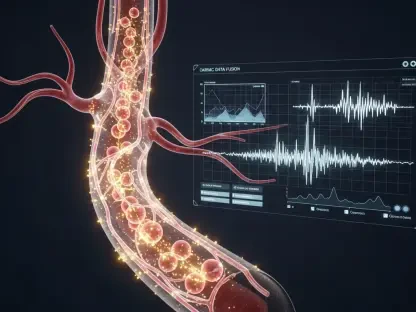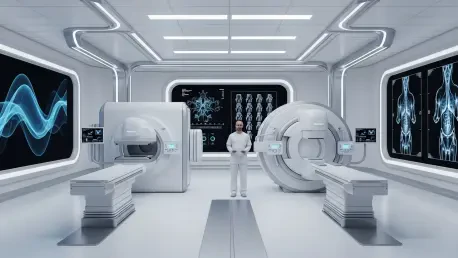

The precision with which modern medicine can now peer into the microscopic layers of the human body has reached a transformative threshold that once belonged strictly to the realm of speculative science fiction. With the recent FDA 510(k) clearance of GE HealthCare’s True Definition DL, the landscape of computed tomography is shifting from a reliance on sheer hardware power toward a sophisticated, software-centric paradigm. This milestone marks a definitive moment where artificial intelligence is no longer just a supportive tool but a core component of the imaging chain. By fundamentally altering how raw data is converted into diagnostic images, this deep learning-based reconstruction software offers a solution to the long-standing compromises that have historically limited the clarity of CT scans.
The Convergence of Neural Networks and Precision Radiology
For decades, the standard path toward better medical imaging required massive investments in hardware, often involving the replacement of entire gantries and X-ray tubes to achieve incremental gains in resolution. The introduction of True Definition DL challenges this trajectory by demonstrating that a software update can rival the diagnostic power of hardware overhauls. This evolution is rooted in the convergence of high-speed computing and neural networks, allowing radiologists to extract more information from existing equipment. The software works by integrating deep learning directly into the reconstruction process, which represents a leap forward from the early days of AI where algorithms were merely applied as a post-processing layer.
One of the most persistent criticisms of earlier iterations of noise-reduction technology was the production of waxy or plastic-looking images that lacked the natural texture of human anatomy. True Definition DL moves beyond these aesthetic shortcomings by utilizing a reconstruction engine trained on thousands of high-quality image datasets. This training allows the software to recognize the difference between genuine anatomical signals and the digital noise that often obscures fine details. Consequently, the promise of deep learning-based reconstruction is the restoration of clinical confidence, providing images that are both mathematically accurate and visually familiar to the human eye.
The transition from viewing AI as a computational luxury to a clinical necessity is now complete in the modern medical imaging department. As patient volumes continue to grow and the complexity of cases increases, clinicians require tools that can synthesize vast amounts of data without introducing new errors. True Definition DL stands at the center of this shift, offering a pathway to precision radiology that prioritizes clarity and speed. This development suggests a future where the intelligence of the system is just as vital as the radiation it emits, fundamentally redefining the standard of care for patients across the globe.
Overcoming the Historic Constraints of Computed Tomography
The practice of radiology has long been governed by the radiologist’s dilemma, a persistent struggle to balance three competing factors: radiation dose, image sharpness, and scan time. To get a sharper image, one typically had to increase the dose or accept a higher level of digital noise, both of which carried negative implications for patient safety or diagnostic accuracy. Traditional methods, such as Filtered Back Projection and Iterative Reconstruction, served the industry for years but eventually reached their mathematical limits. These older techniques often struggled to clean up noise without also blurring the edges of vital structures, leaving clinicians to navigate a middle ground of “good enough” imaging.
Digital noise and motion artifacts have historically been the enemies of diagnostic confidence, particularly in emergency and high-stress environments. When a patient cannot hold their breath or when a scan must be performed at an ultra-low dose for pediatric safety, the resulting images are often marred by streaks and graininess. These limitations are not merely technical inconveniences; they directly impact the ability of a physician to rule out a subtle fracture or identify a tiny pulmonary nodule. The traditional workflow often necessitated repeat scans or additional testing, which added to the rising costs of healthcare and delayed critical interventions for patients in need.
Furthermore, the rising global prevalence of chronic diseases like cancer and cardiovascular disorders demands an imaging workflow that is faster and clearer than ever before. With aging populations requiring more frequent monitoring, the traditional constraints of CT imaging have become a bottleneck in the healthcare system. The industry has reached a point where the physical limits of hardware cannot be pushed much further without significant risks. Therefore, the arrival of AI-driven reconstruction is a timely response to an urgent clinical demand, providing a way to break the trade-off cycle and deliver high-definition results regardless of the physical constraints of the scan.
Deep Neural Networks: Redefining High-Contrast Visualization
The internal mechanics of Deep Neural Networks (DNNs) represent a radical departure from the linear algorithms of the past. True Definition DL utilizes these networks to perform a sophisticated analysis of raw data, effectively distinguishing between the true anatomy of a patient and the artifacts caused by physics-based limitations like photon starvation. By processing data through multiple layers of artificial neurons, the system can reconstruct images with a level of fidelity that was previously impossible. This approach is particularly effective in high-contrast environments, where the boundaries between different tissues—such as bone and air—must be captured with extreme precision to be useful.
A standout feature of this new clearance is the utilization of the 1024 matrix display, which provides a dramatic increase in spatial resolution compared to the industry-standard 512 matrix. This higher resolution allows for the visualization of microscopic structures, such as the fine patterns of trabecular bone or the delicate branches of the bronchial tree. Coupled with sub-second chest imaging capabilities, the technology solves the perennial challenge of imaging patients who are unable to cooperate with breath-hold instructions. This speed ensures that even the most difficult-to-image patients can receive a high-quality scan without the risk of motion blur compromising the diagnostic value of the procedure.
The software is strategically positioned within a larger deep learning ecosystem, acting as a specialized companion to existing solutions like TrueFidelity and True Enhance. While TrueFidelity focuses on broad noise reduction and low-contrast detectability, True Definition DL is laser-focused on high-contrast tasks that define pulmonary, orthopedic, and otologic care. This targeted approach allows healthcare providers to customize their imaging protocols based on the specific anatomical area being studied. By offering a suite of AI tools, the system ensures that every diagnostic task—from finding a faint tumor in the liver to identifying a hair-line fracture in the wrist—is supported by the most appropriate computational model.
Clinical Evidence and Expert Perspectives on Diagnostic Clarity
In the realm of pulmonary medicine, the impact of high-definition reconstruction is already being felt through enhanced visualization of small airways. Early-stage interstitial lung disease, which often presents as subtle, ground-glass opacities, can be difficult to distinguish from background noise on standard CT scans. Experts have noted that the clarity provided by True Definition DL allows for earlier interventions, potentially slowing the progression of fibrotic lung conditions before they become irreversible. This level of detail is essential for the long-term management of respiratory health, providing a clearer window into the lungs than was ever possible with traditional reconstruction.
Orthopedic and trauma specialists are also seeing significant benefits, particularly when identifying subtle trabecular bone patterns and micro-fractures. In many cases, these small injuries are invisible on standard X-rays and can even be obscured by the graininess of traditional CT scans. The precision of the new DNN-based reconstruction allows for a more confident assessment of joint health and fracture stability. Similarly, in otologic care, resolving the intricate structures of the inner ear is paramount. The auditory ossicles and the cochlea are so small that even minor imaging artifacts can lead to misdiagnosis of congenital defects or erosive pathologies, making this high-resolution tool a game-changer for ear, nose, and throat specialists.
The overarching goal of these advancements is to end the diagnostic odyssey that many patients face when their initial tests are inconclusive. By providing first-scan clarity, True Definition DL helps prevent the need for unnecessary biopsies and follow-up imaging, which are both costly and anxiety-inducing. Radiologists and clinical experts generally agree that as the world faces the silver tsunami of an aging population, the role of AI will be central to managing the massive influx of patients. The ability to produce a definitive diagnosis the first time a patient enters the scanner is becoming the benchmark for efficiency and excellence in modern hospital systems.
Integrating AI-Driven Reconstruction into Existing Workflows
A key advantage of GE HealthCare’s approach is the scalability of the software, which allows for in-field upgrades of existing hospital infrastructure. This democratization of high-end technology means that a medical facility does not necessarily need to purchase a brand-new scanner to benefit from the latest AI breakthroughs. By implementing True Definition DL on established platforms like the Revolution Apex and Revolution Vibe, hospitals can significantly extend the life and utility of their current assets. This strategy is particularly important for regional and community hospitals that may have limited capital budgets but still face high demands for advanced diagnostic services.
The implementation of AI-driven reconstruction is also a strategic move toward improving patient throughput and reducing the backlogs that plague many radiology departments. By speeding up both the acquisition of the scan and the subsequent reconstruction process, the software allows technicians to move patients through the system more efficiently. This reduction in wait times is achieved without compromising image quality; in fact, the quality is often superior to what was previously possible. This framework creates a more sustainable model for healthcare delivery, where the focus remains on the patient while the underlying technology handles the heavy lifting of data processing.
Ensuring patient-centric care remains the ultimate objective, and True Definition DL achieves this by maintaining lower radiation doses while simultaneously improving image quality. This balance is critical for the long-term health of patients who require frequent imaging, as it minimizes the cumulative risks associated with radiation exposure. Looking ahead, the rise of the computational X-ray suggests a future where human expertise is augmented by AI to a degree that was once unimaginable. As the medical community prepares for this synergy, the integration of deep learning into everyday workflows stands as a testament to the power of innovation in serving the fundamental goal of healing.
The clearance of this technology by the FDA established a new benchmark for how digital innovation could be applied to physical medicine. It confirmed that the most effective way to improve patient outcomes was to bridge the gap between complex data and clinical decision-making. By prioritizing the development of software that could enhance existing hardware, the industry signaled a commitment to making high-quality diagnostics more accessible to a broader range of people. This shift successfully moved the focus of radiology away from the limitations of the past and toward a future where clarity was a standard expectation rather than a rare achievement. The widespread adoption of these AI-driven tools subsequently reduced diagnostic errors and streamlined the journey from initial symptoms to effective treatment.