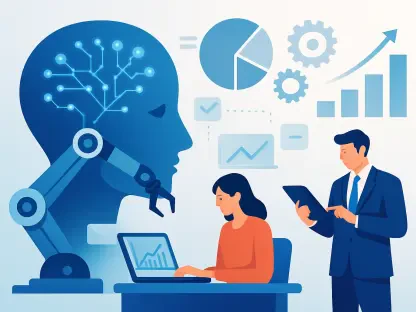

The global industrial sector is witnessing a high-stakes transition where the digital intelligence of neural networks finally meets the raw mechanical power of heavy infrastructure. This movement, known as Physical AI, marks a departure from the text-based outputs of generative models, moving instead into the complex, real-time control of power grids, high-speed rail, and automated manufacturing. As the market for industrial automation matures, a distinct hierarchy has emerged. While software-centric giants continue to dominate the development of foundational digital models, a specialized group of industrial veterans is carving out a dominant position by grounding these algorithms in the tangible laws of the physical world.
Hitachi has emerged as a central figure in this evolution, leveraging a strategic advantage that pure technology firms often struggle to replicate. The company argues that the true potential of industrial intelligence cannot be unlocked through software prowess alone but requires a deep, inherited understanding of engineering and physics. This approach seeks to move beyond predictive analytics toward a system where the digital and physical worlds operate as a single, unified entity. By focusing on the intersection of machine learning and domain expertise, the market is seeing a shift in how heavy industry approaches digital transformation, emphasizing reliability over raw processing power.
The Strategic Shift Toward Industrial Intelligence
The landscape of artificial intelligence is undergoing a fundamental transformation, moving beyond the digital confines of generative chatbots into the tangible world of heavy machinery and transportation systems. This evolution has birthed a new era where technology is dedicated to controlling robots and industrial infrastructure in real-time environments. As the race for dominance in this sector intensifies, the market is no longer satisfied with general-purpose tools. Industrial stakeholders are increasingly seeking solutions that can handle the unpredictability of physical environments, leading to a surge in demand for specialized applications that prioritize mechanical precision and operational safety.
Hitachi is positioning itself at the forefront of this movement, asserting that success in this field requires a grounded approach that combines cutting-edge machine learning with a century of domain expertise. The company’s strategy revolves around the idea that digital-native firms lack the historical context necessary to manage critical infrastructure. By integrating its extensive history in engineering with modern computational capabilities, the firm aims to provide a blueprint for how legacy industries can remain competitive. This transition from general data processing to physics-based intelligence marks a significant shift in the conceptualization and implementation of global industrial automation.
A Century of Engineering as a Foundation for Innovation
To understand the current market trajectory, one must look at the historical role of companies that built the backbone of modern society. For over a hundred years, the focus remained on designing, manufacturing, and maintaining high-speed railways and power grids. This long-standing presence in heavy industry provides a unique form of foundational knowledge that software-based companies often lack. Unlike digital AI, which can produce errors without immediate physical consequences, Physical AI operates within the rigid constraints of gravity, friction, and thermal dynamics. An error in this space does not just result in a faulty text summary; it can lead to catastrophic mechanical failure.
These background factors are critical because they transform AI from a predictive engine into a control system for reality. Historical data in this context is not merely a collection of numbers but a repository of product design and control logic. By integrating thermal fluid simulation and signal-processing tools, the goal is to create models that truly understand the machines they govern. This deep integration allows for a more nuanced approach to maintenance and operation, where the AI is aware of the structural limits and environmental stresses acting upon a piece of equipment at any given moment.
Bridging Software Precision with Physical Reality
The Philosophical Core: Prioritizing Physics Over Pure Data
The central thesis of this industrial strategy is that Physical AI requires a systematic understanding of the real world that transcends traditional data processing. Models must be grounded in the laws of physics to be effective in high-stakes industrial settings. While a standard AI might predict an outcome based solely on statistical patterns, a grounded approach incorporates mechanical engineering principles. This ensures that the decisions made by the system are physically possible and safe, bridging the gap between digital intuition and mechanical certainty. This methodology reduces the risk of hallucinations, which are common in LLMs but unacceptable in heavy industry.
The Integrated World Infrastructure Model: Architecture for Complexity
At the heart of this technical roadmap lies the Integrated World Infrastructure Model, or IWIM. This architecture functions as a mixture-of-experts system, where instead of relying on a single, massive model, the framework integrates multiple specialized datasets. This modular approach allows the system to pull from specific expertise, such as railway signaling logic or power grid fluctuations, depending on the immediate requirements. By utilizing advanced interface protocols to connect with external frameworks and simulation tools, the model can stitch together real-time sensor information into a cohesive operational brain that manages entire networks of machinery simultaneously.
Proving the Concept: Real-World Industrial Deployments
These strategies are already being validated on factory floors and in transit hubs across the globe. In manufacturing environments, AI systems are being used to diagnose malfunctions in commercial equipment by training on original design drawings and maintenance records. This allows the system to pinpoint failing components with an accuracy that matches veteran engineers. Similarly, in major urban transit networks, AI manages traffic malfunctions by identifying root causes and assisting operators in formulating response plans. These deployments demonstrate that the ability to translate physics and design logic into machine intelligence is a functional reality that reduces downtime and increases systemic resilience.
Emerging Trends and the Future of Industrial Research
Looking ahead, several emerging trends are shaping the future of industrial research and development, particularly regarding the optimization of specialized software. A significant bottleneck in modern engineering is the time required to write and test software for complex hardware. Breakthroughs in automated software testing and variability management are beginning to address this. For instance, the use of retrieval-augmented generation to automate test scripts for vehicle control units has significantly reduced the required man-hours, allowing for faster iteration cycles and more robust safety protocols in automotive manufacturing.
Furthermore, the integration of high-performance hardware is enabling the widespread use of digital twins at an unprecedented scale. These virtual replicas allow for the simulation of robotic motions or grid fluctuations before any physical deployment occurs. As regulatory environments begin to focus more on AI safety and reliability, an emphasis on safety as a structural constraint is becoming a competitive necessity. Organizations that prioritize rigorous, physics-based models over purely data-driven ones are likely to find themselves better positioned to navigate future compliance landscapes that may penalize unpredictable or non-transparent algorithms.
Strategies for Integrating Domain Expertise and AI
For businesses looking to navigate this new era, several key strategies emerge from this industrial model. First, it is essential to recognize that data quality is significantly more important than data quantity in a physical context. Meaningful data derived from engineering designs and physical sensors is often more valuable than vast sets of unstructured information. Organizations should focus on creating specialized, modular systems rather than seeking a general solution. This allows for greater flexibility and ensures that the AI remains highly proficient in its specific domain of operation.
Additionally, safety must be treated as a fundamental engineering constraint rather than a secondary compliance task. Implementing a multi-tier safety framework that covers input validation, output verification, and real-time monitoring is a best practice for any firm deploying AI in high-stakes environments. Fostering collaborative ecosystems where industrial firms provide ground-truth data and technology firms provide computational muscle will likely be the most effective path forward. This synergy ensures that the AI is both technologically advanced and practically viable for the rigors of the physical world.
The Endurance of Industrial Heritage
The race for dominance in the field of Physical AI demonstrated that success belonged to those who mastered the intersection of the digital and the material. Hitachi’s progress showed that while software innovators led in generative capabilities, companies with a century of experience building infrastructure possessed a critical, unshakeable advantage. By anchoring machine intelligence in the laws of physics and the nuances of mechanical engineering, the industry moved toward a more reliable and efficient future. The transition highlighted that data alone was insufficient for managing reality; it required the context of design and the discipline of traditional engineering.
Ultimately, the market realized that the physical world demanded a different kind of intelligence than the digital one. The strategic takeaway for global enterprises was the necessity of integrating domain-specific expertise into every layer of the technological stack. This shift ensured that automation remained safe and functional, even under the most demanding conditions. As the digital and physical worlds became increasingly indistinguishable, the entities that flourished were those that respected the mechanical foundations of society while embracing the possibilities of advanced computation. The endurance of industrial heritage proved to be the most valuable asset in the age of intelligent machines.