


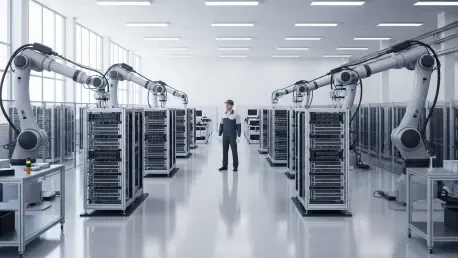

The American industrial sector is currently navigating an unprecedented convergence of sophisticated artificial intelligence and a cautious macroeconomic climate that demands extreme operational efficiency. While technological breakthroughs in machine learning and autonomous systems offer a path toward total factory automation, many manufacturers are balancing this potential against the realities of geopolitical instability and fluctuating trade policies. This shift is no longer characterized by the mere addition of robotic arms to a production line; it represents a comprehensive move toward building a smarter, more resilient domestic manufacturing base. Industry titans are reporting significant revenue growth specifically tied to the infrastructure that powers AI, signaling that the digital transformation of the factory floor is the primary driver of modern industrial expansion. As organizations prioritize high-tech growth areas to maintain a competitive edge, the focus has shifted from simple capacity expansion to the strategic implementation of digital intelligence.
Modernizing the Factory Floor with Digital Intelligence
Industrial leaders like Rockwell Automation have identified a massive surge in demand for technologies that support the backend infrastructure of artificial intelligence, particularly within the data center and semiconductor sectors. While traditional segments like consumer packaged goods have shown signs of hesitation due to global trade volatility, the push for intelligent devices and autonomous mobile robots remains exceptionally strong among top-tier manufacturers. These organizations are increasingly looking at automation as a way to insulate themselves from labor shortages and unpredictable shipping costs. The current growth in the “Intelligent Devices” segment, which has reached over a billion dollars in quarterly sales, highlights how critical material handling and autonomous navigation have become. This trend suggests that even as overall capital spending remains measured, the specific investments in AI-driven hardware are accelerating because they offer the most direct route to long-term cost reduction and production stability.
Beyond the installation of physical hardware, the rise of digital twin technology and advanced simulation software is fundamentally altering how American facilities are designed and operated. By leveraging virtual models, manufacturers can now simulate entire production cycles to identify bottlenecks before a single piece of equipment is ever moved on the shop floor. This software-centric approach allows for significantly higher operating margins because it minimizes the risks associated with physical trial and error, which was once a major drain on resources. The ability to optimize facility layouts virtually is proving to be a game-changer for companies navigating the high costs of domestic expansion. As software and control segments outperform traditional hardware, the industrial landscape is becoming a domain where digital precision dictates physical success. This transition enables a level of operational agility that was previously impossible, allowing factories to pivot their production lines rapidly in response to shifting market demands.
The Rise of Collaborative and Humanoid Robotics
Collaborative robots, or cobots, have transitioned from experimental tools to essential components of the modern industrial workforce, effectively filling the gaps left by a shrinking labor pool. Companies such as Teradyne have successfully deployed over 100,000 units globally, proving that machines designed to work safely alongside human operators are a scalable solution for complex tasks like welding and palletizing. These cobots are increasingly being integrated into the “wafer to data center” supply chain, where they assist in the assembly and testing of the very hardware that powers artificial intelligence. This creates a self-reinforcing cycle where robotic systems are used to build the next generation of AI infrastructure. The steady growth in the robotics division, even during typical seasonal lulls, indicates that the demand for flexible automation is now a constant factor in the market. Manufacturers are favoring these adaptable systems because they can be integrated into existing workflows without the need for massive facility overhauls.
Looking toward more versatile applications, the development of humanoid robots represents the next major frontier for the American industrial landscape and labor definition. Projects like Tesla’s Optimus are designed to tackle the most repetitive or unsafe tasks that have historically high turnover rates, moving the industry beyond specialized, fixed-position machinery. By focusing on bipedal robots that can navigate human-centric environments, developers are aiming to create a general-purpose robotic workforce that is not limited to a single function. While high-volume production of such advanced systems is still scaling up at specialized facilities in California and Texas, the long-term goal is to replace human labor in roles that are inherently dangerous or inefficient. This bipedal autonomy represents a high-risk but high-reward trajectory that could redefine the economics of manufacturing. The move toward general-purpose robotics suggests a future where the physical constraints of a factory are no longer defined by the limitations of human workers.
Strategic Reshoring and the Future of Domestic Manufacturing
The overarching trend within the United States industrial sector is a deliberate move toward reshoring and the aggressive build-out of domestic production capacity. By integrating AI-driven automation and mobile robotics, manufacturers are attempting to protect themselves from the vulnerabilities exposed by international supply chain disruptions. This shift toward domestic self-sufficiency is fueled by the need for faster turnaround times and a reduction in the carbon footprint associated with global logistics. Although the pace of investment fluctuates according to the political climate and interest rates, the transition toward an automated, AI-integrated industrial base has become a permanent feature of the national economy. This evolution is supported by a robust ecosystem of software providers and hardware manufacturers who are focused on making the “Made in USA” label synonymous with high-tech efficiency. The result is a manufacturing landscape that is more resilient to external shocks and better equipped to handle the rapid cycles of the digital age.
The collective evidence from recent industrial performance suggested that success in the new era required a focus on high-margin software and flexible robotic integration. Organizations that moved quickly to adopt digital twin simulations and collaborative systems found themselves better positioned to weather macroeconomic headwinds than those relying on legacy processes. Moving forward, the most effective strategy involved prioritizing the upskilling of the remaining human workforce to manage these complex autonomous systems rather than competing with them. Leaders were encouraged to invest in edge computing and localized AI processing to reduce latency in robotic decision-making on the factory floor. The transition toward a fully automated industrial base was no longer a matter of if, but how fast a company could adapt its infrastructure. Ultimately, the integration of humanoid robotics and domestic AI production pipelines established a new standard for global manufacturing excellence, proving that technological leadership was the most reliable defense against global market volatility.







