


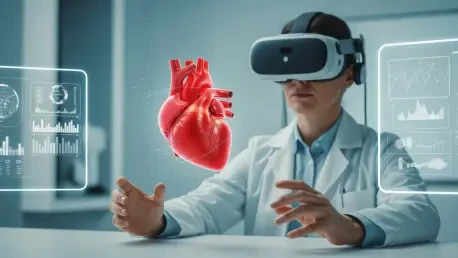

The days of peering through the restricted keyhole of a flat glass screen are rapidly fading as digital data begins to flow into the physical rooms where professionals collaborate and operate. This transition marks the end of a purely observational relationship with technology, moving instead toward an era where information possesses depth, volume, and presence. While many early adopters once viewed Extended Reality as a novelty reserved for entertainment, the current landscape proves that spatial computing is the new architectural foundation for modern enterprise.
Beyond the Screen: The Dawn of the Spatial Era
The fundamental shift in human-computer interaction is defined by the move from using a device to inhabiting a digital environment. Instead of scrolling through two-dimensional spreadsheets or static blueprints, users now step into their data, manipulating complex models as if they were physical objects. This evolution challenges the outdated misconception that immersive tech is a niche gaming tool, positioning it instead as a critical utility for productivity.
By removing the barrier of the screen, the workspace expands to fill the entire field of vision. This change allows for a more natural cognitive processing of information, as the human brain is evolutionarily wired to understand 3D spaces rather than flat surfaces. The result is a profound transformation in how tasks are conceptualized and executed across various professional sectors.
The Convergence: Physical and Digital Realities
The spectrum of spatial computing, which encompasses Virtual, Augmented, and Mixed Reality, provides a versatile toolkit for modern industry. Global demand for real-time, three-dimensional data visualization has peaked as companies seek more intuitive ways to manage complexity. These “infinite workspaces” eliminate the physical constraints of traditional hardware, replacing multiple monitors with a boundless digital canvas that follows the user.
Moreover, the integration of digital overlays into the physical world allows for a seamless blend of contextual information and manual labor. A technician can view repair instructions directly on the machinery being serviced, reducing the cognitive load of switching between a manual and the task at hand. This convergence ensures that relevant data is always available at the exact point of need.
Revolutionizing Industrial Training: Operational Safety
High-fidelity simulations have become the standard for high-risk environments such as aerospace and nuclear energy. By utilizing immersive environments, organizations allow technicians to practice on virtual jet engines or sensitive reactor components without the physical dangers or equipment wear associated with traditional training. This method provides a safe space for error, where mistakes lead to learning rather than catastrophic failure.
The statistical improvements in information retention are difficult to ignore. Immersive practice accelerates technical learning curves by engaging muscle memory and spatial awareness. Consequently, workers arrive on the job with a level of familiarity that screen-based videos or manuals simply cannot replicate, leading to fewer on-site accidents and higher operational efficiency.
Precision and Accessibility: The Modern Medical Landscape
Healthcare is undergoing a radical democratization of specialized expertise through remote medical collaboration. Surgeons can now synchronize on high-resolution 3D patient models, allowing for meticulous surgical planning before a single incision is made. This spatial approach enhances precision and significantly improves patient outcomes by identifying potential complications in a virtual environment first.
Geographical barriers are also falling as real-time AR guidance brings world-class surgical knowledge to remote and underserved regions. A specialist located in a major metropolitan hub can provide over-the-shoulder assistance to a general practitioner in a rural clinic, guiding their hands through a complex procedure via digital overlays. This connectivity ensures that the quality of care is no longer dictated solely by a patient’s location.
Validating the Shift: Data-Driven Insights and Industry Trends
Evidence supporting the superiority of spatial learning continues to grow, with studies indicating that immersive methods lead to higher engagement compared to traditional classroom settings. Experts reach a consensus that the operational value added to enterprise workflows justifies the investment, even when accounting for current hardware limitations. The ability to visualize the invisible, such as airflow or magnetic fields, provides a competitive edge in design and engineering.
Furthermore, the impact of “remote synchronization” on global team innovation is undeniable. Teams spread across different continents can now gather in a shared virtual space to solve problems in real time, fostering a level of creative synergy that video calls lack. This shift toward spatial collaboration is redefining how global companies approach research and development.
Frameworks for Integrating Spatial Tools: Professional Environments
Successfully integrating spatial tools requires a strategic focus on high-impact use cases where 3D visualization offers a clear advantage. Organizations must prioritize the transition in areas where spatial awareness is linked to safety or precision to justify the initial overhead. Overcoming ergonomic challenges, such as device weight and battery life, remains a priority for hardware developers as they refine the next generation of professional headsets.
The roadmap for scaling from pilot programs to foundational infrastructure involved a commitment to training and user adaptation. As spatial computing becomes more lightweight and accessible, the focus shifted from the technology itself to the outcomes it enables. Professionals across all sectors recognized that the transition was not merely about adopting a new gadget, but about embracing a more human-centric way of interacting with the digital world.







