
The factory floor of the future has arrived, and it walks on two legs, but its introduction has ignited a fierce battle between one of the world’s largest automakers and its workforce. Hyundai Motor Group’s plan to deploy sophisticated humanoid robots in its manufacturing plants has triggered a direct confrontation with its powerful labor union in South Korea. This clash over the robot, named Atlas, is more than a simple labor dispute; it represents a critical inflection point in a nation that already boasts the highest density of industrial robots globally. The outcome of this struggle could set a powerful precedent for how societies navigate the complex intersection of technological advancement, corporate efficiency, and the fundamental right to human employment, making it a closely watched test case for the future of industrial labor worldwide.
The Rise of the Machine and the Union’s Red Line
The Catalyst Hyundai’s Robotic Ambitions
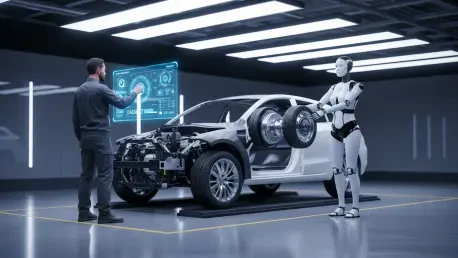
At the heart of the conflict is Atlas, a humanoid robot developed by Boston Dynamics, the U.S. robotics firm acquired by Hyundai. Unveiled just before CES 2026, Atlas is not a simple automaton but a highly advanced machine engineered to replicate human dexterity and strength. It is designed to learn the majority of production tasks within a single day and can autonomously perform high-intensity labor, including lifting objects weighing up to 50 kilograms to a height of over two meters. Hyundai’s strategic vision involves deploying Atlas at its Hyundai Motor Group Metaplant America facility in Georgia, with a target start date of 2028. Beyond this initial rollout, the company has declared an ambitious goal to establish a system capable of mass-producing 30,000 of these robots annually, signaling a clear intention to integrate them across a wide array of its assembly processes and redefine the very nature of its manufacturing operations.
This aggressive push towards advanced automation is not merely a technological experiment but a core component of Hyundai’s long-term corporate strategy. The company envisions a future where its production lines are more flexible, resilient, and efficient, capable of rapidly adapting to market changes and consumer demands. The integration of humanoid robots like Atlas is seen as the key to unlocking this potential, reducing reliance on a human workforce that is subject to fatigue, injury, and labor disputes. By automating physically demanding and repetitive tasks, Hyundai aims to streamline its operations, reduce production costs, and enhance its competitive edge in a fiercely contested global automotive market. The company portrays this move as a necessary evolution, one that will ultimately lead to higher quality products and a more sustainable business model, positioning itself as a leader in the next generation of smart manufacturing. However, this corporate vision for a hyper-efficient future directly conflicts with the immediate concerns of its current human employees.
The Response Labor Draws a Line in the Sand
The announcement was met with a swift and unequivocal rejection from the Hyundai Motor branch of the Korean Metal Workers’ Union. In a strongly worded statement published in its newsletter, the union drew a clear line in the sand, directly challenging the company’s authority to unilaterally reshape the workforce. “We will not tolerate any orders that have not been agreed upon by both the labor union and management,” the statement declared, followed by the even more pointed warning: “We will not allow any robots to enter production sites without our permission.” This is not an empty threat. The union is grounding its opposition in its collective bargaining agreement, a legally binding contract which stipulates that management must consult the union on any technological changes or restructuring plans that could affect employment levels and working environments. The union’s stance transforms the introduction of Atlas from a simple operational upgrade into a high-stakes confrontation over control of the factory floor and the future of its members.
This forceful response is rooted in a deep-seated distrust of automation, cultivated over decades of labor relations within South Korea’s industrial sector. The union perceives the push for humanoid robots not as a tool to assist workers but as a direct instrument for their replacement. Their primary fear is mass job displacement, which they argue will lead to greater economic insecurity for their members and exacerbate workforce inequality. The union contends that while the company focuses on the potential gains in efficiency and cost reduction, it is ignoring the profound human cost of such a transition. The demand for consultation is therefore not just a procedural matter; it is a fundamental assertion of the workers’ right to have a say in a decision that could irrevocably alter their livelihoods. The union’s position underscores a belief that technological progress should not come at the expense of human dignity and job security, and that any path forward must be a negotiated one.
The Broader Implications for a Hyper Automated Nation
A Reflection of National Anxiety
The union’s firm position is not an outlier but rather a vocal manifestation of a broader anxiety gripping the South Korean public. The prospect of intelligent machines entering the workforce has crystallized long-held fears about the future of human labor. A revealing survey conducted in October 2025 by the activist group Gabjil 119 found that nearly half of all Korean workers (48.2%) expressed a genuine fear that they would be replaced by artificial intelligence. An even more overwhelming majority, nearly eight out of ten respondents (77.9%), believed that the proliferation of AI would worsen labor market inequality and deepen wealth polarization. This widespread apprehension is amplified by the fact that South Korea is already a global leader in automation. According to 2024 data from the International Federation of Robotics, the country has the highest robot density in the world, with 1,012 robots for every 10,000 employees—a figure more than six times the global average. In this hyper-automated environment, the introduction of a physical, human-like robot like Atlas is seen as the final step in a process moving from digital AI to the direct physical replacement of human workers.
This national sentiment is shaped by the country’s unique economic history and social structure. South Korea’s rapid journey from a post-war developing nation to a global economic powerhouse was built on the back of a highly disciplined and productive human workforce. This legacy has fostered a strong, organized labor movement that has historically fought for and won significant protections and benefits. Now, that very workforce sees the next wave of technological disruption not as an aid, but as an existential threat. The anxiety extends beyond the simple fear of job loss; it touches upon concerns about the erosion of the middle class, the de-skilling of valuable trades, and the potential for a future where the economic gains from automation flow exclusively to capital owners, leaving labor further behind. The clash at Hyundai is therefore a microcosm of a larger national conversation about how to balance the undeniable benefits of technological progress with the need to maintain social cohesion and economic fairness in an increasingly automated world.
A Test Case for the Future of Work
The high-profile nature of the Hyundai-Atlas conflict has made it a crucial test case, with its outcome being closely monitored by other major industries in South Korea. Sectors known for high-risk and physically demanding operations, such as shipbuilding and steel, are also aggressively pursuing robotic solutions. Hanwha Ocean, a major shipbuilder, is steadily increasing its automation rate with the goal of achieving 100% automation in its welding processes by 2030. Similarly, the steel conglomerate Posco Group has been utilizing Boston Dynamics’ quadruped “Spot” robots since 2023 for maintenance tasks in hazardous areas near blast furnaces. An official from the shipbuilding industry noted the clear potential for robots to replace human workers in dangerous roles with high fatality rates. However, this official also acknowledged that businesses are proceeding with caution, observing the Hyundai situation to gauge the potential for similar labor backlash. The conflict is thus setting a national precedent for how such technological transitions will be managed.
In the end, this confrontation was seen not just as a crisis but as a pivotal moment for labor relations in the age of advanced automation. Lee Byoung-hoon, a professor emeritus of sociology at Chung-Ang University, described the deployment of humanoid robots as a “monumental change” that would fundamentally alter the business paradigm. He viewed the resulting tension as an “opportunity to set the example for an exemplary negotiation,” emphasizing the need for open communication and good-faith bargaining between the company and its union. This perspective was echoed by an official from the Korean Metal Workers’ Union, who reiterated that the core of their demand was for Hyundai’s management to honor the collective bargaining agreement and collaborate with workers to reach a consensus. The resolution of this landmark dispute hinged on the recognition that while technological progress was inevitable, its implementation had to be a negotiated process, not a unilateral corporate directive, to ensure a just and equitable transition for the human workforce at the center of the change.