
The global rail industry is on the cusp of a profound transformation, driven not by a single technological breakthrough but by the integration of artificial intelligence as a foundational, distributed operating system that will redefine every aspect of its complex operations. This evolution is not about creating one centralized, all-knowing system, but rather about embedding a network of intelligent layers for prediction, optimization, and automated monitoring directly within the core components of the railway: its infrastructure, rolling stock, maintenance facilities, and stations. The most significant trend identified by recent analysis is a fundamental shift away from the industry’s traditional reactive, labor-intensive practices toward a proactive, data-driven methodology. In this new paradigm, AI is designed to augment human expertise rather than replace it, acting as a powerful analytical partner that directs a professional’s focus toward the most critical issues, enabling quicker and more informed decision-making. This transition promises to reshape the very nature of railway management, moving it from a system of scheduled checks and emergency responses to one of continuous, intelligent oversight and preventative action.
Revolutionizing Rail Infrastructure and Operations
From Reactive Repairs to Predictive Maintenance
The long-standing industry reliance on manual inspections and scheduled maintenance is rapidly becoming obsolete as artificial intelligence ushers in a new era of predictive, data-driven asset management. The current model, while systematic, is inherently reactive, often addressing issues only after they have begun to manifest, leading to costly emergency call-outs and disruptive service interruptions. In contrast, the emerging “predict and prevent” approach leverages a constant stream of information from an array of sophisticated sensors, including high-definition cameras, LiDAR scanners for precise topographical mapping, and sensitive vibration monitors installed on tracks and trains. By continuously analyzing these vast datasets, advanced machine-learning systems can identify subtle patterns of asset degradation and accurately forecast potential failures in critical components like tracks, signals, and electrical systems months before they occur. This foresight allows maintenance teams to transition from a rigid timetable to an intelligent, condition-based schedule, intervening precisely when and where needed to avert problems, thereby dramatically enhancing network reliability and safety.
Optimizing Network Capacity and Energy Consumption
Beyond revolutionizing maintenance protocols, artificial intelligence is poised to unlock unprecedented gains in operational optimization, energy efficiency, and overall network capacity without the substantial capital investment required for new physical infrastructure. AI-powered traffic management systems can process an immense volume of live and historical data—encompassing train positions, speeds, track conditions, and even weather forecasts—to anticipate bottlenecks and dynamically adjust traffic flow in real-time. This sophisticated orchestration can smooth out operations across the network, reducing delays and increasing the total number of trains that can be safely accommodated. Concurrently, intelligent algorithms can function as a digital co-pilot, providing real-time advice to drivers on the most efficient patterns of acceleration and braking for their specific route and load. Following this guidance can lead to energy consumption savings of 10-15%, a figure that compounds into major financial and environmental benefits when scaled across an entire fleet, demonstrating AI’s capacity to drive both economic and sustainable performance improvements.
Enhancing Safety and Managing New Risks
A New Frontier in Safety and Passenger Experience
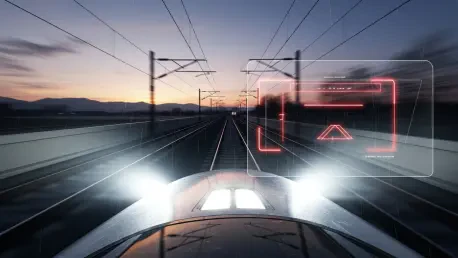
The application of artificial intelligence extends directly to the front lines of railway service, promising to visibly enhance both operational safety and the overall passenger journey. In terms of safety, the integration of machine learning with advanced sensor technology creates a new layer of proactive protection. For instance, thermal cameras paired with AI can detect obstacles on the track, such as animals or debris, far beyond the range of human visibility, especially in adverse weather or at night, triggering automated alerts. Intelligent systems can also monitor activity at level crossings and meticulously analyze CCTV footage from stations and carriages to identify security risks, including unattended baggage or suspicious behavior, allowing for a more rapid response from security personnel. For passengers, AI-driven analytics can forecast travel demand with remarkable accuracy by synthesizing data from ticket sales, public event schedules, and other relevant sources. This allows operators to optimize timetables and dynamically adjust the number of carriages on a given service to mitigate overcrowding, resulting in a more comfortable and seamless travel experience for everyone.
Navigating the Cybersecurity Challenge
While the digital transformation of railways unlocks immense potential, it simultaneously introduces critical and complex cybersecurity risks that demand a new approach to governance and security. The convergence of modern Information Technology (IT) systems, which handle data and communications, with legacy Operational Technology (OT), which controls physical railway assets like signals and switches, creates an expanded attack surface with novel vulnerabilities. Malicious actors could potentially exploit these digital seams to disrupt services, compromise safety systems, or access sensitive data. Therefore, a central finding from industry analysis is that future governance frameworks must treat cyber resilience as an issue inseparable from physical safety. This requires a holistic security strategy that protects the entire integrated system, from data centers to trackside signals. Railway operators must move beyond siloed security approaches and foster a culture where cybersecurity is a core operational priority, ensuring that the very technology driving progress does not become the network’s greatest weakness.
The Inevitable Track Forward
The integration of artificial intelligence into the fabric of the rail sector was no longer a question of if, but of how and when. The journey revealed that railway operators faced a critical decision point. They could either proactively adopt and strategically control this transformative technology, shaping it to meet their specific operational goals and safety standards, or they could find themselves forced to react to its proliferation as an unmanaged layer of complexity. The operators who chose the former path discovered opportunities to redefine efficiency, enhance safety, and improve customer satisfaction on an unprecedented scale. Those who hesitated found themselves struggling to adapt to a new technological landscape, burdened by systems they did not fully understand or control. Ultimately, the successful railways of this new era were those that recognized AI not merely as a tool, but as the fundamental operating system for a more intelligent and resilient future.