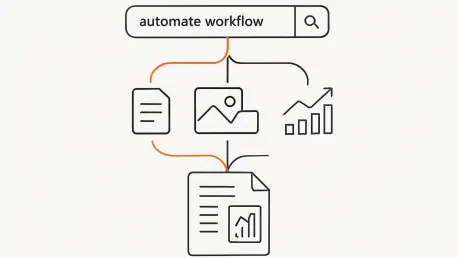

The promise of artificial intelligence in the professional sphere was one of seamless efficiency, a world where complex tasks could be delegated and executed with minimal human effort, freeing up professionals for higher-level strategic thinking. Yet, for many, the reality of a so-called “AI-powered” workday involves a laborious digital assembly line, a process of generating text in one tool, creating images in another, and then manually stitching these disparate elements together in a third application. This fragmented workflow has introduced a new form of digital friction, forcing users to become conductors of a disjointed orchestra of single-task AIs rather than directors of a unified, creative vision. The critical question businesses now face is whether their technology is merely assisting with micro-tasks or truly partnering in end-to-end execution.
The Hidden Cost of a Fragmented AI Workflow
The proliferation of generative AI tools has saturated the market with highly specialized “assistants,” each proficient in a single domain such as writing, image generation, or data analysis. While powerful in isolation, their lack of integration creates a significant challenge known as the “tool hop.” A typical creative project might require a professional to start in a text generator, move to an image creator for visuals, use a spreadsheet tool for data, and finally import everything into a design platform for layout and formatting. Each hop introduces a new interface, a separate prompting process, and the manual labor of exporting and importing assets, turning what should be a streamlined process into a cumbersome and time-consuming sequence of manual interventions.
This constant shuffling between applications gives rise to a substantial but often overlooked expense: coordination overhead. This is the cumulative time and cognitive energy spent managing, formatting, and integrating outputs from various disconnected AI assistants. Instead of reducing workload, this model adds a new layer of project management where the user’s primary role is to bridge the gaps between non-communicating tools. This bottleneck not only hampers productivity but also stifles creativity, as the focus shifts from the strategic goal to the tedious mechanics of content assembly. The very technology intended to accelerate workflows has, in many cases, become a source of new inefficiencies.
Differentiating Two AI Models From Tasks to Solutions
The prevailing AI model positions the technology as a task-specific assistant. In this framework, the AI excels at executing discrete commands, such as “write a blog post introduction” or “create an image of a futuristic city.” The user’s role is that of a hands-on builder and constant supervisor, responsible for breaking down a large project into granular steps, feeding each step to the appropriate tool, and then manually integrating the results. The process is a fragmented chain of prompting, exporting, re-formatting, and assembling, with the human operator bearing the full burden of project strategy and final production. This approach keeps the user deeply enmeshed in the tactical details of creation.
In contrast, an emerging paradigm is redefining AI’s role as an end-to-end execution partner. This model leverages agentic AI, where a unified system of autonomous agents collaborates to manage an entire project lifecycle from a single, high-level directive. Here, the user transitions from a builder to a director, focusing on articulating a clear vision and providing strategic feedback. Instead of managing individual tasks, the user delegates the whole project—from initial research and content generation to final design and assembly—to the AI system. This integrated process allows the AI to handle the complex, multi-step workflow autonomously, transforming a series of disjointed tasks into one cohesive, automated solution.
Inside an Execution Partner a Case Study in Agentic AI
The operational difference of an execution partner is immediately apparent in its user interface. Instead of a dashboard filled with complex menus and granular controls, platforms like SuperCool present a single, simple directive: “Give SuperCool a task to work on…” The entire interaction is driven by a detailed natural language prompt. For instance, a user can request, “Create a comprehensive pitch deck for a B2B SaaS product targeting mid-sized logistics companies, focusing on ROI and integration benefits.” This high-level vision replaces the need for dozens of step-by-step instructions, empowering the system to interpret the goal and formulate its own execution plan.
A key differentiator that builds user trust in this model is transparency. Once a task is submitted, the platform does not simply return a finished file after a period of processing. It visualizes the path from idea to asset by breaking the project down into logical milestones, such as “Strategic Planning,” “Asset Generation,” and “Final Assembly.” Users can observe in real time as the system outlines the project structure, generates contextually relevant text and visuals, and designs a professionally styled final product. This visibility confirms that the AI is performing an organized, logical workflow rather than producing a generic or “hallucinated” response, demonstrating a clear and reasoned path to the completed asset.
Practical Applications When to Deploy an Execution Partner
The value of an execution partner becomes most apparent in scenarios demanding speed, consistency, and comprehensiveness. For consultants and solo entrepreneurs, these systems can automate entire administrative workflows. A single brief requesting a “complete client onboarding kit” can yield a welcome packet, a process overview document, and a timeline visual, all consistently branded and delivered in a fraction of the time it would take to create them manually. This allows solo professionals to delegate time-consuming production tasks and focus on client strategy and business growth.
This model is also exceptionally powerful for generating cohesive, multi-format asset kits. An HR team, for example, can issue one directive to create an employee handbook package and receive a comprehensive set of materials, including a detailed PDF guide, a summary video for training, and a presentation deck for team meetings. The platform’s ability to maintain consistent branding, tone, and messaging across different media types from a single source of truth is a significant advantage. Furthermore, this technology closes the production gap for marketing or internal communications teams that lack dedicated designers or video editors, empowering them to produce professional-grade branded graphics and videos in-house without expanding their headcount.
Mastering the Prompt and Feedback Loop for Optimal Results
While designed for simplicity, the effectiveness of an agentic AI system is directly proportional to the quality of the user’s input. Vague instructions will invariably lead to generic results. The key to unlocking an execution partner’s full potential lies in mastering the art of the detailed prompt. A successful directive clearly defines the desired outcome, target audience, key messaging, and any specific constraints or stylistic preferences. This initial vision-setting phase is the most critical user contribution, as it provides the AI with the necessary context to develop a tailored and effective strategy.
Once the initial asset is generated, the workflow shifts to an iterative refinement process. Execution partners are not meant to deliver a perfect final product on the first attempt but rather a strong, comprehensive draft ready for feedback. Refinements are typically handled through a chat-based interface where the user can provide specific adjustments, such as “make the tone more formal” or “replace the chart on slide five with a timeline graphic.” The system then regenerates the asset based on this feedback, creating a collaborative loop that combines human strategic direction with AI’s rapid execution capabilities. This partnership model ultimately enables the creation of high-quality, finished assets with unprecedented speed and efficiency.
Ultimately, the distinction between an assistant and a partner defined the evolution of AI’s role in the modern workplace. While assistants capably handled isolated commands, the true advancement came with execution partners that could autonomously manage entire workflows, transforming the user’s role from a hands-on operator to a strategic director. This shift not only addressed the productivity drain caused by a fragmented toolchain but also opened new possibilities for businesses to scale content creation, maintain brand consistency, and empower their teams to focus on what truly matters: innovation and growth. The most successful professionals were those who learned to delegate not just tasks, but outcomes.