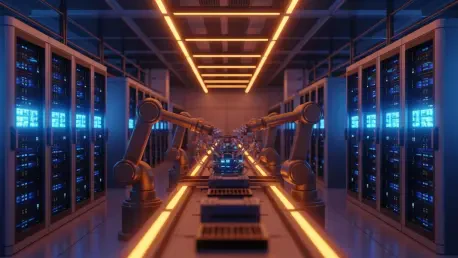

The realization of generative artificial intelligence as a core driver of modern business value has shifted from speculative experimentation toward the necessity of robust, industrial-grade operational frameworks that can survive the rigors of high-volume production. Many organizations have spent the period between 2024 and 2026 stuck in a cycle of disconnected pilot projects that fail to integrate with existing legacy infrastructures or provide measurable financial returns. This friction often stems from a lack of standardized governance and the immense technical complexity required to maintain agentic systems at scale. To resolve this, the emergence of production-ready AI factories represents a fundamental pivot in how corporate digital strategies are executed. These factories are not merely hardware clusters but comprehensive ecosystems designed to streamline the lifecycle of a model from its initial fine-tuning to its deployment across global edge locations. By providing a structured path forward, this model eliminates the guesswork that previously plagued enterprise-level transformations.
Bridging the Deployment Chasm: The Shift Toward Industrialization
The current technological landscape demands a transition away from general-purpose tools toward specialized environments that prioritize security, transparency, and resource efficiency. One of the primary obstacles to this transition has been the fragmentation of the software stack, where developers struggle to bridge the gap between development environments and live operational platforms. Without a unified architecture, the cost of maintaining custom-built AI solutions often balloons beyond initial projections, leading to abandoned initiatives and wasted capital. The partnership between NTT DATA and NVIDIA addresses these systemic failures by offering a factory approach that treats AI development as a repeatable manufacturing process rather than a series of artisanal experiments. This methodology ensures that every deployed model adheres to strict compliance standards while remaining flexible enough to adapt to fluctuating market demands. Consequently, leaders are now able to focus on high-level strategic outcomes rather than being bogged down by the intricacies of low-level infrastructure.
Building on this industrial framework, the deployment of enterprise AI factories relies on a sophisticated orchestration of high-performance networking and GPU-accelerated computing modules. This integration allows for a seamless flow of data across hybrid cloud and edge environments, ensuring that latency-sensitive applications perform reliably regardless of their physical location. By centralizing the management of these resources, organizations can achieve a level of operational consistency that was previously impossible when managing disparate clusters of local servers. This centralized governance also plays a crucial role in mitigating the risks associated with data privacy and ethical AI usage, as every interaction can be logged, audited, and optimized in real-time. The result is a highly resilient foundation that supports continuous innovation without compromising the integrity of corporate data. Furthermore, the ability to scale these resources up or down on demand provides the fiscal predictability that chief financial officers require before authorizing large-scale overhauls.
Technical Architecture: Powering Domain-Specific Intelligence
A significant technical differentiator in this ecosystem is the sophisticated utilization of the NVIDIA NeMo framework alongside NIM microservices to create optimized, containerized applications. These microservices enable developers to package complex generative models into efficient units that can be deployed almost instantaneously across various infrastructure tiers without the need for extensive rewriting or reconfiguration. By leveraging these optimized containers, enterprises significantly reduce the time-to-market for new intelligent services, allowing them to respond to competitive pressures with unprecedented agility. This software suite provides the necessary tools for building agentic systems capable of performing multi-step tasks autonomously within a defined business logic. These agents can navigate internal databases, interact with customer interfaces, and execute transactions, all while operating within safe boundaries. This level of automation represents a major leap forward in how labor-intensive business processes are redesigned for the modern era.
As the industry moved toward a more mature phase of technological adoption, the focus clearly shifted from general curiosity to the systematic industrialization of intelligent capabilities. Decision-makers recognized that the long-term viability of their digital investments depended on moving beyond isolated pilots into integrated, governed environments that prioritized performance and scalability. The collaborative efforts between these technology giants provided the necessary infrastructure and strategic guidance for organizations to navigate this transition effectively. Leaders who prioritized the implementation of standardized factories found themselves better positioned to capture the value of generative technologies while maintaining rigorous control over their data ecosystems. Moving forward, the emphasis remained on refining these domain-specific applications to ensure they continued to deliver high returns on investment. For enterprises seeking to remain relevant, the path forward required a disciplined commitment to building production-grade solutions that were both sustainable and secure.