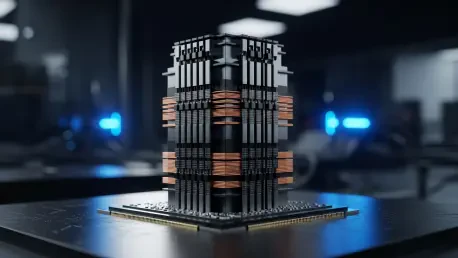

The sheer magnitude of the global shift toward artificial intelligence has forced the world’s most valuable semiconductor designers to rethink traditional procurement strategies in favor of massive, multi-year financial commitments that redefine industrial partnerships. Nvidia recently finalized a historic five hundred billion dollar supply agreement with SK Hynix, representing the largest procurement deal ever recorded in the history of the semiconductor industry. This massive financial commitment centers on securing high-bandwidth memory, a component that has surfaced as the primary bottleneck in the global production of high-performance artificial intelligence hardware. By locking down this critical component through a long-term contract, Nvidia is not merely purchasing essential parts for its upcoming hardware cycles; it is effectively weaponizing its supply chain to solidify its lead in the ongoing technological arms race. This strategic move ensures that the company can meet the relentless demand for its compute clusters while placing significant pressure on any competitor attempting to match its scale in an increasingly crowded and hardware-constrained market landscape.
Strategic Dominance in the Semiconductor Landscape
Securing the HBM Bottleneck: A Critical Advantage
High-bandwidth memory is a specialized form of dynamic random-access memory that utilizes advanced three-dimensional stacking technology to facilitate the massive data throughput required by modern graphic processing units. Because this memory is integrated directly onto the chip package using sophisticated interposers, the manufacturing process is notoriously difficult and carries significantly lower yields than traditional memory modules. With SK Hynix controlling approximately half of the global high-bandwidth memory market, this agreement ensures that Nvidia possesses the specialized materials necessary to satisfy the overwhelming demand from the world’s largest hyperscale data center operators. The technical complexity of these components means that manufacturing capacity cannot be expanded overnight, making existing production lines more valuable than the processing chips themselves. By securing a dominant share of this output, the company bypasses the supply constraints that have previously slowed the deployment of advanced generative models across various industrial sectors.
Starving Competition: The Barrier to Entry
Beyond ensuring its own production continuity, this agreement functions as a formidable strategic barrier that effectively starves the broader market of the essential resources that competitors such as AMD and Intel require for their own accelerators. By monopolizing a massive portion of SK Hynix’s specialized production capacity for several years, Nvidia makes it nearly impossible for rival chipmakers to scale their competitive hardware architectures to a meaningful degree. Even in scenarios where a competitor develops a design that matches or exceeds current performance benchmarks, they may find themselves unable to bring that product to market in high volumes due to a lack of available memory supply. This creates a scenario where the physical control of the supply chain becomes a more potent competitive tool than architectural innovation alone. Consequently, the industry is seeing a shift where the ability to manufacture at scale is determined not just by the quality of a design, but by the exclusive access to the specialized foundries and materials that make those designs a physical reality.
Financial Scale and Future-Proofing
Investing in Technological Insulation: Long-Term Outlook
From a financial and operational perspective, the five hundred billion dollar commitment represents a staggering bet on the sustained growth of the artificial intelligence sector through the end of the decade. Analysts indicate that because memory typically accounts for a substantial portion of a modern accelerator’s bill of materials, this deal could ultimately support over one and a half trillion dollars in total revenue. This level of investment signals that the company is preparing for a period of sustained dominance rather than a temporary surge in interest fueled by speculative trends. Furthermore, the contract provides long-term technological insulation by granting priority access to next-generation memory standards like HBM3E and HBM4 as they emerge from the laboratory. This ensures that future chip architectures will have a guaranteed path to production without being hindered by the shortages that defined earlier development cycles. This strategic foresight allows for more predictable product roadmaps, giving large-scale buyers the confidence they need to commit to multi-year infrastructure projects.
The Shift Toward Supply Chain Hegemony: Redefining Control
The evolution of semiconductor hegemony is being redefined by this shift from purely intellectual property competition to the physical control of the global manufacturing pipeline. While providing reliability for cloud giants like Microsoft and Meta, this arrangement also deepens their long-term dependency on a single hardware provider, granting the company immense leverage over the rollout of global digital infrastructure. By integrating its financial future so closely with a primary memory manufacturer, the leading chip designer has transformed into a supply chain hegemon that effectively dictates the pace of progress for the entire industry. This move institutionalizes a market lead by ensuring that any organization wishing to participate in the high-end computing revolution must operate within an ecosystem that is largely defined by these exclusive supply arrangements. As the industry moves forward, the focus is increasingly moving away from who has the best algorithm to who possesses the physical components required to run them, fundamentally altering the balance of power within the global technology sector.
Strategic Navigations: Future Pathways and Industrial Resilience
Industry leaders recognized that the era of just-in-time manufacturing had reached its limits, necessitating a pivot toward aggressive vertical integration and preemptive resource acquisition. To maintain competitive relevance in this environment, organizations prioritized the diversification of their supply sources by investing in emerging memory technologies or forming deeper partnerships with secondary manufacturers. The focus shifted toward developing more efficient on-chip memory architectures that could potentially reduce the heavy reliance on external high-bandwidth stacks. Furthermore, stakeholders evaluated the necessity of localized manufacturing hubs to mitigate the risks associated with such concentrated supply chains. This period demonstrated that long-term success in the technology sector required a balance between hardware innovation and the securing of physical manufacturing pipelines. Moving forward, the industry explored open-standard memory alternatives to ensure that the barriers to entry did not stifle the very innovation that the current artificial intelligence boom was intended to foster.