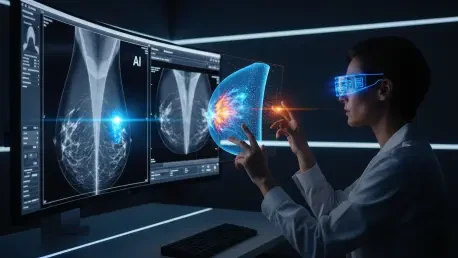

The modern radiology department is facing unprecedented pressure, grappling with ever-increasing patient volumes, a global shortage of specialized staff, and the persistent demand for faster, more accurate diagnoses. Against this challenging backdrop, the latest innovations showcased at the Radiological Society of North America (RSNA) conference signal a profound and necessary evolution, moving beyond incremental improvements to fundamentally reshape diagnostic imaging. A clear and unified direction has emerged, defined by three interconnected pillars: the deep and seamless integration of artificial intelligence into core imaging systems, an unwavering focus on automating tasks to enhance workflow efficiency, and the strategic consolidation of disparate software into unified, cloud-based enterprise platforms. This industry-wide strategic shift is not merely about developing more powerful machines; it is about creating an intelligent, interconnected ecosystem designed to augment the capabilities of clinicians, streamline complex operational pathways, and ultimately elevate the standard of patient care across every major imaging modality.
Revolutionizing Core Imaging Modalities
Helium-Free MRI Technology
Philips made a significant impact by unveiling its BlueSeal Horizon 3T MRI, a landmark system featuring the industry’s first fully sealed, helium-free 3T magnet. This engineering breakthrough directly addresses one of the most persistent and costly challenges in MRI operation: the reliance on liquid helium. Helium is a finite resource with a volatile supply chain, and traditional MRI systems require complex, expensive venting infrastructure and regular, costly refills. By eliminating this dependency, the BlueSeal magnet not only reduces the total cost of ownership but also simplifies installation and siting requirements, making advanced 3T imaging more accessible to a wider range of healthcare facilities, including those in remote or resource-constrained locations. This fundamental redesign of the magnet, the core component of any MRI system, represents a major step toward more sustainable and economically viable advanced diagnostic imaging, removing a significant barrier to entry and operation for hospitals worldwide and setting a new standard for MRI hardware design.
Beyond its pioneering magnet technology, the BlueSeal Horizon 3T platform is meticulously designed to accelerate clinical workflows and enhance diagnostic precision through the intelligent application of software. The system incorporates AI-driven features like SmartPlanning, which automates scan planning for complex cardiac examinations, reducing manual steps and improving consistency. Furthermore, its SmartSpeed Precise technology leverages sophisticated algorithms to achieve a harmonious balance between exceptional image sharpness and dramatically increased scanning speeds, capable of performing procedures up to three times faster than conventional methods. This acceleration directly translates into higher patient throughput, a critical advantage for busy radiology departments. By shortening scan times, the system also improves the patient experience, reducing anxiety and minimizing the potential for motion artifacts. This powerful combination of groundbreaking hardware and intelligent software underscores a holistic approach to innovation, where operational efficiency is achieved in tandem with uncompromising diagnostic quality.
Hybrid Systems for Interventional Radiology
Canon Medical demonstrated a powerful solution for the growing field of interventional radiology with its FDA-cleared Alphenix 4D CT, a hybrid platform that seamlessly integrates a state-of-the-art angiography system with a high-performance CT scanner. This innovative configuration is purpose-built to transform the interventional suite into a comprehensive diagnostic and therapeutic environment. Traditionally, complex procedures often required moving a patient between separate angiography and CT rooms, a process that is not only time-consuming but also introduces potential risks and delays. The Alphenix 4D CT eliminates this fragmented workflow by allowing clinicians to perform detailed diagnostic assessments, sophisticated treatment planning, and the therapeutic intervention itself all within a single room, on a single platform. This consolidated approach significantly shortens procedure times, enhances patient safety by minimizing movement, and empowers interventional teams to make critical decisions with real-time, multi-modal imaging guidance, optimizing outcomes for complex oncological and vascular procedures.
The clinical power of the Alphenix 4D CT is rooted in its advanced imaging technology, which is enhanced by a suite of AI-driven tools. The system features a wide-area CT detector capable of capturing entire organs in a single, ultra-fast rotation, providing comprehensive anatomical context for intricate procedures. This is complemented by a high-definition flat panel detector for angiography, which utilizes 76 µm pixel technology to deliver the exceptional spatial resolution needed to visualize fine vessels and precisely guide catheter-based therapies. The platform’s imaging capabilities are further amplified by deep learning reconstruction algorithms that reduce noise and improve image quality, even at low radiation doses. AI also plays a crucial role in optimizing workflows, automating routine tasks, and providing decision support to the clinical team. This fusion of best-in-class hardware and intelligent software provides interventional radiologists with the clarity, confidence, and efficiency required to tackle the most challenging cases with greater precision and safety.
Advancing Precision in Breast Health
AI-Powered Mammography and Biopsy Guidance
In the critical area of breast health, new advancements are sharply focused on improving cancer detection, particularly in challenging cases involving dense breast tissue. Siemens Healthineers showcased a significant enhancement to its Mammomat B.brilliant platform with the introduction of ClearCEM, a novel technique for contrast-enhanced mammography (CEM). Dense breast tissue can obscure potential lesions on a standard mammogram, making detection difficult. ClearCEM addresses this by using an iodinated contrast agent and dual-energy imaging to highlight areas of unusual blood flow, which are often associated with malignancy. The technology’s advanced reconstruction algorithms process the images to significantly improve the conspicuity of suspicious findings, effectively separating them from the background of dense fibroglandular tissue. This provides radiologists with a clearer, more definitive view, increasing diagnostic confidence and helping to reduce the number of inconclusive examinations that might otherwise lead to additional imaging or unnecessary biopsies.
The clinical utility of the ClearCEM technology extends beyond initial detection into the crucial phase of biopsy and treatment planning. When a suspicious lesion is identified through a CEM exam, the next step is to obtain a tissue sample for pathological analysis. The Mammomat B.brilliant platform leverages the ClearCEM data to generate a high-depth resolution localizer image, which can then be used to guide a tomosynthesis-guided biopsy. This innovative workflow allows for exceptionally precise targeting, with a documented accuracy of within one millimeter. Such precision is vital for ensuring that the biopsy sample is taken from the correct location, which increases the diagnostic yield of the procedure and minimizes the risk of missing a cancerous lesion. By seamlessly integrating advanced diagnostic imaging with precise interventional guidance, this technology provides a more complete and effective clinical pathway for patients, from initial screening to definitive diagnosis.
The Future of Radiology Informatics
A major systemic challenge facing modern healthcare is the fragmentation of imaging data across multiple, often incompatible, departmental systems. To address this, Fujifilm introduced Synapse One, a comprehensive, cloud-based enterprise imaging platform designed to break down these information silos. This solution consolidates a wide array of essential applications—including advanced 3D visualization tools, sophisticated scheduling systems, a patient portal, and a physician portal—into a single, secure, and cohesive ecosystem. By unifying these disparate functionalities, Synapse One aims to foster robust interoperability across the healthcare enterprise. This consolidation dramatically reduces the integration strain and associated costs that arise from managing a patchwork of software from multiple third-party vendors. For hospitals and health systems, this creates a more streamlined and manageable IT environment, facilitating better communication and data sharing among clinical teams and empowering them with a holistic view of the patient’s imaging history.
In a similar move toward integrated, cloud-native solutions, Philips presented its FDA-cleared Cardiovascular Workspace. This specialized Software as a Service (SaaS) platform is specifically designed to meet the complex demands of cardiovascular imaging and reporting. Deployed via the cloud, the workspace provides cardiologists, radiologists, and other specialists with secure, remote access to imaging studies and analysis tools, enabling flexible and efficient workflows from any location. A key feature of the platform is its automated data synchronization with a vendor-neutral archive (VNA), which ensures that all imaging data, regardless of the original modality or manufacturer, is stored in a standardized and easily accessible format. This seamless integration promotes smoother and more effective multidisciplinary collaboration, allowing care teams to review cases, share insights, and coordinate treatment plans more effectively. By streamlining data management and communication, the Cardiovascular Workspace helps to accelerate diagnoses and improve the overall efficiency of cardiovascular care delivery.
Redefining the Ultrasound Experience
High-Performance Imaging Meets User-Centric Design
The latest generation of ultrasound devices demonstrates a powerful convergence of high-performance imaging technology with a renewed and critical focus on user-centric, ergonomic design. Mindray’s new Resona A20 premium ultrasound system exemplifies this trend, incorporating several technological enhancements aimed at delivering superior diagnostic clarity. The system features advanced transducers that provide ultra-wideband coverage and is powered by FreeBeam beamforming technology. Unlike traditional beamforming, FreeBeam processes a greater volume of echo data with enhanced precision, resulting in images with outstanding resolution and uniformity from the near to the far field. These advancements provide clinicians with a richer and more detailed view of anatomy and pathology, which is essential for making confident diagnoses in a wide range of clinical applications, from obstetrics and gynecology to vascular and cardiac imaging. The core mission is to equip sonographers with the highest possible image quality to improve diagnostic accuracy.
While superior image quality is paramount, the design of the Resona A20 equally prioritizes the health and efficiency of the sonographer. The system features a highly adjustable control panel and a large, 27-inch monitor mounted on an articulating arm, allowing users to easily customize the workstation to their preferred posture, thereby reducing physical strain during long scanning sessions. The monitor can also be collapsed, making the system more compact and easier to transport between rooms. Complementing these physical design elements, the user interface incorporates customizable, AI-powered profiles. These profiles can automatically adjust imaging parameters and activate specific measurement tools based on the exam type selected, which streamlines the scanning process and reduces the number of manual adjustments required. This holistic design approach recognizes that optimizing the user experience is just as important as enhancing the underlying technology, leading to greater efficiency, consistency, and a more sustainable work environment for sonographers.
AI-Driven Automation and Ergonomics
Samsung further advanced the integration of artificial intelligence into daily clinical practice with its R20 ultrasound system. This platform is built around a sophisticated software beamforming engine and is equipped with a comprehensive suite of over a dozen distinct AI tools designed to enhance nearly every aspect of the ultrasound examination. These intelligent features are dedicated to automating time-consuming and repetitive tasks, such as performing complex measurements of fetal anatomy or cardiac function. The AI also provides real-time diagnostic assistance by highlighting potential abnormalities and offers on-screen guidance to help sonographers acquire optimal imaging planes. By offloading these routine tasks to the system’s AI, the R20 allows sonographers to dedicate more of their focus and expertise to patient interaction and the critical interpretation of complex findings, ultimately improving both the efficiency and the quality of the diagnostic process.
A standout feature of the Samsung R20 is its deep commitment to ergonomics, which has been validated through independent assessment for its ability to mitigate work-related musculoskeletal disorders (WMSDs). Sonographers are at a notoriously high risk for developing debilitating strain injuries due to the repetitive motions and awkward postures required during scanning. The R20’s design directly confronts this issue with a lightweight control panel, easily accessible controls, and a flexible architecture that promotes neutral posture. The independent validation provides healthcare organizations with tangible evidence that investing in this technology can lead to a healthier and more sustainable workforce. By directly addressing the well-documented physical challenges of the profession, this focus on ergonomics represents a crucial advancement, ensuring that the benefits of high-tech imaging are not achieved at the expense of the clinicians who operate the equipment daily.
A Conclusive Shift Toward Integrated Intelligence
The innovations presented at the RSNA conference collectively signaled a definitive maturation of diagnostic imaging technology. The discourse had moved beyond the theoretical potential of artificial intelligence and workflow automation to the practical, real-world implementation of these concepts in tools designed to address pressing clinical and operational needs. The overarching strategy was clear: to deliver enhanced clinical effectiveness through the dual approaches of widespread automation and comprehensive platform consolidation. This strategic direction steered the industry toward a new paradigm characterized by greater speed, deeper integration across the healthcare enterprise, and more profound diagnostic precision. The consistent thread woven through these advancements was the transformative role of AI, which was leveraged not as a standalone feature but as a core enabling technology to create smarter, more efficient, and more accurate tools for clinicians, all with the ultimate goal of improving patient care.