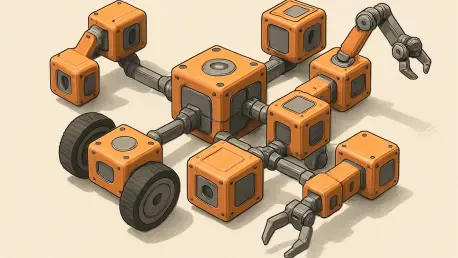

The traditional engineering doctrine suggests that increasing the complexity of a mechanical system inevitably elevates its risk of failure because more moving parts create more opportunities for a single point of collapse. In the realm of modular robotics, this has long been a paralyzing paradox, where the desire for high adaptability is constantly undermined by the statistical certainty that adding more modules makes the entire collective more fragile. However, a groundbreaking shift in design philosophy is now challenging this fundamental assumption by proving that interconnectedness can actually reverse the reliability curve. By shifting the focus from individual component durability to a collective resource-sharing model, researchers have developed a framework where the presence of more units strengthens the system rather than weakening it. This evolution represents a departure from isolated machine logic, moving instead toward a unified, biological approach to robotic survival and operational continuity in the field.
Mechanisms of Hyper-Redundancy and Collective Resilience
Biological Inspiration for Technical Systems
The concept of hyper-redundancy draws significant inspiration from the natural world, where biological organisms utilize collective behavior to ensure survival under extreme duress. Much like how cells in a complex organism transport vital nutrients across semi-permeable membranes to support damaged tissue, or how birds in a flock share sensory data to navigate around obstacles, the Mori3 modular origami robot utilizes a decentralized resource-sharing network. This biological mimicry allows the robot to view its individual modules not as independent entities, but as nodes within a larger, living circuit. When a single module experiences a hardware malfunction or a depletion of its internal energy reserves, the surrounding units do not simply ignore the failure. Instead, the physical and digital architecture allows for the seamless transfer of power and information across the structural boundaries of each unit, ensuring that the collective goal remains achievable despite localized losses.
Building upon these natural parallels, the design of the Mori3 system integrates a multi-layered approach to what the research team defines as essential resource sharing. It was discovered during the development phase that sharing only a single type of resource, such as electricity or sensor data, was insufficient to maintain true system integrity in unpredictable environments. To achieve a state where reliability improves with scale, the system must facilitate the simultaneous exchange of power, communication, and sensing capabilities. This triple-layered redundancy ensures that even if a module is “digitally blind” or “mechanically dead,” it can still function as a vital conduit for the rest of the machine. The integration of these pathways does not require a complete overhaul of the robot’s physical geometry but rather a sophisticated reimagining of how modules interface at their connection points, turning every joint into a potential lifeline for the entire robotic structure.
Practical Validation Through Stress Testing
To prove the efficacy of this resource-sharing paradigm, rigorous experimental testing was conducted to simulate the types of catastrophic failures often encountered in remote or hazardous deployment zones. In one specific demonstration, researchers deliberately severed all internal power and wireless communication links to the central module of a four-part Mori3 robot while it was engaged in a locomotion task. Under normal circumstances, such a failure would result in the central unit becoming a “dead weight” or a physical obstruction, effectively paralyzing the entire robot and ending the mission. However, because the system was configured for hyper-redundancy, the adjacent modules immediately detected the loss and began supplying the necessary energy and data routing through the physical contact points. This “revival” process allowed the incapacitated module to remain active, enabling the robot to continue walking toward its objective without any human intervention.
The success of these tests highlights a critical shift in how engineers approach the “reliability-adaptability conflict” that has plagued modular systems for decades. By demonstrating that a robot can successfully navigate a barrier and contort its body to pass through tight spaces even after a major internal failure, the research team has validated a blueprint for a new generation of resilient machines. This level of autonomy is particularly vital for applications where repair is impossible, such as deep-sea exploration or extraterrestrial construction. The ability of the Mori3 to maintain its gait and structural logic despite the simulated “death” of its core components suggests that the more modules are added to a system, the more pathways for recovery are created. This effectively turns the traditional fear of complexity on its head, making larger, more intricate robotic swarms more dependable than their simpler, more isolated predecessors.
Future Implications for Autonomous Robotic Swarms
Scaling Up Toward Large-Scale Interconnectivity
The transition from small-scale modular prototypes to massive robotic swarms represents the next logical step in the evolution of this resource-sharing technology. As these systems move from controlled laboratory settings into real-world applications between 2026 and 2030, the ability for individual units to dock and exchange energy or data will become the standard for industrial automation. Imagine a scenario in a large-scale logistics hub where hundreds of small robotic units cooperate to move heavy cargo; if one unit’s battery fails, it can simply latch onto a neighbor to continue its task or be towed to a charging station while still contributing to the collective processing power. This shift toward a “collective metabolism” for machines will allow for the deployment of thousands of low-cost units that, when combined, possess the durability and intelligence of a much more expensive and complex singular machine, all while maintaining a much higher tolerance for individual loss.
Furthermore, this scalability opens new doors for the development of adaptive infrastructure that can heal itself or reorganize in response to environmental changes. In the coming years, we can expect to see these principles applied to modular building components or emergency response robots that can form bridges, shelters, or communication towers on demand. Because the resource-sharing protocol is decentralized, there is no master controller that represents a single point of failure; rather, the “intelligence” and “vitality” of the system are distributed across every participating module. This decentralized nature ensures that as long as a sufficient number of modules remain connected, the system can preserve its functionality. The ongoing research suggests that the future of robotics lies not in creating the perfect, unbreakable machine, but in perfecting the ways that imperfect machines can support one another to achieve a common purpose.
Strategic Integration and Operational Implementation
For organizations looking to implement these advancements, the focus must shift from purchasing monolithic robotic platforms to investing in interoperable modular ecosystems. The primary takeaway from the Mori3 research is that the value of a robotic system is increasingly found in the quality of its interfaces and the robustness of its sharing protocols rather than the specifications of a single unit. Decision-makers should prioritize hardware that adheres to open standards for power transfer and data exchange, as these will be the foundational components of resilient autonomous fleets. Moving forward, it is essential to develop software architectures that can dynamically reroute resources in real-time, much like the “smart grids” used in modern city power management. This ensures that the collective can optimize its energy consumption and processing load based on the immediate needs of the mission, effectively extending operational lifespans without requiring larger batteries.
The successful implementation of hyper-redundancy in modular robotics has established a new benchmark for durability in autonomous systems. Engineers and project managers should now view hardware failure as a predictable variable that can be managed through clever architectural design rather than a catastrophe that must be avoided at all costs. By adopting a “resource-first” approach to robotic design, the industry moved away from the fragility of isolated systems and toward the enduring strength of interconnected collectives. These developments provided a clear roadmap for creating machines that can thrive in the most demanding environments, ensuring that the next generation of robotic technology is defined by its ability to persist, adapt, and succeed through cooperation. The focus remained on refining these collaborative protocols to ensure that every new module added to a system served as a safeguard for the whole, rather than a liability.