
The immersive potential of mixed reality has long been confined to the solitary boundaries of an individual’s physical living space, creating a digital experience that remains invisible to everyone else in the room. This inherent isolation stems from the way contemporary headsets utilize onboard sensors and cameras to map a user’s unique environment, overlaying graphics that are tethered to specific pieces of furniture or wall sections. Because no two rooms are identical, a virtual object sitting on a host’s coffee table has no logical anchor point for a remote friend located miles away in a different layout. VirtualGo is currently pioneering a breakthrough to dismantle these walls, seeking to transform what was once a private sensory experience into a collaborative social environment. By establishing a shared spatial language, this technology enables multiple participants to inhabit the same augmented reality, regardless of their physical location or the varying dimensions of their personal surroundings.
The Obstacle: Reconciling Disparate Physical Spaces
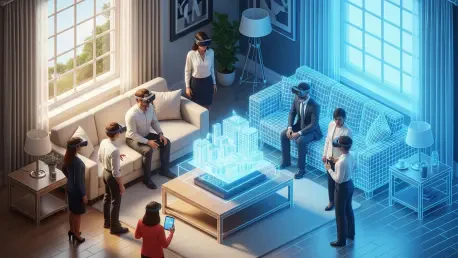
Creating a cohesive multiplayer experience in mixed reality is fundamentally different from traditional online gaming because it requires the synchronization of physical and digital worlds simultaneously. In a standard virtual environment, every player downloads the same map assets, ensuring that a tree or a building appears in the exact same coordinates for everyone logged into the server. However, mixed reality is dependent on the “game board” of a user’s actual home, which includes sofas, televisions, and doorways that do not exist in a remote player’s residence. To bridge this gap, VirtualGo creates a high-fidelity “digital twin” of the host’s environment through a comprehensive room scan. This allows for a hybrid session where the host sees their real-world surroundings while remote guests join via virtual reality. Guests are placed inside a virtual reconstruction of the host’s house, ensuring that everyone interacts with the same spatial layout in real-time. This method effectively neutralizes the isolation of private physical geometry.
The necessity for localized presence has restricted mixed reality to being a niche novelty rather than a primary social platform for daily communication. When developers attempt to create remote multiplayer modes, they often find that the interaction breaks down as soon as a digital character moves through a wall in one person’s house that is an open hallway in another. This lack of spatial parity ruins the immersion and prevents the execution of complex mechanics, such as tactical cover-based combat or cooperative puzzle-solving. By using the host’s room as the definitive geometry for the session, VirtualGo ensures that every participant sees the same hiding spots and obstacles. Whether it is a ghost lurking in a hallway or a teammate taking cover behind a couch, the system aligns every perspective to a single physical source. This transition is essential for building a robust ecosystem where spatial computing becomes as socially integrated as today’s mobile applications and standard online gaming.
Technical Standards: Path Toward Global Connectivity
While the initial focus of VirtualGo may lean toward entertainment, the implications of this technology reach far into the realms of remote work, education, and general social interaction. By providing a reusable framework for sharing physical locations, the system could enable distant family members to sit at a virtualized version of a shared dining table or allow students to explore a specialized laboratory from their own homes. This shift moves the medium away from experimental tech demos and toward a practical platform for daily connection where physical distance no longer dictates the quality of a shared experience. However, the success of this system depends on the extreme accuracy of the initial room scan and the stability of the networking protocols. Even a minor discrepancy in the digital model can ruin the immersion for a remote player, while lag can cause visual disconnection. Engineers are currently refining these systems to ensure a seamless and believable social interaction that mimics real life.
Ultimately, the industry shifted its focus toward establishing more rigorous standards for spatial data interoperability to support these emerging social frameworks. Developers recognized that the success of shared mixed reality relied on a unified approach to environment mapping and low-latency data transmission. In the years leading up to 2028, researchers prioritized the creation of open-source protocols that allowed different hardware ecosystems to communicate within a single shared space. This collaborative effort ensured that users were not locked into a single brand, fostering a more inclusive and expansive digital landscape. Strategic investments in local edge computing helped mitigate the latency issues that previously plagued high-fidelity spatial sharing, making the experience accessible across varying infrastructures. These advancements eventually transformed the living room from a static physical area into a dynamic gateway for global connectivity and collaborative interaction through mixed reality.