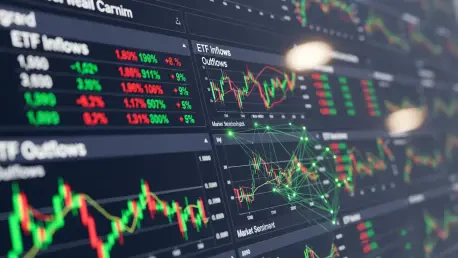

The cryptocurrency market is undergoing a fundamental transformation, shifting from an arena driven by social media sentiment to a more deliberate, institutionalized ecosystem. The slow, steady currents of institutional capital, Exchange-Traded Fund (ETF) mechanics, and macroeconomic positioning now shape the landscape in this complex new environment. Artificial Intelligence (AI) has emerged as a powerful analytical tool, but its capabilities are often misunderstood. This article explores the dual nature of AI in this context, examining what it can reveal about assets like XRP within an ETF-driven market and, just as importantly, where its capabilities end and human judgment must begin. It delves into how AI helps organize complexity rather than predict the future, ultimately making the case for a symbiotic relationship between machine intelligence and human insight.
From Volatile Tides to Deep Currents: The Market’s Maturation
To understand the role of AI today, it is essential to appreciate how dramatically the market has evolved. The old paradigm was defined by speed and sentiment, where news headlines, influencer tweets, and community hype could trigger rapid, volatile price swings in a market largely driven by short-term speculation. The arrival of spot Bitcoin and Ethereum ETFs, however, marked a significant turning point. This influx of institutional capital has made the market “heavier” and more methodical. Price movements are now less about immediate reactions and more about the strategic allocation of billions of dollars by fund managers. These deep-seated forces—ETF inflows and outflows, regulatory considerations, and long-term portfolio strategies—now carry far more weight than speculative fervor, creating a new set of rules for assets like XRP and demanding a more sophisticated approach to analysis.
Decoding the DatAI’s Role in the Modern Market
AI’s True Strength: Organizing Complexity Not Predicting Prices
The most common misconception about AI in financial markets is that its purpose is to predict future prices with certainty. In reality, its true value lies in its ability to process and synthesize vast, complex datasets to reveal patterns and relationships invisible to the human eye. In the current ETF-driven landscape, AI excels at mapping the intricate connections between capital flows, on-chain data, derivatives positioning, and traditional market movements. Its strength is in detecting “rotation, not momentum”—highlighting the subtle reallocation of capital between different assets even when the overall market appears to be moving sideways. AI provides a snapshot of the meaningful positioning taking place beneath a quiet surface, but it stops short of explaining the human rationale behind those moves.
The XRP Case Study: A Lens on Institutional Interest
XRP serves as a compelling case study for AI’s capabilities. Often moving independently of broader market trends, its valuation is highly sensitive to factors like regulatory clarity and institutional access. AI models correctly identify this nuance, placing a heavier weight on fundamental inputs like fund flows over transient indicators such as social media chatter. For instance, recent analysis highlighted a trend where altcoin ETFs, with XRP and Solana at the forefront, attracted significant net inflows even as Bitcoin and Ethereum ETFs experienced outflows. An AI can parse this data to show that this is not a classic “risk-on” rally but a selective, cautious rotation of institutional capital. This analysis is not a price forecast; it is an objective look at what large-scale investors are actually doing with their money, providing a data-driven view of market conditions that may contradict prevailing narratives.
The Blind Spots: Where AI Fails to Grasp Regulation and Intent
Despite its analytical power, AI has significant blind spots. Its most glaring weakness is its inability to quantify novel events, particularly regulatory decisions. AI learns from historical data, but landmark legal rulings or new legislation often have no precedent. For an asset like XRP, whose history is deeply intertwined with regulatory battles, this is a critical limitation. An AI can react and recalibrate after a ruling is announced, but it is effectively blind to the development and potential impact beforehand. Furthermore, AI cannot understand human intent. It can measure defensive positioning or a flight to liquidity, but it cannot explain why investors are being cautious. The fear, prudence, or strategic patience driving market behavior remains opaque to the algorithm, yet this “why” is often the key to anticipating the market’s next major move.
The Evolving Symbiosis of Analyst and Algorithm
Looking ahead, the relationship between AI and human analysis is set to become even more intertwined. As digital asset markets grow more complex with the introduction of new financial products and evolving regulations, the need for AI to sift through overwhelming data will only increase. However, this will simultaneously amplify the importance of the human analyst. The future of market analysis will not be about choosing between machine and mind but about leveraging both. AI will flag moments of tension—highlighting discrepancies between market narratives and actual capital flows—but it will require a human expert to interpret these signals, understand the contextual drivers, and make a strategic judgment call.
A Practical Guide: Leveraging AI for Informed Judgment
The major takeaway for investors and analysts is to recalibrate their expectations of AI. Instead of seeking a crystal ball for price predictions, it should be viewed as a sophisticated dashboard that illuminates the underlying structure of the market. The most actionable strategy is to use AI-driven insights to identify where institutional capital is moving, where liquidity is concentrated, and which assets are showing strength independent of market hype. This data-driven foundation should then be combined with fundamental human analysis, particularly regarding the regulatory landscape and macroeconomic outlook. This approach fosters “informed judgment,” where the “what” provided by the machine is enriched by the “why” provided by human experience and intuition.
Conclusion: The Unwavering Value of Human Context
In the new era of institutionalized crypto markets, AI proved to be an indispensable tool for making sense of immense complexity. It revealed the powerful, often invisible forces that were shaping the movements of assets like XRP within the ETF ecosystem. By tracking capital flows and identifying subtle rotations, it provided an objective view of investor behavior that cut through the noise. However, it could not replace the uniquely human ability to understand context, anticipate novel events, and interpret intent. The future of navigating these markets belonged not to the best algorithm or the shrewdest analyst, but to the symbiotic partnership between the two. Ultimately, technology continued to enhance vision, but nuanced judgment remained the key to turning data into wisdom.