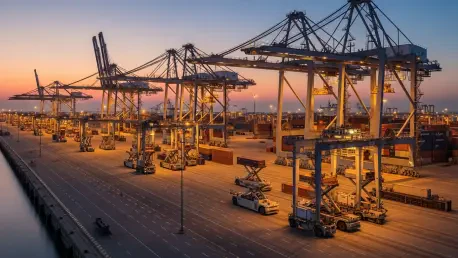

The intricate dance of global commerce relies on a series of critical handoffs, and none are more pivotal than the operations within the world’s sprawling container ports. Recent supply chain disruptions have starkly revealed just how fragile these connections can be, transforming the conversation around port automation from a niche topic of operational efficiency into a central pillar of national economic security. As nations grapple with the urgent need to ensure the reliable and predictable flow of goods, the strategic implementation of automated systems within these vital logistics hubs has become a paramount concern, representing a critical investment in resilience against future shocks.
The Port as Critical National Infrastructure
Unlike a self-contained factory that serves the interests of a single corporate entity, a port terminal functions as a piece of shared public infrastructure, a vital artery through which the economic lifeblood of an entire nation flows. Any failure, slowdown, or disruption at a major port does not remain isolated; it creates a catastrophic domino effect, sending shockwaves through inland supply chains that paralyze rail networks, overwhelm warehousing capacity, and leave retail shelves empty. This critical role demands an exceptional degree of reliability and continuous, uninterrupted operation, as the economic cost of downtime can be measured in billions. Consequently, operational stability is no longer just a business objective but a fundamental matter of national and economic security, requiring a new approach to how these assets are managed and fortified against a growing list of potential threats.
The justification for investing in advanced automation has evolved significantly in response to this new reality. The initial drive for automation was often framed narrowly, centered on the goal of reducing direct labor costs. However, the modern imperative is now a much broader strategic need for operational resilience and predictability in an increasingly volatile global landscape. The consistency and stability offered by automated systems are no longer viewed as mere efficiency gains; they are now understood as essential tools for insulating national economies from the shocks of geopolitical tensions, pandemics, and other unforeseen disruptions. By ensuring that goods can move reliably and predictably through these gateways, regardless of external pressures, automation provides a crucial buffer that helps maintain economic continuity and security for the nation as a whole.
The Reality of a Modern Automated Terminal
The transition to an automated port is not a sudden, “lights-out” revolution where humans are entirely replaced by machines, but rather a gradual, decades-long evolution toward greater system intelligence. This carefully managed progression has moved from the initial phase of mechanization, where manual labor was replaced by human-operated machines, to computer-controlled automation that introduced predefined operational routes and software-assisted scheduling. The current state of the art is a sophisticated model of partial and highly supervised autonomy. Most of the world’s advanced ports today operate on a hybrid model, seamlessly blending remote-controlled equipment with automated yard machines and autonomous vehicles that function within tightly controlled, geofenced zones. Every element of this complex system remains under the watchful eye of skilled human operators, who manage exceptions and oversee the entire process.
The true intelligence of a modern automated port lies not in any single piece of robotic hardware but in the overarching software layer that orchestrates the entire, complex operation from end to end. The Terminal Operating System (TOS) acts as the central nervous system, a powerful digital brain that optimizes the intricate sequence of thousands of container moves every single day. By coordinating every asset in real time—from the arrival of massive container ships and the movement of quay cranes to the routing of vehicles and the management of terminal gates—the TOS works to maximize throughput and prevent the kind of congestion that can bring a port to a standstill. Advanced systems are increasingly incorporating predictive analytics and artificial intelligence, not to replace human decision-making, but to augment it, helping operators manage immense complexity and anticipate operational bottlenecks before they occur.
Technologies That Build a Resilient Supply Chain
Automated cranes, particularly the massive ship-to-shore (STS) cranes and the yard cranes that manage container stacks, were among the first technologies to be widely adopted in ports due to their highly structured and predictable operating environments. By automating the highly repetitive and physically demanding movements required to load and unload vessels, terminals achieve a level of precision, safety, and consistency that is simply unattainable with purely manual operations. This technological shift has also fundamentally transformed the role of the human operator, moving them from hazardous cabs perched high above the ground to safe, climate-controlled remote control rooms. From this vantage point, a single operator can comfortably and efficiently supervise multiple machines at once, creating a safer and more stable operational foundation that is far less susceptible to human error or external disruption.
The connective tissue of the modern automated terminal is its fleet of autonomous vehicles, such as automated straddle carriers and internal terminal vehicles (ITVs), which are responsible for the constant horizontal transport of containers across the vast expanse of the yard. Guided by an advanced fusion of technologies, including GNSS for precise positioning and LiDAR for environmental mapping and obstacle detection, these vehicles navigate the complex terminal environment with remarkable precision. Their operation within geofenced, continuously supervised zones eliminates the inherent variability and unpredictability of manual transport, preventing the formation of bottlenecks and guaranteeing the kind of steady, reliable throughput that is essential for national economic security. This system-wide coordination ensures a consistent and predictable flow of goods from the quay to the container stacks and out the gate, forming the backbone of a truly resilient supply chain.
Navigating the Human and Economic Landscape
The immense capital investment required for comprehensive port automation is justified by a return that extends far beyond simple labor savings. The primary economic drivers supporting these multi-million-dollar projects are the pursuit of greater throughput stability, the benefit of predictable long-term operating costs, and a significant reduction in the direct and indirect expenses associated with accidents, equipment damage, and unplanned downtime. For large, high-volume “mega-ports” that handle a continuous flow of global traffic, this business case is clear and compelling. However, the calculus is more complex for smaller regional terminals, raising strategic questions for policymakers about whether ports should be treated as purely private enterprises driven by market forces or as pieces of critical national infrastructure deserving of coordinated public investment to secure the integrity of national supply chains.
While the implementation of automation unequivocally improves safety by removing workers from some of the most hazardous industrial environments, it has simultaneously created significant friction with labor unions, who are understandably concerned about the potential for job displacement. This political and social challenge has been a significant factor in slowing automation adoption rates in some regions, particularly within the United States, where ports are major regional employers and operational decisions are subject to intense public and political scrutiny. However, this long-standing narrative is gradually being reshaped by powerful demographic shifts, as a generation of experienced operators approaches retirement and fewer new workers enter the field to replace them. This emerging reality is reframing the debate, positioning automation not as a threat to labor, but as a necessary tool to sustain operations and ensure the long-term viability and competitiveness of these critical economic gateways.