
The automotive assembly line is currently undergoing its most radical transformation since the introduction of the first stationary robotic arms decades ago. As the manufacturing world converges with advanced neural networks, the debut of the AEON system at the BMW Leipzig plant signals a departure from rigid, pre-programmed automation toward a flexible, cognitive workforce. This transition represents more than just a mechanical upgrade; it is an ambitious experiment in whether machines can truly mimic human spatial reasoning and operational adaptability within a high-stakes industrial environment.
The Emergence of Collaborative Humanoid Robotics
The shift from bolted-down machinery to mobile, AI-driven humanoid systems marks a fundamental change in how we perceive factory efficiency. Unlike traditional robots that are confined to safety cages and specific tasks, these new machines are designed to operate in open spaces alongside human technicians. The core principle driving this evolution is the integration of autonomous decision-making, which allows a robot to navigate unpredictable floor conditions and handle varied materials without constant human intervention.
This technological leap is particularly relevant because it bridges the gap between human intuition and machine precision. While a human worker excels at recognizing subtle quality defects, a robot provides the tireless consistency required for repetitive logistics. By combining these strengths, manufacturers are creating a hybrid workflow where the machine acts as a physical extension of the digital enterprise, translating complex data into precise mechanical actions in real time.
Core Technical Architectures of the AEON System
Sensory Perception and Autonomous Navigation
At the heart of the AEON system lies a sophisticated suite of 22 high-fidelity sensors and a network of high-definition cameras that grant the unit 360-degree spatial awareness. This sensory array does not just detect obstacles; it cross-references live visual data against pre-scanned digital twins of the factory floor. This constant data synchronization ensures that the robot remains aware of its exact coordinates, allowing it to navigate through busy corridors and around moving equipment with a level of fluidity that was previously impossible.
The reliance on digitized environments means these robots are not just wandering blindly but are moving through a known mathematical space. This integration allows the AI to predict potential collisions before they occur, adjusting its pathing in milliseconds. Such a high degree of perception is what enables the robot to perform delicate tasks, like scanning vehicle parts for microscopic misalignments, which requires both steady movement and an acute understanding of three-dimensional geometry.
Mobility Design and Energy Efficiency
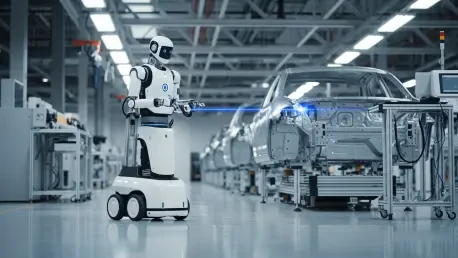
Breaking away from the traditional bipedal design, the AEON utilizes a specialized two-wheel navigation system that prioritizes stability and speed over human-like walking. This choice reflects a pragmatic approach to industrial design; wheels are significantly more energy-efficient and less prone to mechanical failure than complex leg joints. This design allows the 132-pound units to maintain a steady pace across the vast Leipzig facility without the high power draw associated with balancing a bipedal frame.
To address the common bottleneck of battery life, the system incorporates a 30-second battery swap mechanism. While the three-hour operational window per charge might seem limited, the rapid-swap capability ensures that the robots remain active for the duration of a full manufacturing shift. This logistics-first engineering approach demonstrates a commitment to high-efficiency production cycles, ensuring that the “humanoid” element serves the factory’s needs rather than just mimicking human biology for the sake of aesthetics.
Latest Developments in Global Robotics Competition
The rapid innovation seen in the AEON system is largely a response to the intensifying global arms race in industrial robotics. Competitors like the Chinese firm Unitree have been aggressive in pushing the boundaries of what “intelligent” machines can do, forcing traditional European powerhouses to accelerate their own R&D cycles. This pressure has transformed the robotics sector from a slow-moving industry into a fast-paced field where software updates and sensor upgrades occur with the frequency of smartphone iterations.
For European manufacturers, the investment in high-cost AI solutions—often totaling hundreds of thousands of dollars per unit—is no longer optional. To match international technological trajectories, companies must embrace these expensive platforms to offset rising labor costs and a shrinking specialized workforce. The shift toward machines capable of independent operational adjustments is the new benchmark for staying relevant in a market that increasingly values agility over sheer scale.
Real-World Applications in the Automotive Sector
In the practical setting of the BMW Leipzig plant, these humanoid units are already proving their worth by handling the “dull, dirty, and dangerous” tasks that typically slow down human assembly. For example, robots are tasked with the autonomous transportation of heavy components across the factory floor, a role that requires constant communication with the central logistics grid. By taking over these grueling movements, the robots ensure that the flow of materials never falters, even during complex production shifts.
Perhaps the most compelling use case is the “tandem” work model, where robots and humans share a workspace without physical barriers. In this scenario, the robot might handle the repetitive scanning of vehicle VINs or part numbers while the human worker focuses on the intricate assembly of interior electronics. This collaboration demonstrates that the robot’s primary value lies in its role as a supportive tool that absorbs the cognitive load of routine data collection, leaving the creative problem-solving to the human staff.
Technical Hurdles and Socio-Economic Challenges
Despite the impressive capabilities of the AEON system, significant hurdles remain before widespread adoption becomes a reality. The high cost of deployment is a major deterrent; spending hundreds of thousands of euros on a single unit requires a clear and immediate return on investment that many smaller manufacturers cannot yet justify. Furthermore, the current battery technology still limits the total work time between swaps, creating a logistical overhead that requires careful management of charging rotations.
Beyond the technical limitations, the socio-economic impact of these machines continues to stir intense debate. The specter of labor displacement hangs over the industry, as workers fear that “collaborative” tools are merely the first step toward total automation. While industry leaders emphasize that AI is meant to augment rather than replace, the long-term challenge will be managing the workforce’s transition as more roles become automated, requiring a delicate balance between technological advancement and social responsibility.
Future Outlook for AI-Driven Industrial Automation
Looking ahead, the potential for humanoid robots to transition from experimental pilot programs to standardized factory components is high. We can expect future iterations to feature enhanced manual dexterity, perhaps incorporating tactile feedback sensors in their grippers to handle even more delicate components like wiring harnesses or glass. As the AI models powering these machines become more refined, their ability to learn new tasks through observation rather than explicit programming will likely become a standard feature.
These breakthroughs will have a profound impact on economic stability and manufacturing efficiency. By reducing the reliance on rigid infrastructure, factories will become more modular, allowing companies to reconfigure production lines in days rather than months. This flexibility will be the defining characteristic of the next generation of industrial hubs, where the distinction between digital software and physical hardware becomes increasingly blurred.
Comprehensive Assessment of Humanoid Integration
The integration of the AEON system into the BMW production line provided a clear glimpse into a future where the mechanical and the cognitive are inseparable. The pilot program demonstrated that the primary challenge was not just building a robot that could move, but creating an ecosystem where AI could safely and effectively interact with human unpredictability. The balance between the high-tech investment of the Swedish-designed units and the practical output on the factory floor suggested that the era of the “smart” factory had finally matured beyond mere hype.
Ultimately, the technology proved its value by transforming logistics from a series of manual hurdles into a streamlined, data-driven process. The move toward humanoid forms was justified by their ability to fit into existing human-centric infrastructure without requiring massive structural changes to the plant. As these systems become more affordable and their batteries more resilient, the focus for manufacturers will likely shift from basic implementation to the optimization of human-robot synergy, ensuring that the next leap in productivity is a collaborative one.