
A stunning paradox defines modern computation, a world where an artificial intelligence can achieve a gold-medal score at the International Mathematical Olympiad yet simultaneously stumble over simple arithmetic. This contradiction places a spotlight on an often-overlooked tool, a single-purpose device whose greatest virtue is its refusal to be brilliant. As sophisticated algorithms redefine what is possible, the humble calculator continues its quiet work, posing a critical question: in the race for computational supremacy, does unwavering accuracy still hold value against flawed genius? The answer reveals not just the future of a pocket-sized device, but also the enduring human need for certainty in an increasingly complex technological landscape.
When an AI Genius Fails at Basic Math Who Do You Trust
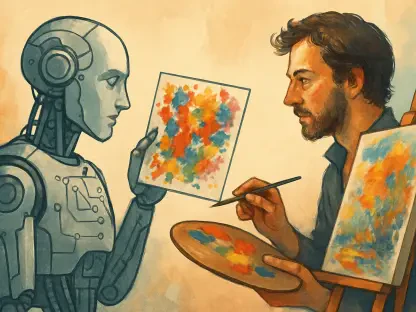
The recent achievements of artificial intelligence in the realm of complex mathematics are nothing short of monumental. Advanced models from technology giants like Google, OpenAI, and DeepSeek have demonstrated the capacity to solve problems that challenge the world’s brightest young mathematicians. Yet, these same powerful neural networks have been documented to “hallucinate,” generating confident but incorrect information, and occasionally failing at basic addition. This creates a fundamental paradox where the more complex a system becomes, the more unpredictable its foundational outputs can be, leaving users to wonder where to place their confidence for routine, mission-critical calculations.
In stark contrast to this brilliant yet erratic performance stands the calculator, a device engineered for a single, non-negotiable purpose: to be correct every single time. It does not learn, guess, or create; it simply executes mathematical operations with absolute precision. This core function is its only promise, and its inability to deviate from that promise is its greatest strength. As one executive from the long-standing calculator manufacturer Casio plainly stated, “calculators always give the correct answer.” This unwavering dependability forms the bedrock of its continued existence.
The Unlikely Showdown Silicon Chips vs Neural Networks
The question of the calculator’s relevance has become particularly urgent due to the rapid acceleration and integration of AI into nearly every professional field. From scientific research and financial modeling to everyday business operations, AI-powered tools are becoming standard, promising efficiency and insight on an unprecedented scale. This widespread adoption forces a direct comparison between the old guard and the new, questioning whether a tool with limited functions can maintain its place in a world increasingly reliant on multifaceted, intelligent systems.
This dynamic highlights the enduring presence of single-purpose devices in a multifunctional world. While a smartphone can perform calculations, browse the web, and manage communications, its very versatility can be a drawback in environments demanding focus and simplicity. The calculator, free from notifications and software updates, offers a streamlined, dedicated user experience. This sets the stage for the central conflict: the calculator’s unwavering reliability and simplicity against the vast but occasionally fallible brilliance of AI and its host devices.
The Calculator’s Two Pillars of Survival
The calculator’s survival hinges on its foundational promise of absolute reliability. Unlike an AI, which operates on probabilities and can produce different outputs based on evolving data, a calculator’s logic is hard-coded. Pressing “2+2” will yield “4” with incontrovertible certainty, a guarantee that is indispensable in professional settings where even minor errors can have significant consequences. This precision stands in direct opposition to the concept of AI “hallucinations,” where a language model might confidently assert a mathematical falsehood. This reliability is why professionals like Thitinan Suntisubpool, a shop owner in Bangkok, continue to depend on her physical calculator. Its durable design withstands daily use, and its clear, unambiguous display serves as a universal language in transactions with customers, preventing misunderstandings where a smartphone screen might be less effective.
Beyond its dependability, the calculator thrives by dominating specific niche markets where its simplicity becomes a superpower. In many developing nations, for instance, a reliable internet connection and consistent electricity are luxuries. An affordable, solar-powered calculator is not just a convenient tool but an essential one for education and commerce, bridging a digital divide that smartphones have yet to close. This has been identified as a key market for manufacturers, who see opportunity where advanced technology is impractical. Similarly, in educational settings, the calculator’s lack of connectivity is a feature, not a flaw. It provides a focused, distraction-free tool that allows students to learn mathematical principles without the interruptions of social media or web browsing. This targeted demand is validated by market data; Casio reported sales of 39 million units in the fiscal year ending in March of last year, a significant rebound from post-pandemic lows and a clear indicator of a stable, if specialized, global market.
Voices from the Frontline Industry Insiders and Academic Experts Weigh In
Even within the industry that champions the calculator, there is a candid acknowledgment of its changing role. Tomoaki Sato, a senior executive at Casio, concedes that the market for personal calculators in business environments is on a “downward trend.” He pragmatically forecasts a future where the device could eventually “go the way of the abacus”—a historically vital tool that became a niche artifact. This perspective suggests a strategy of managed decline, focusing on markets where the calculator’s unique strengths remain paramount.
This view is complemented by Ryohei Saito, a Casio general manager in Thailand, who emphasizes that “not everywhere in the world has smartphone connectivity.” He frames the calculator not as an outdated piece of technology but as an “optimized tool focused on necessary functions.” From this standpoint, its lack of connectivity is a deliberate design choice that makes it superior for specific use cases, rather than a deficiency. It is a tool perfected for an environment where digital infrastructure cannot be taken for granted.
However, the academic world offers a more definitive verdict on the calculator’s long-term fate. Gregor Dolinar, president of the International Mathematical Olympiad, describes the progress of AI in solving complex problems as “fascinating.” He argues that for advanced mathematics, the choice is clear, stating, “it’s easier to just ask AI,” particularly since it can provide step-by-step reasoning for its solutions. His assessment is unequivocal, expressing a firm belief that physical calculators are destined to “slowly disappear.” This prediction is reinforced by a clear generational shift he observes in his own university classroom. Students, he notes, no longer carry physical calculators because “they can calculate everything on a phone,” signaling that for the next generation of professionals, the dedicated calculator is already becoming obsolete.
A Legacy in the Balance A Framework for Understanding the Calculator’s Future
To understand the calculator’s future, it is essential to place it within its historical context. The modern pocket device is the culmination of centuries of innovation, tracing its lineage back to inventions like the 17th-century “La Pascaline” and Casio’s own desk-sized “14-A” relay calculator from 1957. These machines were all part of humanity’s enduring quest for a “substitute for the human mind,” a reliable tool to offload the burden of calculation. Viewed through this lens, the calculator is not a technology on the verge of failure but rather one successful chapter in a much longer story, now making way for its successor.
The longevity of the calculator will ultimately be defined by a strategy of coexistence, anchored by the core virtues that AI and smartphones cannot fully replicate: absolute reliability, extreme affordability, and complete independence from digital infrastructure. These factors will ensure its continued relevance in specific, protected markets for the foreseeable future. Its trajectory is not a sudden freefall into obsolescence but a slow, graceful fade. This decline will be driven not by a market-wide collapse but by the enduring loyalty of niche users who continue to find unparalleled value in its singular, perfect function.
Ultimately, the story of the calculator in the age of AI was never about a simple tool becoming obsolete but about the clarification of its purpose. Its value was not measured in processing power or multifunctionality but in the quiet, absolute certainty it provided with every press of a button. While more advanced technologies pushed the boundaries of what was computationally possible, the calculator held its ground by doing one thing perfectly. Its legacy was therefore secured not as a competitor to AI, but as a testament to the idea that sometimes, the most valuable tool is not the one that can do everything, but the one that can be trusted to do one thing right.