
Laurent Giraid is a distinguished technologist and research pioneer whose work sits at the volatile intersection of machine learning and physical reality. With a career deeply rooted in the evolution of natural language processing and multimodal architectures, Giraid has become a leading voice in the shift toward “Physical AI”—systems that don’t just process text, but understand the Newtonian mechanics of the world we inhabit. Currently focused on the ethics and efficiency of large-scale vision models, he provides a unique bridge between high-level academic research and the pragmatic demands of industrial automation.
The following discussion explores the breakthrough architecture of the Perceptron Mk1, a model that challenges the dominance of industry giants like OpenAI and Google by prioritizing “Efficiency Frontier” economics. Giraid breaks down the technical shifts required to move from static image analysis to true temporal reasoning, the logic behind open-weights edge deployment, and the future of AI that can see, count, and reason in real-time.
High token costs often prevent the large-scale industrial use of video AI. How were you able to achieve a cost structure 80-90% lower than current frontier models, and what specific bottlenecks in the “Efficiency Frontier” did you have to solve to maintain high reasoning scores at those prices?
The disparity in pricing—where we offer $0.15 per million input tokens compared to the $2.00 or $3.00 blended costs of GPT-5 or Gemini 3.1 Pro—comes down to a fundamental redesign of the multimodal recipe. We spent 16 months building from the ground up to move away from the “brute force” scaling that makes frontier models so expensive for video. By targeting the Efficiency Frontier, we optimized the model to sit at a $0.30 blended cost mark while actually outperforming rivals in specialized areas like the RefSpatialBench, where we scored 72.4 against Sonnet 4.5’s 2.2. This wasn’t just about cutting costs; it was about solving the bottleneck of high-resolution spatial reasoning without the massive compute overhead typically required for such precision.
Understanding long-form video requires more than just looking at isolated frames. How does the 32K context window manage temporal continuity during occlusions, and what did your performance on the EgoSchema “Hard Subset” reveal about the model’s ability to infer what happens between the first and last frames?
Most traditional vision-language models treat a video like a slide show, but the Mk1 treats it as a continuous stream at 2 frames per second within a robust 32K token context window. This architecture allows the model to maintain object identity even when a person or item is briefly hidden behind an obstacle, which is a game-changer for surveillance and robotics. Our score of 41.4 on the EgoSchema “Hard Subset” is particularly telling because that specific test is designed to defeat models that only look at the start and end of a clip. Matching a 27B parameter model like Q3.5-27B proves that our system is actually “watching” the middle of the video to understand the narrative arc of the action.
Physical reasoning involves understanding object dynamics, such as reading analog gauges or timing a basketball shot against a buzzer. What technical shifts allow the model to achieve pixel-precise pointing in dense scenes, and how does it differentiate between simple pattern recognition and the actual laws of physics?
We moved beyond simple pattern recognition by training the model to jointly reason over spatial and temporal data, which is how it can judge if a basketball left a shooter’s hand before the shot clock hit zero. This requires a “pixel-precise” pointing capability that allows the model to localize objects and count into the hundreds even in cluttered, dense environments. In our testing, we even saw this extend to reading analog clocks and gauges, tasks that are notoriously difficult for digital-first AI because they require a spatial understanding of angles and movement. It is the difference between a model that knows what a “gauge” looks like and a model that understands the physical state the gauge is reporting.
Specialized SDK functions like “Focus” and “Counting” aim to simplify developer workflows. Could you explain the step-by-step logic behind using in-context learning for these tasks, and how can a developer use just a few examples to automate high-stakes monitoring like PPE detection on a construction site?
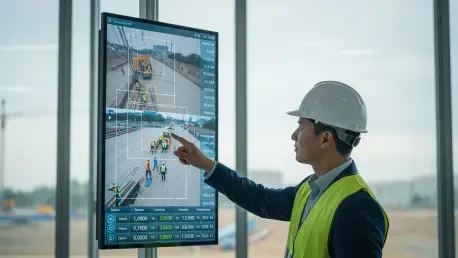
Our Python SDK is built to bridge the gap between complex reasoning and functional deployment through features like “Focus” and “In-Context Learning.” For a construction site, a developer doesn’t need to retrain the whole model; they simply provide a few visual examples—like an image of a safety vest—and the model uses those as reference points to label and monitor every instance in a live feed. The “Focus” function then allows the system to automatically zoom and crop into those specific regions based on a natural language prompt. This logic allows a developer to go from a raw video stream to a structured safety monitoring tool with remarkably few lines of code and minimal training data.
Edge deployments often require sub-200ms latency, which led to the development of the 2-billion parameter Isaac series. Why is it important to offer an open-weights alternative alongside the flagship proprietary API, and how do you balance the trade-offs between cloud-based reasoning and on-premise control?
The decision to release the Isaac series, such as the 0.2-2b-preview, as an open-weights model stems from the reality that many industrial partners cannot rely on the cloud due to latency or security constraints. These 2-billion parameter models are optimized for a sub-200ms time-to-first-token, making them fast enough for real-time edge devices where every millisecond matters. By offering a dual-track strategy—proprietary API for massive reasoning tasks and open-weights for edge control—we give companies the flexibility to keep sensitive data on-premise. We believe that for Physical AI to be ubiquitous, it must be able to run locally on hardware like smart glasses or robotic arms without a constant tether to a central server.
Early-fusion research, such as the work seen in the Chameleon and MoMa papers, laid the groundwork for modern multimodal systems. How did that lineage influence your “multimodal recipe” for physical AI, and what are the primary challenges when training a model to understand cause-and-effect in the real world?
The lineage from the Chameleon and MoMa papers is essential because those projects explored how to efficiently train models on mixed-modal sequences of text and images from the start, rather than just “bolting” vision onto a language model. Our “multimodal recipe” takes that foundation and pushes it into the temporal realm, which is where the real challenge of cause-and-effect lies. Training a model to understand that a specific action—like a worker being suspended by ropes—leads to a specific outcome requires the model to internalize the “why” behind the movement. It’s a jump from identifying objects to identifying the physical consequences of their interactions, which is the hardest hurdle in creating AI that truly understands the physical world.
Manufacturers are currently using these models for real-time quality control on assembly lines. What metrics are you seeing regarding error detection compared to traditional computer vision, and how does the model adapt to atypical visual data, such as grainy historical footage or suspension-style construction methods?
We are seeing a significant shift where our model can detect defects and verify assembly steps in real-time with a level of nuance that traditional computer vision, which often relies on rigid templates, simply cannot match. For instance, our model achieved a score of 88.5 on the VSI-Bench, the highest recorded, which translates to much higher reliability in complex industrial environments. This adaptability was highlighted when we tested it on grainy 1906 archival footage of NYC skyscrapers; the model didn’t just see “construction,” it correctly identified the era and described atypical sights like workers suspended by ropes. This ability to interpret “noisy” or non-standard data means the AI is much more resilient to the unpredictable lighting and angles found on a real-world factory floor.
What is your forecast for physical AI?
I believe we are entering an era where Physical AI will become as ubiquitous and invisible as digital AI is today, moving from experimental labs to the very fabric of our infrastructure. In the coming years, we will see a surge in “multimodal quality control agents” and wearable assistants that don’t just provide information, but understand the physical context of the user’s environment in real-time. As models become more efficient and capable of running on the edge with sub-200ms speeds, the barrier between seeing a problem and solving it will vanish. My forecast is that within this decade, the most powerful AI won’t be the one that writes the best essay, but the one that safely navigates a robot through a crowded hospital or identifies a hairline fracture on a production line before it causes a failure.