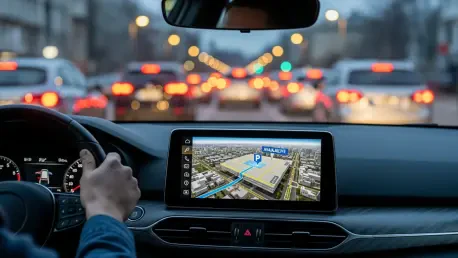

The seemingly endless circling of city blocks in a desperate hunt for an open parking space represents one of the most universal and infuriating aspects of modern urban driving. This daily ritual of frustration not only wastes time but also contributes significantly to traffic and pollution, a problem that conventional navigation systems have long ignored. Researchers at MIT, however, have developed a groundbreaking “parking-aware” navigation system designed to tackle this challenge head-on. Rather than simply guiding drivers to a destination’s doorstep, this intelligent system directs them to the most strategic parking spot by calculating the probability of finding an open space. By fundamentally redefining the endpoint of a journey, this approach promises to create a more realistic and efficient travel experience, integrating the entire process of driving, parking, and walking into a single, cohesive, and optimized plan that could transform how we navigate our cities.
A Fundamental Flaw in Urban Navigation
Current GPS technologies, despite their sophistication in mapping the fastest routes, possess a critical blind spot by completely disregarding the “parking search phase.” This fundamental omission leads to a cascade of negative consequences that extend far beyond minor inconvenience. For the individual driver, it results in unpredictable and often significant delays, as the time spent anxiously hunting for a parking spot can frequently exceed the initial travel time estimate provided by the navigation app. This discrepancy fuels stress and undermines the reliability of trip planning. Furthermore, this flawed time estimation creates a pervasive and misleading perception of convenience, potentially discouraging commuters from considering more efficient and sustainable alternatives like mass transit. When the full “drive and park” duration is accurately accounted for, public transportation might often prove to be the faster and more practical option for urban travel.
The systemic impact of this navigational oversight is even more profound, affecting the entire urban ecosystem. The collective act of thousands of drivers “cruising” for parking at any given moment significantly exacerbates city traffic congestion. These vehicles move slowly and unpredictably, not as part of a directed journey but in a random search for a place to stop, clogging streets and disrupting the natural flow of traffic. This increase in slow-moving vehicles leads directly to a measurable rise in fuel consumption and the emission of harmful pollutants, degrading air quality and contributing to environmental concerns. The problem is self-perpetuating: as more drivers are forced to circle, congestion worsens, which in turn makes the search for parking even more difficult and time-consuming. This vicious cycle highlights a critical need for a navigation paradigm that addresses the journey’s true endpoint: a secure parking space.
Engineering a Smarter Solution
To counteract these deep-seated issues, the MIT research team engineered a sophisticated, probability-aware system that fundamentally alters the objective of navigation. The core of this innovative solution is a methodological shift away from the destination’s address and toward the optimal parking location. This is achieved through a dynamic programming model that meticulously calculates the most efficient plan by balancing a comprehensive set of variables. The algorithm computes the time required to drive to every potential public parking lot within a reasonable distance of the final destination, the time it would then take to walk from each of these lots to that destination, and, most crucially, the real-time probability of successfully securing an available spot at each location. By working backward from a successful parking outcome, the system determines the route with the lowest overall expected travel time, offering a holistic strategy that encompasses the drive, the search, the park, and the final walk.
A significant strength of the MIT framework is its advanced ability to handle uncertainty and plan for real-world contingencies, providing a more robust and resilient navigation strategy. The system is not rigid; it anticipates the very likely possibility of failure, such as a driver arriving at the recommended “ideal” lot only to find it has just filled up. In such a scenario, the model has already factored in the next best steps, accounting for the proximity of alternative lots and their respective success probabilities. As researcher Cameron Hickert explained, the system can determine if it’s a “smarter play” to head toward a dense cluster of nearby lots—which may have slightly lower individual success rates but offer more options—rather than committing to a single, high-probability lot that is more isolated. This multi-layered planning, combined with a multi-agent perspective that models the competitive actions of other drivers, ensures the guidance remains relevant and effective even in a dynamic, unpredictable urban environment.
From Theory to Reality
For a system this intelligent to function in the real world, it requires a steady stream of accurate, real-time data on parking availability—a resource that is notoriously scarce, as most parking garages and street spaces are not equipped with sensors to track vehicle counts. To overcome this critical limitation, the researchers investigated the viability of using crowdsourced data as a powerful and scalable alternative. They proposed several effective methods for gathering this essential information. These include active participation, where users can directly report a lack of parking via a mobile app, as well as passive data collection. For instance, the system could track vehicles that are circling a specific block or monitor how many vehicles enter and then quickly exit a lot, which serves as a strong indicator of no availability. Looking ahead, the researchers envision a future where autonomous vehicles contribute to this data pool automatically, reporting open spots they pass and further enhancing the system’s accuracy and impact.
The efficacy of this parking-aware navigation approach was rigorously tested and validated through extensive simulations that used real-world traffic and parking data from the Seattle metropolitan area. The findings were compelling and demonstrated the potential for massive efficiency gains, particularly in highly congested urban settings, where the MIT system achieved time savings of up to 66 percent. For an individual motorist, this translated to a reduction in total travel time of approximately 35 minutes when compared to the common but inefficient strategy of waiting for a spot to open up in the closest lot. The study also confirmed the feasibility of using crowdsourced data, finding that observations gathered from users would have a low error rate of only about 7 percent when compared to actual parking availability. While not yet a commercial product, this research provided a powerful proof of concept for a more holistic approach to urban mobility, one that promised to empower drivers and create more sustainable cities.