
Laurent Giraid stands at the forefront of the modern AI frontier, navigating the complex intersection of machine learning, natural language processing, and the ethical frameworks that govern them. As organizations increasingly view their proprietary data as their most valuable asset, the pressure to secure the entire lifecycle of an AI model—from ingestion to inference—has never been higher. With the looming shadow of quantum computing threatening to dismantle current cryptographic standards, Giraid’s work focuses on building “quantum-resilient” architectures that protect intellectual property and sensitive datasets. Our discussion today explores the subtle dangers of data manipulation, the technical architecture of hardware-based trust, and the strategic shift toward crypto-agility that will define the next decade of cybersecurity.
Organizations often find that training data can be manipulated in ways that are difficult to detect. How can teams identify these subtle degradations in model output, and what specific steps should be taken during data ingestion to prevent such corruption?
The danger of data poisoning is that it doesn’t usually result in a loud, catastrophic failure, but rather a quiet erosion of the model’s integrity that can go unnoticed for months. When bad actors manipulate training data, they are essentially stitching a “backdoor” into the model’s logic, causing it to fail only under very specific, triggered conditions while appearing perfectly healthy during standard testing. To catch these subtle degradations, teams must move beyond simple accuracy metrics and implement rigorous anomaly detection at the point of data ingestion, ensuring that every piece of information used for training is vetted against a baseline of known-good parameters. We must treat the training pipeline with the same level of scrutiny as a high-security supply chain, implementing hardware-based trust mechanisms that can verify the origin and sanctity of data before it ever touches the neural network. By strengthening controls throughout the entire development lifecycle, organizations can ensure that their models remain reliable witnesses to the data they were intended to represent.
Protecting intellectual property is a major concern when models are extracted or copied. How do hardware keys used for signing models prevent unauthorized duplication, and what does a secure “chain of trust” look like from initial development to final deployment?
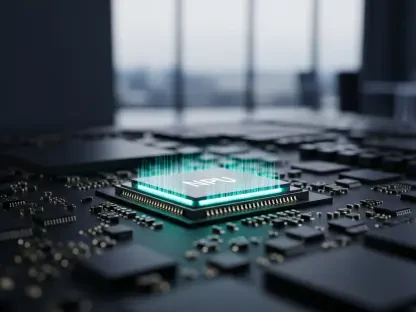
Securing a model’s intellectual property requires more than just a password; it necessitates a physical “root of trust” that follows the model from the lab to the server rack. By using hardware keys to sign models, we can generate and store cryptographic identities inside a secure boundary, ensuring that the model cannot be executed or modified without a verified signature. This creates a rigorous chain of trust where the hardware module verifies that the data enclave is in a trusted state before ever releasing the necessary keys for operation. It feels much like a digital seal on a physical vault; if the seal is broken or the environment is tampered with, the system simply refuses to function. This step-by-step verification ensures that even if a bad actor manages to copy the model file, they lack the hardware-backed “key” required to actually run or extract the underlying logic, effectively neutralizing the threat of IP theft.
Groups are currently collecting encrypted data with the intent to decrypt it once quantum computing matures. Which types of long-term data should be prioritized for protection today, and what metrics determine if a dataset is at high risk for future decryption?
The “harvest now, decrypt later” strategy is one of the most chilling threats we face, as it turns today’s secure archives into tomorrow’s open books. Any dataset with a shelf life of ten years or more—such as financial records, deep intellectual property, or sensitive training data—is currently at extreme risk because capable quantum systems are expected to emerge within that same decade-long window. We determine a dataset’s risk level by looking at its “secrecy lifespan”; if the information remains damaging or valuable beyond the next ten years, it must be shielded with post-quantum protections immediately. It is a race against time where the metrics are not just about the strength of current encryption, but the enduring value of the secrets held within those files. Organizations must accept that current public key cryptography is on a countdown clock, and the only defense is to proactively migrate high-value assets to quantum-resistant standards.
Migration to quantum-resistant cryptography can take years and affect system interoperability. How can a company implement “crypto-agility” to switch algorithms without redesigning its entire infrastructure, and what are the practical trade-offs of using hybrid cryptographic methods?
Crypto-agility is essentially the “plug-and-play” philosophy applied to deep-level security, allowing us to swap out aging algorithms for post-quantum methods without tearing down the entire IT house. The most practical way to achieve this is through hybrid cryptography, which layers established, battle-tested algorithms with new, NIST-suggested quantum-resistant methods to provide a safety net during the transition. The trade-off is often found in performance and system overhead, as running dual encryption processes can lead to slower processing times and increased complexity in key management. However, this hybrid approach is a necessary bridge because it maintains interoperability with older systems while ensuring that data remains protected even if one of the algorithms is compromised. It allows a company to evolve its defenses incrementally, ensuring that the migration doesn’t become a multi-year bottleneck that halts innovation.
Hardware-based enclaves can isolate sensitive workloads even from high-level system administrators. How does external attestation verify that an enclave is in a trusted state before releasing keys, and how do tamper-resistant logs support compliance with emerging international AI regulations?
Hardware-based enclaves create a “black box” environment where data can be processed in total isolation, ensuring that even a system administrator with full privileges cannot peek at the sensitive information inside. External attestation is the process by which a hardware module checks the enclave’s code and configuration against a known-good “gold standard” before it allows any cryptographic keys to be released for use. This creates a transparent yet unbreakable audit trail, producing tamper-resistant logs that record every access and operation without revealing the data itself. These logs are becoming the gold standard for compliance with frameworks like the EU AI Act, as they provide indisputable proof that an AI system was trained and operated within legal and ethical boundaries. It gives regulators the transparency they need while giving organizations the absolute privacy they require to protect their competitive edge.
What is your forecast for AI quantum resilience?
The next decade will see a massive bifurcation between organizations that treat security as a static checklist and those that embrace it as a dynamic, hardware-anchored evolution. I predict that by the time we reach the end of this ten-year window, quantum-resistant cryptography will no longer be an “extra” feature but a mandatory baseline for any AI system handling public or high-value data. We will likely see a significant shift toward hardware-based trust as the primary defense against both traditional hackers and future quantum threats, making isolated enclaves the standard for all sensitive model inference. Ultimately, the survival of an organization’s AI strategy will depend on how quickly they can implement crypto-agility, as those who wait for a functional quantum computer to appear will find themselves holding archives of data that have already been compromised.