
The global race to harness the power of artificial intelligence is creating an unprecedented tidal wave of demand that is propelling the semiconductor industry toward a monumental milestone. The sector is currently on a trajectory to approach a $1 trillion market size by the end of this year, a staggering figure that underscores a profound shift in technological priorities. This exceptional growth is not a gradual evolution but a rapid, AI-supercharged expansion that is fundamentally reshaping the industry’s landscape and presenting historic investment opportunities. A broad, consensus-driven optimism permeates the sector, with official bodies like the World Semiconductor Trade Statistics (WSTS) reporting a robust 22.5% sales increase in 2025 to over $772 billion and forecasting a near-trillion-dollar market of $975 billion for 2026. This transformation is deeply rooted in the build-out of AI-centric infrastructure, a market that itself is projected to swell to $1.2 trillion by 2030, with AI accelerators alone expected to command $900 billion in sales within the same timeframe.
Key Players in the AI-Driven Surge
Nvidia’s Unprecedented Dominance
Nvidia’s position at the apex of the artificial intelligence revolution remains virtually unassailable, cementing its role as the primary engine of the current market expansion. The company’s commanding 94% share of the GPU market makes it an essential partner for nearly every major player in the AI space, from hyperscale cloud providers building out massive data centers to enterprises deploying sophisticated inference systems. Its technology serves as the foundational bedrock for training the large language models (LLMs) that have captured the public imagination and for the subsequent deployment of these models in real-world applications. This pivotal role has generated extreme optimism among market analysts, leading to a significant upward revision of financial forecasts. Projections for the company’s Data Center segment revenue for the first quarter of 2026 have nearly doubled from earlier estimates, reflecting a voracious and seemingly insatiable demand for its high-performance accelerators, a trend that shows no signs of abating.
The sheer scale of Nvidia’s influence extends far beyond mere market share figures; it is woven into the very fabric of the AI ecosystem’s future growth. The projected expansion of the data center market to $1.2 trillion by 2030 is directly correlated with the deployment of advanced computing hardware, a domain where Nvidia’s solutions are the current gold standard. The demand is not monolithic but bifurcated into two critical areas: the initial, compute-intensive training of massive AI models and the less intensive but far more widespread task of inference, where trained models generate outputs. Nvidia has strategically positioned its product stack to dominate both segments, ensuring its continued relevance as the industry matures. This strategic positioning has prompted some Wall Street analysts to issue forecasts that far exceed official industry projections, with some predicting a potential 30% revenue increase for the broader sector, driven almost entirely by the momentum created by the demand for AI-specific hardware that Nvidia so effectively supplies.
Lam Research and the Supply Chain Ripple Effect
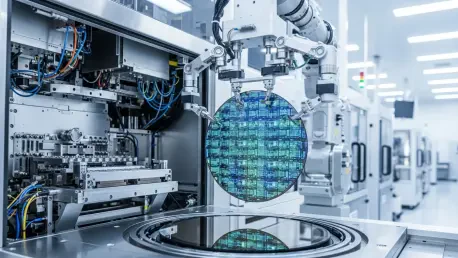
While direct beneficiaries like Nvidia capture headlines, the AI-driven boom is creating powerful ripple effects throughout the semiconductor supply chain, significantly benefiting equipment manufacturers such as Lam Research. The company operates as a critical “picks-and-shovels” player, providing the essential machinery required to fabricate the advanced chips that power AI systems. Its recent success is inextricably linked to the soaring demand for high-bandwidth memory (HBM), a specialized type of DRAM that is a crucial component in modern AI accelerators due to its ability to provide the massive data throughput these processors require. As demand for AI chips has surged, so has the need for HBM, creating a lucrative market for Lam’s manufacturing equipment. This direct correlation has fueled a remarkable 138.5% surge in the company’s stock this year alone, illustrating the profound financial impact of occupying a strategic position within the AI hardware supply chain and capitalizing on the industry’s foundational needs.
The growth trajectory for Lam Research is further secured by persistent and systemic bottlenecks in the memory market, particularly the ongoing shortage of HBM. This supply-demand imbalance is not expected to resolve quickly, with industry experts forecasting that shortages will likely persist well into 2027. This sustained pressure is forcing memory chip makers to undertake significant capital expenditure to expand their production capacity. Micron, for example, recently boosted its fiscal 2026 budget to an impressive $20 billion, a substantial portion of which is earmarked for new HBM fabrication lines. Such massive investments translate directly into a robust and predictable order backlog for Lam’s specialized deposition and etch equipment. This dynamic ensures a strong revenue stream for the company for the foreseeable future, as it stands to benefit directly from the capital-intensive efforts of the entire memory industry to catch up with the relentless pace of AI-driven demand, insulating it from the fortunes of any single chip designer.
Market Outlook and Investment Considerations
Analyzing the Financial Landscape
The financial underpinnings of the semiconductor sector appear exceptionally strong, with multiple indicators pointing toward sustained and vigorous growth. The official forecast from the World Semiconductor Trade Statistics (WSTS), which projects the market will reach $975 billion in 2026 after a solid 22.5% increase in 2025, provides a conservative baseline for this optimism. However, this bullish sentiment is amplified on Wall Street, where some analysts, such as Vivek Arya of Bank of America, are championing an even more aggressive outlook. These more optimistic models suggest a potential 30% revenue increase, a figure that would handily surpass the official industry estimates. This divergence highlights a powerful consensus that the AI revolution is not just a temporary surge but a long-term structural shift that will continue to fuel demand for advanced silicon. The sector’s financial health is further validated by a recent 5.3% upward revision in the Zacks Consensus Estimate for sector-wide earnings, signaling that corporate profitability is keeping pace with the rapid revenue expansion.
Navigating Future Growth and Potential Hurdles
The investigation into the semiconductor market revealed a landscape ripe with opportunity, particularly for companies strategically aligned with the core drivers of AI hardware and advanced memory manufacturing. The financial momentum, underscored by rising earnings estimates and aggressive capital expenditure cycles, pointed toward a period of sustained long-term growth. However, this promising outlook was not without its complexities. The analysis concluded that investors had to remain acutely aware of potential headwinds that could temper the industry’s upward trajectory. Key among these considerations were the increasingly high valuation levels of market leaders, which could introduce volatility, and the looming possibility of industry-wide capacity constraints that could throttle the pace of expansion. Ultimately, navigating this environment required a balanced perspective that acknowledged the transformative power of AI while remaining grounded in a careful assessment of market fundamentals and potential supply chain bottlenecks.