
A highly unusual software development maneuver within Sony’s PlayStation division has ignited speculation that the company’s long-term strategy extends far beyond the current generation of home consoles. Whispers emerging from developer circles suggest a deliberate and methodical effort is underway, not just to refine the PlayStation 5 experience, but to lay the very foundation for its successor—a device that may break from tradition and fit in the palm of your hand. This isn’t about a simple peripheral or a cloud-streaming device, but a fundamental shift in design philosophy, hidden in plain sight within the code that powers every PS5 game. The evidence points toward a long-term vision where the future of PlayStation is both powerful and portable, with the groundwork being strategically established years ahead of any official announcement.
A Strategic Shift in Development Philosophy
The Enigmatic SDK Update
At the heart of this speculation lies a move that is almost unheard of in the world of software engineering: a significant rollback of the PS5’s software development kit (SDK) version number. According to sources familiar with the matter, the SDK version was recently reverted from 12.0 back to 1.0. Typically, such a drastic change signals a major, often disruptive, overhaul of the development environment. In this case, the alleged reason is as strategic as it is surprising. This reset was reportedly implemented to enforce universal support for the console’s Power Saver Mode across the entire PS5 software library. This mandate compels developers to ensure their games, including older titles, can operate efficiently within a much lower power state. This effort is apparently being prioritized even over preparations for the rumored PS5 Pro, indicating its paramount importance to Sony’s long-range plans. Such a resource-intensive and developer-focused initiative suggests a goal far more ambitious than simply improving the energy efficiency of the current home console, pointing toward an application where low-power performance is not just a feature, but a core requirement.
Laying the Foundation for Portability
This intense focus on low-power operation is being interpreted by industry observers as a “trojan horse” strategy for a future PlayStation handheld. By ensuring that every game in the PS5’s extensive and growing library is optimized to run on constrained power, Sony is methodically curating a massive, backwards-compatible launch library for a portable device. This approach would solve one of the most significant challenges that has plagued new hardware launches, including Sony’s own PlayStation Vitthe lack of a compelling software lineup at release. Instead of starting from scratch, a hypothetical PS6 handheld could theoretically launch with immediate access to hundreds of established PS5 titles, all pre-certified to perform well within a mobile power envelope. This forward-thinking strategy demonstrates a learned approach, leveraging the success and ecosystem of the current console generation to de-risk and bolster the launch of the next. It transforms a simple energy-saving feature on the PS5 into a critical building block for the company’s next major hardware venture, ensuring its future portable ecosystem is born with a mature and robust library of games from day one.
Whispers of Future Hardware
Clues from Developer Documentation
Further lending credence to the handheld theory are specific details reportedly found within Sony’s developer documentation. These internal documents are said to contain explicit references that guide developers toward building games compatible with less powerful hardware. One key piece of information notes that “new low-power operation modes may be supported in the future,” directly signaling that the current Power Saver Mode is just the beginning of a larger initiative. An even more telling directive allegedly states that games “should be runnable on only 8-Threads.” This is a crucial detail, as the PS5’s Zen 2 CPU utilizes 16 threads. A target of 8 threads strongly implies that future hardware is being designed with a less complex, more power-efficient processor, a profile that perfectly matches the constraints of a portable gaming device. This guidance effectively forces developers to create games that are scalable down to a hardware specification that does not yet publicly exist, embedding forward compatibility directly into the current development pipeline and providing a tangible link between today’s software and tomorrow’s unannounced hardware.
Project Canis and Its Potential
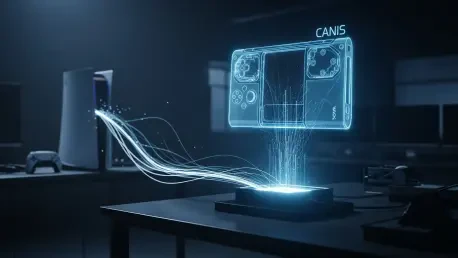
The hardware at the center of these rumors has been given a codename: “Canis.” According to the leaks, this device is being designed as a true next-generation portable console, not merely a streaming accessory. The purported specifications outline a custom AMD system-on-a-chip featuring a CPU with 4 Zen 6c cores and a powerful RDNA 5 GPU architecture with 12 to 20 compute units. This would be complemented by 16 GB of LPDDR5X RAM, a substantial amount for a handheld, all while operating within a tight 15-watt power envelope, which is standard for high-performance portable devices. The performance targets are particularly intriguing. The device is said to aim for half of the PS5’s raw rasterization power but is expected to feature significantly stronger ray tracing capabilities. This suggests a highly advanced and efficient architecture, one that prioritizes modern rendering techniques over brute-force performance. Such a design would allow the handheld to deliver visually stunning, next-generation experiences that could rival its home console counterpart in visual fidelity, all within the strict thermal and power limitations of a portable form factor.
A Glimpse into Sony’s Next Chapter
Ultimately, the confluence of a baffling SDK rollback, explicit developer directives, and detailed hardware rumors painted a compelling picture of a company meticulously planning its next evolutionary step. The evidence suggested that the emphasis on the PS5’s low-power mode was never just about energy conservation; it was a foundational move to ensure a vast library of games was ready for a different kind of future. The strategy appeared to be a deliberate, long-term investment in creating a seamless ecosystem that could bridge the gap between the living room and the world outside. If these whispers held true, the groundwork for the PlayStation 6 era was not being laid in public-facing tech demos, but in the subtle lines of code and confidential developer documents that defined the generation before it. The narrative that unfolded was one of strategic foresight, where the future of PlayStation gaming had been quietly prepared to leave the television behind.