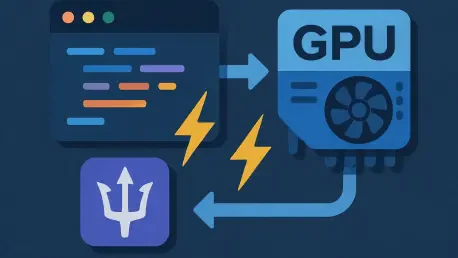

The relentless pursuit of computational efficiency in the era of generative artificial intelligence has pushed silicon design to unprecedented heights, yet the software tools required to harness this power often lag behind the physical capabilities of the chips themselves. Machine learning engineers are increasingly tasked with profiling and optimizing the most intensive kernels in their models, requiring tools that balance high performance with Python-based productivity. As the gap between peak theoretical performance and actual model throughput continues to widen, the industry has reached a critical juncture where traditional programming abstractions no longer suffice. Meta’s introduction of Triton Low-Level Extensions (TLX) marks a pivotal strategic shift in this landscape, providing a specialized framework that offers explicit control over hardware primitives while maintaining the high-level accessibility associated with the Pythonic Triton ecosystem. This development signifies a move toward a more nuanced orchestration of hardware resources, ensuring that the latest architectural advancements from major chip manufacturers are fully leveraged in production environments.
Shifting Paradigms: The Evolution of Graphics Processing Unit Programming Models
The transition toward utilizing Triton at scale within Meta’s infrastructure has been driven by a pressing need for more accessible kernel optimization techniques. Historical data indicates a clear trend: within a standard twelve-month window starting in 2026, the volume of Triton kernels deployed in production environments has increased significantly, far outstripping the growth of traditional CUDA-based kernels. This rapid adoption suggests that the responsibility for performance tuning is no longer confined to a small group of low-level GPU specialists. Instead, machine learning engineers are now empowered to use these higher-level tools to optimize the most computationally demanding segments of their models. This democratization of performance engineering allows for faster iteration cycles and more responsive adjustments to evolving model architectures, which is essential in a fast-paced research environment where every millisecond of latency counts toward the bottom line.
Despite the widespread success of the original Triton model, the rapid pace of hardware evolution eventually began to outstrip the capabilities of existing programming abstractions. Traditional models typically rely on either Single Instruction, Multiple Threads (SIMT), which offers granular control at the cost of extreme complexity, or Single Instruction, Multiple Blocks (SIMB), which automates memory management while sometimes obscuring hardware-specific features. The introduction of cutting-edge architectures, such as NVIDIA’s Hopper and Blackwell chips, created a scenario where neither model was perfectly suited to manage advanced features like warp groups and clusters. This disconnect necessitated a more flexible approach that could bridge the gap between high-level ease of use and low-level performance tuning. TLX was conceived as the answer to this technical debt, offering a way to exploit the newest hardware features without forcing developers back into the painstaking manual management required by older paradigms.
Navigating the Missing Middle: The MIMW Approach
The concept of the “missing middle” identifies a specific layer of orchestration that exists between the fine-grained control of individual threads and the coarse-grained operations of entire data blocks. In the current landscape, maximizing performance is increasingly dependent on how effectively different execution agents are coordinated rather than solely on raw floating-point speed. For instance, a high-performance kernel might require one specific group of warps to manage data movement while another group simultaneously executes complex calculations on the GPU’s tensor cores. Standard abstractions often fail to represent these parallel roles efficiently, leading to suboptimal hardware utilization. By targeting this middle layer, TLX provides the necessary tools to orchestrate these diverse tasks, ensuring that all parts of the streaming multiprocessor are working in harmony rather than waiting on one another for resources or synchronization.
To address these orchestration challenges, TLX introduces the Multiple Instructions, Multiple Warps (MIMW) model as a foundational execution framework. This model elevates the warp group to a primary execution agent, allowing programmers to define how these groups communicate and synchronize with a level of precision previously unavailable in high-level languages. This approach closely mirrors the physical design of modern hardware, where asynchronous data movement units and specialized compute cores are intended to operate in parallel within a single multiprocessor. By shifting the focus from individual threads to coordinated groups, MIMW simplifies the mental model required for developers while providing the performance benefits of asynchronous execution. This structural alignment with modern hardware ensures that as chips become more specialized, the software used to program them can naturally adapt to these changes without requiring a complete rewrite of the underlying logic.
Specialized Control: Advanced Warp-Group Orchestration
One of the primary technical pillars of TLX is its ability to assign explicit, specialized roles to different warp groups within a single kernel. In the standard Triton environment, code is generally executed as a single synchronous flow, which frequently results in hardware components sitting idle while they wait for data to be fetched from global memory. TLX disrupts this bottleneck by enabling a “producer-consumer” architecture. In this setup, specific warps are designated to handle data ingress and egress, acting as the producers, while other warps focus exclusively on heavy mathematical operations, acting as the consumers. This role-based division of labor ensures that the compute-heavy portions of the hardware are never starved for data, as the producer warps always work ahead of the current calculation to prepare the next set of values.
This sophisticated level of separation enables the implementation of deep software pipelining, which is critical for maintaining high utilization rates in modern generative AI models. By fetching the next data tile from memory while the current tile is still being processed by the Tensor Cores, TLX kernels can effectively hide memory latency. This orchestration is particularly vital for models that rely on massive data transfers, where the time spent moving data can often exceed the time spent on actual computation. The ability to manage these concurrent streams of work within a Python-based framework allows engineers to achieve performance levels that were previously only attainable through thousands of lines of complex CUDA code. Consequently, TLX provides a more sustainable path for scaling high-performance kernels across diverse workloads without sacrificing the readability or maintainability of the codebase.
Efficient Pipelining: Hardware-Native Synchronization Primitives
The effectiveness of any parallel execution model depends heavily on how it manages synchronization between different agents. TLX advances beyond traditional thread-level barriers by exposing hardware-native primitives such as memory barriers, or mbarriers. These lightweight, hardware-accelerated synchronization objects allow various warp groups to signal each other efficiently without stalling the entire processor. In older models, synchronization often acted as a global pause button, forcing all threads to wait for the slowest one to finish. In contrast, mbarriers facilitate a much more fluid and asynchronous exchange of signals. This fine-grained control is a prerequisite for effective software pipelining, as it allows different stages of a computation to hand off data buffers as soon as they are ready, rather than waiting for a predefined global checkpoint.
By utilizing these specialized primitives, developers can manage asynchronous data transfers with significantly lower overhead. When a producer warp group initiates a large-scale memory load, it can signal a specific barrier upon the completion of the transaction, which allows the consumer group to begin its mathematical operations immediately. This reduction in latency is particularly noticeable when synchronizing across large clusters of processors. By avoiding the common pitfalls of thread-level stalls, TLX ensures that the GPU remains in a state of constant activity. This approach not only improves the overall throughput of individual kernels but also contributes to more predictable performance profiles, which are essential for large-scale training runs where a single slow kernel can delay the entire distributed system.
Streamlining Data: Memory Orchestration and Layout Management
Memory orchestration and layout management are essential for optimizing data processing efficiency and ensuring seamless system performance across complex computational environments.
Direct access to specialized memory features is a significant advantage provided by TLX, particularly for the latest-generation hardware features like the Tensor Memory Accelerator (TMA) and specialized Tensor Memory (TMEM). These features are designed to facilitate multidimensional data transfers and high-speed communication between execution groups without requiring constant intervention from processing threads. TLX provides a standardized way to overlap these memory movements with active computation, ensuring that the data pipeline is always full. By offloading the management of memory movement to dedicated hardware units, compute cores are freed up to focus on the matrix multiplications that drive AI model performance. This synergy between software abstraction and hardware capability is what enables the significant speedups seen in modern production workloads.
Furthermore, TLX addresses the notoriously difficult task of managing data layouts and memory swizzling, which often serves as a barrier to entry for high-performance GPU programming. In traditional low-level environments, developers must manually map data to memory addresses to avoid bank conflicts and ensure maximum bandwidth utilization. This process is error-prone and often requires significant trial and error. TLX mitigates this complexity by inferring sensible defaults and managing the underlying layouts automatically based on the hardware in use. This productivity-first approach enables engineers to implement complex techniques like kernel fusion, where multiple logical operations are combined into a single hardware pass to save memory bandwidth. By simplifying the structural requirements of the code, TLX allows developers to focus on the algorithmic logic of their models rather than the minutiae of memory addressing.
Production Success: Accelerating Generative Advertising Models
A compelling real-world application of TLX occurred during the optimization of Meta’s Generative Ads Model (GEM), which faced significant challenges due to its heterogeneous module types and varied input shapes. These structural characteristics often result in poor hardware utilization when using standard configurations, as the varied data shapes do not always align perfectly with the GPU’s preferred tile sizes. By deploying TLX on NVIDIA Blackwell hardware, Meta engineers achieved substantially higher Model FLOPs Utilization (MFU) than was previously possible. This improvement was not merely incremental; it represented a fundamental shift in how the model interacted with the underlying silicon, allowing for more complex generative tasks to be performed within the same power and time constraints.
The success of the GEM project was further enhanced by the integration of an AI-assisted framework known as the Agent for Compute Efficiency (ACE). This system automates the profiling and tuning of TLX kernels, identifying the most efficient warp configurations and memory layouts without requiring constant human intervention. The combination of TLX’s precise control and ACE’s automated optimization allowed for the creation of generalized attention kernels that unified several disparate mechanisms into a single, high-efficiency operation. This resulted in a twofold speedup in forward-pass performance, demonstrating that when high-level extensions are paired with intelligent tuning tools, the results can far exceed what manual optimization alone could achieve. This case study serves as a blueprint for how large-scale AI models can be tuned for maximum efficiency on the latest hardware.
Efficiency at Scale: Optimizing Recommendation Systems
Recommendation systems present a unique set of computational challenges, particularly regarding the replication of user features to match thousands of candidate items. In traditional architectures, this replication process often consumes massive amounts of memory bandwidth, as identical data is copied repeatedly to align with the candidate list. TLX enables a groundbreaking solution known as In-Kernel Broadcast Optimization (IKBO), which fundamentally changes how this data is processed. Instead of replicating data in memory before computation begins, the TLX kernel is designed to consume user and candidate data at their original sizes. The broadcast operation is then performed implicitly during the calculation phase, utilizing the specialized orchestration capabilities of warp groups to manage mismatched data shapes on the fly.
By implementing a warp-specialized mega-kernel, TLX enables a constant and balanced data flow through the use of ping-pong scheduling techniques. On contemporary H100 hardware, this approach delivered a fourfold speedup for linear compression kernels, which are essential for processing the vast amounts of data used in modern ranking systems. Furthermore, the optimization reduced latency for compute-intensive models by up to two-thirds, a critical improvement for real-time recommendation engines where user experience is directly tied to response speed. This success in a production environment highlights the practical utility of TLX for solving specific, high-impact bottlenecks that occur at the intersection of data management and compute efficiency. It demonstrates that the most significant gains in performance often come from rethinking how data moves through the system rather than simply increasing raw processing power.
Robust Foundation: Impact on Large Language Model Training
In the domain of Large Language Model (LLM) pretraining, TLX has become an essential tool for managing the immense complexity of Mixture-of-Experts (MoE) architectures. These models require highly specialized matrix multiplication operations where computation and inter-node communication must be seamlessly integrated to prevent the network from becoming a bottleneck. TLX provides the necessary stability and performance to sustain these massive training runs over several weeks of continuous operation. In such environments, the cost of a kernel failure or a performance regression is magnified across thousands of GPUs, making the reliability of the programming tool as important as its peak speed. The ability of TLX to deliver consistent performance under these rigorous conditions has made it a cornerstone of the pretraining infrastructure.
The integration of TLX with the broader Triton ecosystem ensures that these high-performance kernels remain maintainable over the long term. As model architectures continue to evolve, developers can update their kernel logic within a familiar Python-based environment rather than having to rewrite thousands of lines of brittle, low-level code. This balance of performance and flexibility is vital for maintaining the momentum of research and development, as it allows for the rapid testing of new ideas without a corresponding increase in engineering overhead. By providing a stable foundation for the most demanding AI workloads, TLX helps ensure that the software stack remains a facilitator of innovation rather than a constraint. This strategic alignment between high-level ease of use and low-level execution precision allows for the sustained growth of large-scale AI capabilities.
Co-Design Principles: Strategic Lessons in Compiler Design
The development and subsequent deployment of TLX have yielded several overarching insights into the future of hardware-software co-design. Meta’s approach highlights the importance of workload-driven development, where new features and extensions are added specifically to solve production pain points rather than for purely academic interest. This philosophy ensures that the compiler remains grounded in practical utility, focusing on the optimizations that will have the greatest impact on real-world AI applications. By prioritizing the needs of production models, the development team has created a tool that is both powerful and highly relevant to the current challenges faced by the industry. This focus on utility over theoretical perfection has been a key driver in the rapid adoption of TLX across various engineering teams.
Another critical lesson learned through this process is the significant multiplier effect of developer productivity. Meta has consistently rejected the notion that hardware performance and ease of use are mutually exclusive. The primary goal of TLX was to provide the vast majority of CUDA’s peak performance while requiring only a small fraction of the traditional development effort. By building TLX as an extension of an existing, popular language like Triton, Meta successfully lowered the barrier to entry and leveraged an established community of developers. This strategy allowed for a faster rollout and a more collaborative approach to performance tuning, as engineers from different backgrounds could contribute to the optimization process. This move toward more accessible high-performance tools is a trend that is likely to define the next era of infrastructure development.
Moving Forward: The Future Roadmap for TLX
Looking toward the near future, the roadmap for TLX includes an expansion of support to a broader range of hardware, including Meta’s custom accelerators like the Meta Training and Inference Accelerator (MTIA). Because the underlying MIMW model is conceptually hardware-agnostic, it serves as a versatile candidate for a variety of upcoming chips beyond those produced by NVIDIA and AMD. This expansion will be critical for ensuring that Meta’s internal software stack remains portable and resilient as the hardware market becomes increasingly fragmented with specialized AI silicon. By maintaining a consistent programming model across different vendors, engineers can focus on refining their algorithms rather than worrying about the specific quirks of each new piece of hardware that enters the data center.
Future iterations of the framework are expected to include advanced features like “Auto-TLX,” a system where the compiler automatically determines the optimal warp-group orchestration and synchronization patterns without requiring manual intervention from the developer. This would represent the ultimate realization of the productivity-performance balance, where the system handles the complexities of hardware utilization while the user provides only high-level intent. Ultimately, the goal is to integrate these low-level extensions deeply into the PyTorch ecosystem, allowing standard model code to be automatically optimized for the latest GPU features. This integration would bring the benefits of hardware-native performance to every user, regardless of expertise in GPU programming. To stay ahead of these developments, organizations should prioritize the adoption of modular software stacks that can easily integrate these evolving compiler technologies, ensuring their infrastructure remains ready for the next generation of AI performance demands.