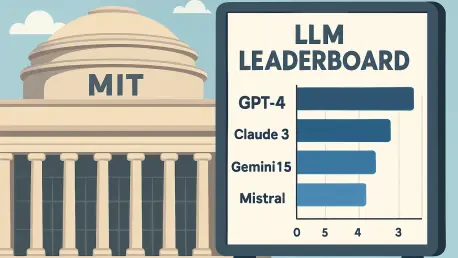

With hundreds of large language models now available, companies are turning to leaderboards that rank them based on user feedback to make crucial, often costly, decisions. We’re joined today by Laurent Giraid, a technologist with deep expertise in AI and machine learning, to discuss a startling discovery: these rankings can be alarmingly fragile. We’ll explore why a handful of votes can completely alter a leaderboard, a new method for identifying these influential data points, and what it will take to build more reliable evaluation systems that businesses can actually trust.
Many firms use LLM ranking platforms to select models for business tasks. Considering that a few user votes can skew these rankings, what is a better evaluation process for a company, and how can they avoid the costly mistake of deploying a sub-optimal model?
It’s a critical issue that I think many organizations are just now waking up to. The allure of a simple, ranked list is powerful, but it can be incredibly misleading. A company shouldn’t just pick the number one model and run with it. A truly robust evaluation process must be multi-faceted and tailored. It starts with an internal benchmark using your own specific data—summarizing your sales reports, triaging your customer inquiries. You need to see how the model performs in your own ecosystem, not just on generic prompts. This avoids the devastating moment when you realize the “top-ranked” LLM you’ve invested in doesn’t actually generalize to the tasks you hired it for, a mistake that can set a project back months and cost a small fortune.
Some LLM leaderboards can change their top-ranked model after removing as few as two votes out of tens of thousands. What makes these systems so fragile, and how much of this sensitivity is due to simple user error versus truly influential outlier prompts?
Honestly, the degree of fragility was a genuine surprise. When we see a system with over 57,000 data points, our intuition is that it should be stable. But to find that removing just two votes—a minuscule 0.0035 percent of the data—can flip the top-ranked model is a powerful wake-up call. This sensitivity comes from the way the data is aggregated. When you look closely at those two influential votes, you often find signs of simple human error. Perhaps the user just mis-clicked, or maybe they weren’t paying close attention. It’s impossible to know their exact state of mind, but the larger point is that you don’t want a system where a single moment of inattention or a uniquely strange prompt can dictate which multi-million-dollar model an entire company decides to deploy.
An efficient method now exists to identify the specific votes that skew LLM rankings. Could you walk us through how this technique works in practice and explain how platform operators could apply it to check the robustness of a given leaderboard?
The beauty of this method is in its efficiency. Manually checking the impact of dropping data is computationally impossible. For a dataset with 57,000 votes, testing the removal of every possible subset of even just 57 votes would take longer than the age of the universe. Instead, this technique uses a sophisticated approximation to pinpoint the most influential data points without that exhaustive process. For a platform operator, it’s like a diagnostic tool. They run the method on their leaderboard data, and it spits out a list of the most problematic votes. The operator doesn’t even have to trust the underlying theory; they can simply remove those identified votes, recalculate the rankings, and see for themselves if the outcome changes. It’s a direct, practical way to perform a stress test and measure just how stable—or fragile—their leaderboard really is.
To improve ranking robustness, suggestions include gathering more detailed user feedback like confidence levels or using human mediators. What are the trade-offs of these approaches, and which do you believe offers the most practical path forward for building more reliable platforms?
Both approaches have their merits and their costs. Gathering more detailed feedback, like asking a user to rate their confidence in their choice, is a fantastic idea. It provides a much richer signal than a simple A/B vote and could help the system automatically down-weight uncertain or low-effort responses. The trade-off is user friction; it takes more time and could reduce participation. On the other hand, using human mediators to review crowdsourced votes adds a layer of quality control, which we saw in a more robust platform that required removing over 3% of its data to flip the rankings. The downside there is obvious: it’s expensive and doesn’t scale easily. For a practical path forward, I lean toward a hybrid model. Start by gathering richer feedback automatically, and then use that data to flag the most contentious or low-confidence matchups for expert human review.
A user likely expects a top-ranked LLM to perform best on their own specific tasks. How does the fragility of current ranking systems impact this expectation of generalization, and what are the downstream consequences for an organization that relies on a “top” model?
This is the core of the problem. A user sees a model ranked number one and naturally assumes it will generalize—that it will be the best for their unique application. The fragility of these rankings shatters that assumption. If the top spot is determined by a few outlier votes, it tells you that the ranking might not hold beyond the very narrow, specific context of those few prompts. The downstream consequences for an organization can be severe. They might spend months integrating a model into their workflow, only to find its performance is inconsistent or outright poor on their real-world data. It leads to a loss of trust in the technology, wasted engineering resources, and a significant delay in achieving their business goals. It turns an exciting AI implementation into a frustrating and costly dead end.
What is your forecast for LLM evaluation and ranking?
I foresee a significant shift away from a single, universal “best” model leaderboard. The future of evaluation will be much more specialized and context-aware. We’ll see the rise of industry-specific benchmarks—rankings for models in finance, healthcare, or legal services, using domain-specific data and expert evaluators. I also believe platforms will become more transparent, not just showing a final rank but also providing robustness scores that indicate how sensitive that ranking is to small data changes. Ultimately, the community will mature beyond this “horse race” mentality and embrace a more nuanced, scientific approach where the goal isn’t just to find the number one model, but to find the right model for the right job, with data to back it up.