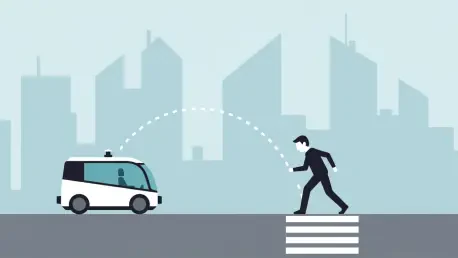

The subtle, almost imperceptible hesitation of a pedestrian at a crosswalk can mean the difference between a smooth commute and a life-altering accident, a complex human cue that has long eluded artificial intelligence. For years, the promise of fully autonomous vehicles has been tempered by their struggle to navigate the chaotic and unpredictable world of human behavior. Now, a groundbreaking development from researchers at Texas A&M University and the Korea Advanced Institute of Science and Technology marks a significant leap forward. They have engineered an AI named OmniPredict, a system that moves beyond simple reaction to achieve a more profound goal: anticipating human intent before it translates into action. This shift from reactive to predictive intelligence represents a crucial step toward creating autonomous systems that are not only safer and more efficient but also more intuitive in their interactions with the world around them.
What if a Car Knew Your Next Move Before You Made It
The ultimate goal for autonomous systems is to integrate seamlessly into human environments, a task that requires more than just advanced sensors and mapping technology. It demands a level of social intelligence, an ability to read the unwritten rules of the road that human drivers learn through experience. An autonomous vehicle that possesses an almost human-like intuition could preemptively slow down for a distracted pedestrian likely to step off the curb or confidently proceed when it recognizes a person has no intention of crossing. This predictive capability promises to resolve the awkward and sometimes dangerous indecision that characterizes many current human-robot interactions.
This vision of an intuitive machine fundamentally alters the dynamic between humans and technology. Instead of people having to adapt to the rigid logic of a machine, the machine learns to adapt to the fluid, often irrational, nature of human decision-making. A car that can anticipate intent becomes more than a tool for transportation; it becomes a cooperative partner in navigating shared spaces. Achieving this level of understanding is the key to unlocking the full potential of autonomous mobility, transforming our streets into safer, more efficient, and more harmonious environments for everyone.
The Shortcomings of Reactive AI Why Self Driving Cars Still Hesitate
Current self-driving systems primarily operate on a reactive model. They are trained on immense datasets of labeled images and videos, learning to recognize objects like pedestrians, cyclists, and other vehicles and to react to their movements according to a predefined set of rules. While this approach has proven effective in controlled situations, it reveals its limitations in the real world. These systems excel at responding to events that match their training data, but they falter when confronted with novel or ambiguous scenarios. A person gesturing in an unusual way, a child chasing a ball toward the street, or a group of people behaving erratically can confuse a reactive AI, forcing it into a state of extreme caution.
This reliance on historical data is precisely why autonomous vehicles often exhibit a characteristic hesitation. Programmed with a primary directive to avoid collisions at all costs, the AI defaults to the safest possible action when faced with uncertainty: it stops. This over-cautiousness, while safe, leads to the jerky, unnatural driving behavior that can frustrate human drivers and disrupt the flow of traffic. These “tense standoffs” at intersections and crosswalks are not just a matter of inconvenience; they erode public trust and highlight the gap that still exists between artificial perception and genuine human understanding.
Inside OmniPredict How an AI Learns to Predict Human Intent
OmniPredict represents a paradigm shift by moving beyond simple object recognition to a more sophisticated form of behavioral reasoning. At its core is a Multimodal Large Language Model (MLLM), a sophisticated architecture powered by GPT-4o technology. This is the first time such a model has been applied specifically to the complex challenge of predicting pedestrian behavior. The term “multimodal” is key; the AI processes and synthesizes multiple streams of information simultaneously to build a rich, contextual picture of its surroundings. It analyzes wide-angle scene images for general context, zoomed-in views to observe a pedestrian’s posture and expression, bounding boxes to pinpoint their exact location, and vehicle speed data to understand the dynamic relationship between car and person.
By integrating these diverse inputs, OmniPredict achieves a holistic understanding that is greater than the sum of its parts. It then uses this comprehensive analysis to forecast likely outcomes across four critical categories. The system assesses a pedestrian’s intent to cross the road, calculates the probability of them becoming temporarily hidden from view (occlusion), identifies specific actions like waving or stopping, and even determines their direction of gaze. This nuanced interpretation allows the system to move from asking “What is the person doing?” to answering the far more critical question: “What is the person about to do?”
Shockingly Good The Breakthrough Performance of a New Predictive Model
The empirical results of OmniPredict’s performance have validated its innovative approach in a resounding fashion. When tested against two of the most challenging public datasets for pedestrian behavior analysis, JAAD and WiDEVIEW, the system delivered what its creators described as “shockingly good” results. Without any specialized pre-training on these specific datasets, OmniPredict achieved an impressive 67% accuracy in its predictions. This figure is not just a marginal improvement; it represents a 10% leap over the most advanced existing models, setting a new benchmark for the field.
Beyond its raw accuracy, the system demonstrated superior capabilities in areas critical for real-world deployment. OmniPredict proved to be faster and more robust, maintaining its high performance even in complex scenarios, such as when pedestrians were partially obscured from view or when they were looking directly at the vehicle—situations that can often confuse traditional models. Furthermore, its ability to generalize its knowledge across a wide variety of road contexts without additional training showcased a more flexible and adaptable form of intelligence. These qualitative advantages, combined with its statistical dominance, signal a major breakthrough in the quest for truly intelligent autonomous systems.
From Seeing to Understanding The Expert Vision for Intuitive AI
The implications of this technology extend far beyond incremental improvements in vehicle safety. Dr. Srianth Saripalli, the project’s lead researcher, envisions a future where urban mobility is defined by a new level of cooperation between humans and machines. By equipping autonomous vehicles with the ability to anticipate human motives, the frequent and frustrating standoffs at crosswalks could become a relic of the past. A vehicle that understands a pedestrian is waiting for a friend rather than preparing to cross can proceed confidently, contributing to a smoother and more efficient traffic flow for the entire system.
This evolution from perception to anticipation is also expected to foster a profound psychological shift in how the public views and interacts with autonomous technology. Trust is a cornerstone of adoption, and it is difficult to trust a machine that behaves like an unpredictable novice driver. However, when an autonomous vehicle demonstrates an understanding of social cues—slowing down intuitively as a person glances toward the street, for instance—it feels less like a cold, calculating machine and more like a competent and aware cohabitant of the road. This perceived intelligence could accelerate public acceptance and usher in an era of more intuitive and collaborative mobility.
From Safer Crosswalks to High Stakes Missions The Future of Anticipatory Technology
While safer city streets are a primary goal, the potential applications of anticipatory AI reach into far more critical domains. The research team highlights its promise as a transformative tool in high-stakes environments, including military operations and emergency response scenarios. In these fields, the ability to rapidly assess human intent can be a matter of life and death. An AI capable of detecting subtle but critical cues—such as changes in posture, signs of agitation, or body orientation indicating a potential threat—could provide an invaluable layer of situational awareness for soldiers and first responders.
In these contexts, the technology would not serve as an autonomous decision-maker but as a powerful augmentation tool. Dr. Saripalli emphasizes that the objective is not to replace human judgment but to “augment them with a smarter partner.” Such a system could function as an early-warning mechanism, flagging individuals displaying concerning behaviors or alerting personnel to indicators of imminent risk that might be missed by the human eye under duress. By helping operators interpret complex and rapidly evolving environments more effectively, this technology could enable faster, more informed, and ultimately safer decisions when the stakes are at their highest.
OmniPredict marked a pivotal turn in the evolution of artificial intelligence, championing a move away from a reliance on brute-force visual learning toward a more elegant model of behavioral reasoning. The project demonstrated that by merging perception with a sophisticated understanding of context, it was possible to unlock a new form of shared intelligence where technology did not just automate tasks but comprehended the intent behind human actions. This leap from simply seeing the world to truly understanding its inhabitants laid the groundwork for a future where AI-powered systems became not only more autonomous but also profoundly more intuitive.