
In an era where digital interfaces are becoming increasingly central to human experience, the line between the virtual and physical worlds continues to blur, yet a fundamental sensory gap has always remained. Researchers at the University ofCalifornia, Santa Barbara, have unveiled a pioneering haptic display technology that finally bridges this divide, creating on-screen graphics that are not only visible to the eye but are also simultaneously perceptible through the sense of touch. This innovation, detailed in the journal Science Robotics, facilitates the display of dynamic, three-dimensional graphical animations that can be physically felt, heralding a new era for interactive surfaces. The potential applications are vast, spanning from reinventing automotive controls and mobile computing to creating truly intelligent and responsive architectural environments that engage more than just our sight and hearing.
The Genesis of a Tangible Vision
The origin of this technological breakthrough traces back to a deceptively simple yet profound challenge posed by mechanical engineering professor Yon Visell to Ph.D. candidate Max Linnander upon his arrival at the university. Visell’s foundational question, “Could the light that forms an image be converted into something that can be felt?” became the driving force behind the entire research project. This exploration into the potential to literally “feel light” was an ambitious undertaking. The team fully acknowledged the inherent difficulty and the significant possibility of failure, but it was precisely this uncertainty, coupled with the revolutionary implications of success, that made the pursuit of an answer what they described as an “irresistible” scientific endeavor. This single question set the stage for a meticulous and lengthy journey characterized by rigorous theoretical work and persistent experimentation, aimed at transforming a philosophical concept into a functional technology.
The development process was anything but swift, beginning with nearly a full year dedicated to establishing the theoretical underpinnings of their concept. The researchers conducted extensive computer simulations to validate the feasibility of their idea before ever attempting to construct a physical device. Once they had a viable theoretical model, the team transitioned to the laboratory to develop working prototypes. However, this phase proved to be fraught with challenges, as months of effort passed without a successful demonstration. The pivotal breakthrough finally occurred when Linnander, on the verge of leaving for a trip, assembled a functional prototype. He presented Visell with a remarkably simple yet elegant proof of concept: a single, isolated pixel excited by brief flashes of light from a small diode laser, operating without any other supporting electronics. Visell’s personal interaction with the device, where he placed his finger on the pixel and felt a distinct tactile pulse synchronized with each flash of light, served as the definitive “special moment.” It was the tangible confirmation that their core idea was not just theoretically sound but practically achievable, providing the crucial impetus to scale up the technology from a single point of light to a full-fledged display.
The Mechanics of Optotactile Sensation
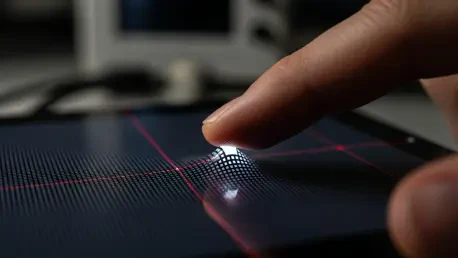
At the heart of this innovative system are thin, flexible display surfaces integrated with dense arrays of millimeter-sized components termed “optotactile pixels.” The technology’s most distinctive feature is its control mechanism, a method known as optical addressing. Unlike conventional haptic or visual displays that depend on a complex and often cumbersome network of embedded wiring and electronics to power and control each individual pixel, this system utilizes projected light from a low-power laser for both functions. This groundbreaking approach dramatically simplifies the construction of the display surface itself. By eliminating the need for intricate electronic pathways within the material, the display becomes significantly lighter, more flexible, and potentially much easier and more cost-effective to manufacture at scale. This elegant solution to a long-standing engineering problem is what enables the system’s unique combination of visual and tactile output in a single, streamlined package.
The physical principle that enables the tactile sensation is a sophisticated and modern application of thermo-pneumatics. Each individual optotactile pixel is meticulously engineered to contain a microscopic, hermetically sealed, air-filled cavity. Suspended within this tiny chamber is a thin film of graphite, a material specifically chosen for its exceptional light-absorption properties. The operational sequence is elegant in its simplicity and speed: first, a scanning laser projects a focused beam of light onto a target pixel. The graphite film instantly absorbs this light energy, causing its temperature to rise with extreme rapidity. This intense heat is then transferred to the small volume of air trapped within the sealed cavity. In accordance with fundamental thermodynamic principles, the heated air expands rapidly, creating a sudden build-up of pressure inside the pixel. This internal pressure exerts a force on the pixel’s flexible top surface, causing it to deflect outward by as much as one millimeter. This physical displacement creates a tangible bump on the display surface, which is easily perceptible by a user’s touch, effectively translating a beam of light into a physical sensation.
Performance and Future Horizons
The entire process, from light absorption by the graphite film to the physical actuation of the pixel’s surface, occurs so quickly that a scanning laser beam can sweep across thousands of individual pixels in rapid succession. This high-speed actuation is what allows for the creation of dynamic and complex haptic graphics. The system is capable of rendering moving contours, shifting shapes, and even animated characters that can be both seen and felt in real-time. The refresh rate is sufficiently high to ensure that these haptic animations look and feel smooth and continuous, creating an experience akin to watching a conventional video display but with the added dimension of touch. This capability to generate fluid, moving tactile sensations opens up a new world of possibilities for interactive content that can convey motion, texture, and shape through physical feedback, far surpassing the simple vibrations of most contemporary haptic systems.
To validate the technology’s practical utility beyond its impressive technical specifications, the researchers conducted a series of perceptual studies to quantify what users experienced when interacting with the displays. The results of these studies were overwhelmingly positive and provided strong evidence of the system’s effectiveness. Participants who were relying only on their sense of touch were able to report the location of individually illuminated pixels with remarkable, millimeter-level precision. Furthermore, they could accurately perceive and interpret moving graphical elements and were easily able to discriminate between various spatial and temporal patterns rendered on the display. These findings underscored the system’s ability to produce a wide and rich variety of tactile content, confirming its potential for conveying complex information haptically. The scalability of the technology is another of its significant advantages. The team has already demonstrated devices incorporating more than 1,500 independently addressable pixels, a density and scale that significantly exceeds that of many comparable tactile displays developed to date. Linnander noted that far larger formats are conceptually straightforward to achieve, envisioning the potential for expansive displays that could leverage the power and precision of modern laser video projectors to create room-scale interactive surfaces.
A Modern Twist on a Historic Principle
While the team’s findings represented a significant advancement in modern display technology, Visell placed their work in a broader historical context, noting that the fundamental concept of converting light into mechanical action had noteworthy antecedents. A parallel was drawn to the 19th-century work of inventors like Alexander Graham Bell, who famously used focused sunlight, modulated by a rapidly rotating fan, to excite audible sound waves in air-filled test tubes with his photophone invention. This new optotactile technology effectively resurrected and modernized the same core physical principles that Bell had explored over a century ago. The research applied these foundational concepts within the context of a high-resolution, digitally controlled display system, transforming a historical curiosity into a cutting-edge interface. The project succeeded in taking a simple yet transformative idea and embodied it in a technology that has the potential to redefine human-computer interaction, creating a world where anything one can see, one can also feel.