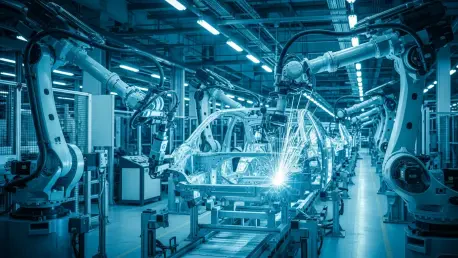

The pursuit of a flawless production line has long driven manufacturing innovation, and now a sophisticated artificial intelligence system promises to bring that ideal closer to reality by autonomously identifying imperfections invisible to the naked eye. Developed by researchers Rajesh Patil and Professor Magnus Löfstrand at Örebro University, this system targets one of the most critical and challenging aspects of industrial production: weld inspection. This review examines the technology’s design, performance, and potential to redefine quality control standards in the era of smart manufacturing.
Evaluating a Leap Toward Smart Manufacturing
This review assesses the AI-driven weld inspection system by examining its potential to revolutionize quality control in manufacturing. An evaluation of this technology extends beyond its technical merits to consider whether it represents a significant return on investment. The system aims to address critical challenges in production efficiency, waste reduction, and inspection accuracy, particularly for complex industrial applications where human error can lead to catastrophic failures and substantial financial loss.
The core question is whether this system can deliver on its promise of creating a smarter, more sustainable factory floor. This analysis delves into its capacity to streamline operations, enhance product integrity, and reduce the environmental footprint of manufacturing. By exploring its performance in demanding scenarios, this review provides a clear perspective on its readiness to transition from a research breakthrough to an indispensable industrial tool.
Core Technology and Operational Mechanics
The system’s architecture integrates Artificial Neural Networks (ANNs) and Support Vector Machines (SVMs) to create a uniquely robust inspection tool. This dual-AI approach allows the system not only to detect defects but also to classify them with a high degree of precision, a crucial step for root cause analysis and process improvement. The technology functions as a pair of “smart eyes” on the production line, capturing and analyzing weld data in real time to deliver immediate feedback without disrupting the manufacturing flow.
A key feature that sets this system apart is its remarkable capability to inspect challenging welds that join dissimilar metals. This task is notoriously difficult for traditional automated systems and is often a slow, meticulous process for human inspectors. By successfully automating this process, the technology opens the door for more complex and innovative product designs, particularly in sectors like automotive manufacturing where lightweighting and material diversity are paramount.
Assessing Inspection Accuracy and Efficiency
The system’s performance is best evaluated against its primary objectives of precision, speed, and adaptability. In terms of defect detection, the AI demonstrates an exceptional ability to identify and classify a wide range of weld flaws, from microscopic cracks to porosity issues. This level of precision ensures that faulty components are caught early, preventing them from moving down the production line and compromising the final product’s quality. Moreover, its operational speed is a significant asset; the system conducts these detailed inspections in real time, effectively eliminating the bottlenecks often associated with manual quality control checks.
Beyond its core functions, the system proves highly adaptable to diverse industrial settings. Its effectiveness has been demonstrated on complex components like engine exhausts, which feature intricate geometries and challenging material combinations. This adaptability is complemented by its positive impact on sustainability. By flagging defects instantaneously, the system makes a quantifiable contribution to reducing material scrap and the associated energy consumption, aligning production with modern environmental and economic imperatives.
Key Advantages and Potential Limitations
The most significant advantages of this AI-driven system lie in its ability to simultaneously enhance product quality, increase production throughput, and advance manufacturing sustainability. It automates a task that is not only difficult and time-consuming for human inspectors but also physically demanding and prone to error. Consequently, manufacturers can achieve a higher level of consistency and reliability in their products while optimizing resource allocation and reducing operational costs.
However, it is important to acknowledge the system’s potential limitations at this stage. As a pre-commercialization technology, it requires further industry-specific testing and validation to prove its robustness across different manufacturing environments. Furthermore, integrating such a sophisticated AI into existing production workflows presents potential complexities, including data management, system calibration, and workforce training. These challenges must be addressed before widespread adoption can be considered a seamless reality.
Summary of Findings and Overall Assessment
This review’s findings confirm that the AI-driven inspection system developed at Örebro University is a highly capable and innovative solution. In a research context, its technology has proven to be sound, delivering on the promise of precise, real-time defect detection even in complex applications. The fusion of ANNs and SVMs creates a powerful analytical engine that provides actionable insights, pushing the boundaries of what is possible in automated quality control.
The system stands as a highly promising technology poised to make a substantial impact on the manufacturing sector. While not yet a market-ready product, its foundational principles are strong, and its potential benefits are compelling. It represents a significant step toward the development of fully autonomous and self-correcting production lines, making it a technology of considerable interest to forward-thinking industrial leaders.
Recommendations for Future Adoption
Based on its demonstrated potential, this AI-driven inspection system merits serious consideration from high-volume producers, particularly within the automotive sector. The technology’s proven ability to handle complex welds, including those with dissimilar metals, addresses a persistent challenge in modern vehicle manufacturing. Its potential to enhance quality while boosting efficiency and sustainability makes it a compelling proposition.
For companies seeking a competitive advantage, initiating pilot programs to test the technology in their specific production environments would be a logical next step. Early collaboration with the research team at Örebro University could provide an invaluable opportunity to tailor the system to unique operational needs, accelerating the journey toward achieving fully autonomous and sustainable manufacturing goals. Such a proactive approach would position early adopters at the forefront of the next wave of industrial innovation.