


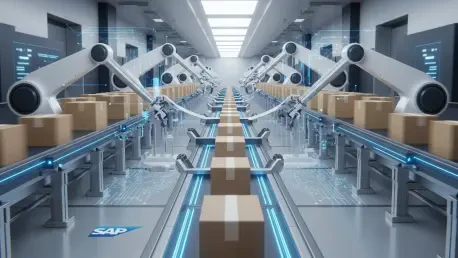

The traditional boundary between digital enterprise logic and the tactile reality of warehouse operations has effectively vanished following a landmark announcement on May 11, 2026. SAP and the pioneering AI robotics firm Cyberwave have successfully operationalized a fleet of autonomous robots at the St. Leon-Rot facility in Germany, signaling a definitive shift toward “Physical AI.” This development moves advanced robotics out of the controlled confines of the research laboratory and into the high-pressure environment of live logistics. Unlike previous generations of automation that required sterile, predictable conditions, these new systems are designed to perceive, learn from, and adapt to the messy complexities of a modern fulfillment center. By integrating these adaptive machines into their daily workflow, SAP is demonstrating that the next frontier of industrial efficiency lies in the seamless fusion of cognitive software and agile hardware, specifically targeting intricate tasks such as box folding and shipping fulfillment.
Transitioning from Static Code to Adaptive Learning
For decades, the primary hurdle in logistics automation was the inherent unpredictability of the warehouse floor, where objects of varying weights and shapes are rarely positioned perfectly. Traditional industrial robots were limited by their reliance on rigid, hand-coded instructions that required extensive recalibration whenever a single variable changed. Cyberwave addresses this fundamental limitation through a platform built on demonstration-based learning, which allows the machine to observe a task and mimic it. Instead of hiring specialized software engineers to write thousands of lines of code for every new packaging requirement, floor managers can now “teach” a robot by physically demonstrating the desired motion. This democratization of robotic training significantly lowers the barrier to entry for complex automation, turning what used to be a weeks-long deployment process into a task that can be completed in just a few hours. This speed is essential for businesses that must pivot quickly.
The underlying intelligence driving these machines is a sophisticated combination of Vision-Language-Action (VLA) models and Reinforcement Learning. VLA models grant the robots a human-like ability to interpret visual data alongside verbal or written instructions, creating a bridge between abstract commands and physical execution. When a robot encounters a new box size or a slightly different orientation on the conveyor belt, it utilizes Reinforcement Learning to refine its grip and movement through a rapid process of trial and error. This synergy enables the systems at the St. Leon-Rot facility to generalize their knowledge across different scenarios rather than being trapped by specific parameters. Consequently, the technology creates a more resilient supply chain where machines are no longer static tools but are instead active participants capable of handling non-uniform items with a level of dexterity that mimics the nuanced touch of a human operator.
The Role of Enterprise Software: Building a Digital Backbone
The success of this deployment is not solely a victory for mechanical engineering; it is a testament to the power of a deeply integrated technical stack. SAP has positioned this initiative as a “reference implementation,” effectively using its own logistics operations to prove the viability of its Business AI portfolio to a global client base. By deploying these solutions within its own walls, the company provides a blueprint for how large-scale enterprises can transition to autonomous systems without disrupting existing workflows. This approach ensures that the “Embodied AI” is not an isolated novelty but a scalable component of the broader business strategy. For enterprise customers, this real-world validation is critical, as it demonstrates that the software can handle the massive, end-to-end data flows required to synchronize a global supply chain. The project serves as a clear signal that the era of experimental pilots has ended, giving way to the era of industrial-grade AI execution.
Orchestrating these physical movements requires a robust digital infrastructure capable of managing high-frequency task allocation in real time. The SAP Logistics Management system serves as the central brain of the operation, determining which tasks need to be performed and assigning them to the most capable robotic units. These digital directives are then translated into physical actions via the SAP Embodied AI Service, which acts as the interface between the cloud-based logic and the hardware on the floor. Furthermore, the SAP Business Technology Platform facilitates the continuous feedback loops necessary for model improvement, ensuring that every successful pick or pack contributes to the collective intelligence of the fleet. This cohesive integration illustrates that for Physical AI to deliver genuine value, it must be tethered to a comprehensive resource planning system. Without this deep connectivity, even the most advanced robot remains a disconnected island of automation rather than a productive asset.
Human-Robot Collaboration: Reshaping the Logistics Workforce
A significant byproduct of this technological leap is the fundamental transformation of the warehouse workforce, moving away from manual labor toward a model of human-robot collaboration. The deployment specifically targets “the three Ds”—tasks that are dull, dirty, or dangerous—which have historically contributed to high turnover rates and workplace fatigue. By delegating repetitive box folding and physically strenuous packaging duties to autonomous robots, human workers are freed to move into higher-value roles. These new positions prioritize critical thinking, system oversight, and problem-solving, turning former manual laborers into robotics supervisors and process optimizers. This transition is not merely about efficiency; it is a strategic response to the persistent global labor shortages that have plagued the logistics sector for years. As robots take over the most taxing parts of the job, the warehouse environment becomes more attractive to a modern workforce that values safety and mental engagement over physical grunt work.
The economic and safety implications of this shift are substantial, with projected data suggesting a twenty-five percent reduction in workplace injuries at facilities that adopt these adaptive systems. By removing humans from the direct path of heavy machinery and reducing the need for repetitive, high-strain motions, companies can foster a more sustainable and ethical working environment. This improvement in safety is coupled with a massive market opportunity, as the warehouse automation sector is on a trajectory to reach nearly sixty billion dollars by 2030. The St. Leon-Rot facility proves that robots are now essential infrastructure for maintaining supply chain resilience in the face of fluctuating e-commerce demands. As the technology matures, the ability of these machines to work safely alongside humans will become the standard requirement for any modern fulfillment center. This evolution ensures that businesses can scale their operations during peak seasons without compromising the well-being of their staff or their bottom line.
Future Directions: From Warehouses to Global Industry
The competitive edge provided by Cyberwave’s focus on “adaptive manipulation” places this partnership at the forefront of a rapidly evolving industrial landscape. While other players in the robotics market have focused on guided vehicles or basic pick-and-place arms, the ability to learn through demonstration addresses the “last mile” of automation. These are the tasks that require genuine dexterity and the cognitive flexibility to handle items that do not fit a standard mold. As these capabilities are refined, the potential for expansion beyond the warehouse is immense. Industry experts anticipate that the principles of Embodied AI will soon migrate into flexible manufacturing, where production lines must change configurations daily, and into retail fulfillment, where robots will interact directly with diverse consumer goods. The success of the current deployment suggests that the underlying architecture is flexible enough to adapt to these various sectors, paving the way for a more automated global economy that is both faster and more reliable.
The deployment of adaptive AI robots at the St. Leon-Rot facility confirmed that the integration of physical intelligence into enterprise logistics was no longer a distant prospect but a present reality. By successfully bridging the gap between digital resource planning and mechanical execution, the partnership between SAP and Cyberwave established a new standard for industrial resilience. This initiative proved that machines could learn to navigate the complexities of the physical world through human demonstration, effectively solving the long-standing problem of warehouse variability. As a result, the logistics sector moved toward a more collaborative workforce model where safety and efficiency were prioritized simultaneously. Looking forward, organizations should begin evaluating their existing digital infrastructure to ensure it can support the massive data requirements of embodied systems. The focus must now shift toward standardizing these AI interfaces across different industries to maximize the return on investment. The successful operationalization of these robots marked the definitive end of the pilot era, setting the stage for a future defined by autonomous, learning ecosystems.







