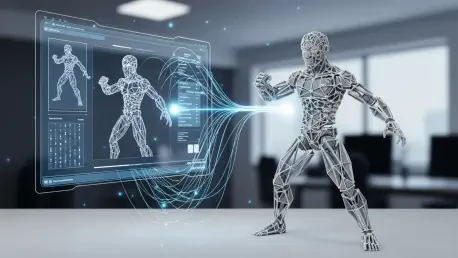

The monumental challenge of generating fluid, realistic 3D animation from the limited information of a single static image has long been a bottleneck for creators across digital industries. DeformSplat technology represents a significant advancement in the 3D content creation industry. This review will explore the evolution of single-image animation, its key features, performance metrics, and the impact it has on various applications. The purpose of this review is to provide a thorough understanding of the technology, its current capabilities, and its potential future development.
An Introduction to DeformSplat
The groundbreaking DeformSplat framework introduces a novel solution for animating 3D characters using only a single 2D image, a task historically plagued by technical hurdles. This AI-powered system is designed to intelligently adjust the pose of a 3D character, generated through Gaussian modeling, to precisely mimic the movements depicted in a target photograph. The result is a dynamic animation that maintains the character’s original shape and proportions from any viewing angle.
This technology emerges as a direct response to the long-standing problem of geometric distortion that has undermined previous methods. Attempts to manipulate 3D models based on a single image often produced unnatural deformations, such as impossibly bent limbs or warped torsos, breaking the illusion of a cohesive object. DeformSplat positions itself as a pivotal development in AI-driven animation by solving this core issue, ensuring that characters move realistically while preserving their structural integrity.
Core Technological Innovations
The success of the DeformSplat framework is anchored in two primary technical components that work in tandem to achieve distortion-free results. These innovations provide a comprehensive system for translating 2D poses into believable 3D motion.
Gaussian-to-Pixel Matching
At the foundation of DeformSplat is a meticulous process of matching 3D Gaussian points, which constitute the character model, to the individual 2D pixels of the source photograph. This technique establishes a direct correspondence between the three-dimensional structure and the flat image, allowing the AI to effectively “read” the spatial information of the pose. This serves as the core mechanism for accurately transferring the target motion onto the 3D model.
The precision of this matching process is critical for capturing the nuances of the intended pose. By creating a detailed map between the 3D points and the 2D image, the system can interpret complex postures and translate them without losing essential details. This ensures the final animation reflects the source photograph with a high degree of fidelity, forming the basis for realistic movement.
Rigid Part Segmentation
Complementing the matching technique is an AI-driven process that provides the model with an inherent understanding of its own anatomy. The system automatically analyzes the 3D object and segments it into distinct regions that should behave as rigid, non-deformable parts, such as limbs, the torso, and the head. This anatomical awareness is crucial for preventing the unnatural bending or stretching that compromised earlier animation methods.
By identifying and grouping these structural components, the framework ensures they move as solid units, allowing for realistic joint articulation without compromising the integrity of individual body parts. This intelligent segmentation preserves the character’s physical plausibility, ensuring that movements like raising an arm or bending a knee occur naturally and correctly from every perspective.
Advancements Over Existing Methods
DeformSplat represents a significant leap forward from prior technologies in single-image animation. Whereas standard 3D Gaussian Splatting excels at reconstructing static 3D objects from 2D images, it lacks an inherent mechanism for realistic animation, often leading to severe distortion when motion is applied. These earlier methods struggled because they treated the 3D model as a malleable cloud of points without considering its underlying structure.
In contrast, DeformSplat’s focus on structural properties is its key differentiator. By integrating an understanding of anatomy through rigid part segmentation, the framework overcomes the critical limitations of its predecessors. This approach generates movements that are not only visually accurate to the source image but also physically believable, setting a new standard for what is possible with single-image animation techniques.
Applications and Industry Impact
The practical applications of DeformSplat are poised to transform the metaverse, gaming, and animation industries. For game developers and virtual world builders, the technology offers a rapid method for creating animated avatars and non-player characters from a single concept art or photograph. This drastically reduces the time and resources needed for character animation, accelerating production pipelines.
Moreover, this technology democratizes 3D content creation by lowering formidable technical and resource barriers. It empowers individual creators, independent filmmakers, and smaller studios to produce high-quality 3D animations that were previously the exclusive domain of large, well-funded companies. This accessibility promises to foster a new wave of innovation and diversity in digital content.
Current Challenges and Limitations
Despite its innovative approach, the technology still faces challenges that may affect its widespread adoption. Handling characters with highly complex details, such as intricate clothing or flowing hair, remains a significant hurdle. Furthermore, the framework’s performance with non-humanoid subjects, like animals or fantasy creatures, requires further refinement to achieve the same level of realism seen with human figures.
The computational demands of the framework also present a potential limitation. Processing high-resolution images and complex 3D models could require substantial computing power, potentially limiting its accessibility for creators without high-end hardware. Ongoing development will be necessary to optimize the system, expand its capabilities, and make it a more versatile tool for a broader range of applications.
The Future of Accessible 3D Animation
Looking ahead, DeformSplat and similar technologies are charting a course toward even more accessible and powerful 3D animation. Future breakthroughs could enable real-time animation from a single image, allowing for dynamic interactions in virtual environments or live digital puppetry. Such advancements would have a profound impact on interactive entertainment and virtual reality experiences.
The long-term influence of this increasing accessibility will likely reshape creative workflows across numerous fields. As the barriers to 3D animation continue to fall, a more diverse pool of creators will be able to bring their visions to life. This shift promises to enrich digital media with a wider variety of styles and narratives, fundamentally altering the landscape of digital entertainment.
Conclusion
The review of DeformSplat technology revealed its capacity to effectively resolve the persistent problem of geometric distortion in single-image 3D animation. By combining intelligent pixel-to-point matching with a deep understanding of anatomical structure, the framework delivered a robust solution that preserved character integrity during motion.
Ultimately, DeformSplat stood out as a transformative development that significantly advanced the field. Its success in creating plausible, distortion-free animations from minimal input marked a pivotal moment for accessible 3D content creation. The technology’s potential to empower a new generation of creators established its importance in the ongoing evolution of digital media.