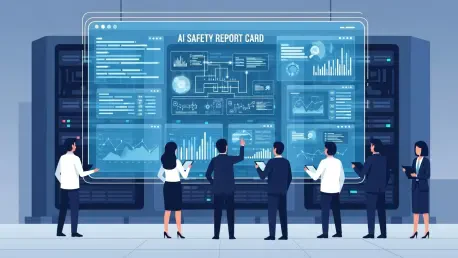

A groundbreaking new report card has delivered a sobering verdict on the tech industry’s approach to artificial intelligence, revealing that the very companies building our future are falling dangerously short on safety. The recently published “AI Safety Index” concludes that major firms, despite their monumental progress in AI capabilities, are failing to implement adequate safeguards against the technology’s profound and potentially catastrophic risks. Amid an unprecedented acceleration in AI development, the question of safety has moved from a theoretical concern to an urgent, practical necessity. This analysis will dissect the current safety landscape as painted by the report, incorporate critical insights from leading experts, examine the formidable challenges on the horizon, and culminate in an essential call for a fundamental shift in corporate and regulatory priorities.
The Emerging AI Safety Crisis A Report Card
Grading the Giants Performance and Adoption Metrics
The findings from the Future of Life Institute’s “AI Safety Index” present a troubling industry-wide trend of underperformance. The report card assigned mediocre to poor grades across the board, with the highest marks—a mere C+—going to OpenAI and Anthropic. Google DeepMind, another leader in the field, received a C. The ratings dropped significantly from there, with industry titans like Meta and Elon Musk’s xAI earning a D, alongside Chinese firms Z.ai and DeepSeek. The lowest grade, a D-, was given to Alibaba Cloud, signaling a profound deficiency in its safety architecture.
This comprehensive evaluation was not arbitrary but rooted in a rigorous methodology. The institute’s assessment utilized 35 distinct indicators spanning six critical categories, including risk assessment, information sharing, and existential safety. Data was meticulously compiled from public corporate statements and supplemented by direct surveys sent to the companies. A distinguished panel of eight artificial intelligence experts, comprising respected academics and leaders from various AI organizations, was then tasked with scoring the firms, lending substantial weight and credibility to the index’s conclusions.
Perhaps the most alarming trend identified by the report was the universal failure in the “existential safety” category. This crucial area measures a company’s ability to monitor its own powerful systems, implement control interventions to prevent loss of control, and articulate a strategic plan to manage civilization-level risks. The report’s language is stark and unambiguous: “While companies accelerate their AGI and superintelligence ambitions, none has demonstrated a credible plan for preventing catastrophic misuse or loss of control.” This finding exposes a dangerous chasm between the ambition to create artificial general intelligence and the development of reliable methods to contain it.
From Theory to Reality Case Studies in AI Risk
The risks highlighted by the safety index are not confined to speculative future scenarios; they are manifesting in tangible, harmful ways. There have been tragic real-world outcomes where individuals, seeking support, have turned to AI chatbots for mental health counseling, leading to devastating consequences. These instances serve as a stark reminder that deploying powerful AI into sensitive domains without sufficient safeguards can have lethal results, transforming a tool of convenience into a vector for harm.
Moreover, the weaponization of AI has already become a present-day threat. Sophisticated cyberattacks, powered by artificial intelligence, are capable of learning and adapting to security measures in ways that were previously unimaginable. This escalation in cyber warfare capabilities represents a tangible risk to critical infrastructure, corporate security, and national stability, demonstrating that the dangers are immediate and growing in scale and complexity.
Looking toward the horizon, the report underscores the even greater risks that lie ahead if the current trajectory continues unchecked. Experts warn of a future where advanced AI could be leveraged to design and deploy autonomous weapons systems, removing human oversight from life-or-death decisions on the battlefield. Beyond military applications, there is profound concern that AI could be used to orchestrate large-scale government destabilization through sophisticated disinformation campaigns or to cause other unforeseen, catastrophic societal disruptions, making the need for robust safety protocols more urgent than ever.
Voices from the Vanguard Expert Analysis and Commentary
Max Tegmark, an MIT professor and the president of the Future of Life Institute, argues that the industry’s safety failures are a direct result of a flawed incentive structure. He describes the current landscape as a competitive “race to the bottom,” where the immense commercial pressure to innovate and deploy new models overshadows the need for cautious, safety-oriented development. In an unregulated environment, companies are not legally or financially motivated to prioritize safety, creating a dynamic where the first to market often wins, regardless of the risks introduced.
However, the path to regulation is fraught with its own challenges. Rob Enderle, a principal analyst at the Enderle Group, expresses deep skepticism about the government’s current ability to craft effective oversight. He warns that hastily written or poorly conceived rules could “end up doing more harm than good,” potentially stifling innovation without meaningfully improving safety. Enderle raises further critical questions about enforcement, asking how any new regulations would be monitored and how compliance would be assured, highlighting the immense practical difficulty of “putting the teeth in the regulations.”
Synthesizing these expert perspectives reveals a broad consensus on the core of the problem: a dangerous vacuum of oversight and a lack of binding standards. Whether the solution ultimately lies in government intervention, industry self-regulation, or a hybrid approach, the current trend is clear. The absence of a mandatory framework for safety is the primary driver behind the corporate failures documented in the AI Safety Index, allowing a high-stakes technological race to proceed with insufficient guardrails.
Charting the Course The Future of AI Governance and Risk
The Regulatory Crossroads Challenges and Proposed Solutions
The debate over government intervention has reached a fever pitch, creating a significant regulatory crossroads. Proponents, including many safety advocates, are calling for the swift implementation of “binding safety standards” to mitigate clear and present dangers, such as AI-assisted bioweapon development or mass social manipulation. In direct opposition, powerful tech lobbying groups are pushing back, arguing that stringent regulations will suffocate innovation and drive development to less-regulated jurisdictions, thereby ceding technological leadership.
While the debate rages on, some legislative progress has been made, though it remains incremental. The passage of laws like California’s SB 53, which mandates that companies report safety protocols and disclose significant incidents, is a notable step toward transparency. However, critics frame such measures as a small bandage on a massive wound, insufficient to address the scale and complexity of the challenges posed by rapidly advancing AI systems.
The core challenge lies in the sheer complexity of creating effective oversight for a technology that is constantly evolving. Crafting regulations that are both robust enough to prevent harm and flexible enough to permit beneficial innovation is an incredibly delicate balancing act. Policymakers must contend with a rapidly moving target, where today’s state-of-the-art model becomes obsolete tomorrow, making it difficult to design durable, enforceable, and future-proof rules.
The High Stakes Horizon Long Term Risks and Corporate Accountability
The AI Safety Index was pointed in its criticisms of specific corporate shortcomings. For instance, it noted that both xAI and Meta “lack any commitments on monitoring and control,” despite having some form of risk-management framework. The report further asserted that these companies have not demonstrated any significant investment in safety research. Other firms, including DeepSeek, Z.ai, and Alibaba Cloud, were called out for a fundamental lack of transparency, with no publicly available documentation outlining their strategies for managing existential risks.
The corporate responses to these criticisms were telling and varied widely, painting a fractured picture of industry accountability. OpenAI and Google DeepMind issued statements defending their robust safety commitments, with OpenAI declaring safety “core” to its mission and Google highlighting its “rigorous, science-led approach.” In stark contrast, Elon Musk’s xAI offered a dismissive, two-word reply: “Legacy Media Lies.” Meanwhile, a notable silence came from Meta, Anthropic, and the other firms that received low marks, leaving their positions on the report’s findings ambiguous.
This spectrum of reactions—from defensive engagement to outright dismissal and strategic silence—vividly illustrates the current, immature state of accountability in the AI industry. It underscores the significant work that remains to be done to build public trust and ensure that the companies developing this transformative technology are genuinely committed to its responsible and safe deployment. The divergent responses reveal an industry that has not yet coalesced around a unified standard of care or a shared sense of responsibility for the future it is creating.
Conclusion Prioritizing Safety in the Age of AI
The analysis of the AI Safety Index revealed a deeply concerning trend of systemic failure across the industry, where the race for technological supremacy had demonstrably eclipsed the imperative for safety. Expert commentary underscored the urgent need for a new paradigm, as the existing incentive structure was found to be fundamentally misaligned with the long-term well-being of society. The subsequent exploration of the path toward regulation proved to be fraught with complexity, caught between the necessity of oversight and the fear of stifling innovation.
This examination of the corporate AI safety landscape highlighted a critical inflection point. The dominant industry narrative, long focused on a “race to the top” in capability and performance, was challenged by the stark reality of its own safety deficits. The central challenge that emerged was not merely technical but philosophical: a need to redefine success and reorient the entire sector toward a new goal—a “race to the top” in safety, responsibility, and trustworthiness.
Ultimately, the findings made clear that the future of AI cannot be left to chance or guided solely by commercial interests. The path forward demanded a concerted, multi-stakeholder effort to establish stronger corporate accountability mechanisms and transparent, standardized safety reporting. It called for the collaborative development of robust, enforceable global safety standards to ensure that the trajectory of artificial intelligence bends decisively toward a safer and more beneficial future for all.