
The relentless hum of artificial intelligence processing code has led many to prophesy the twilight of the human programmer, yet some of the industry’s most forward-thinking leaders are making a counterintuitive bet on the very role believed to be most at risk. As generative AI models demonstrate a startling capacity for writing, debugging, and optimizing software, a question echoes through the halls of tech companies worldwide: If an algorithm can perform the tasks of an entry-level developer, what is the value of hiring one?
This is not a hypothetical debate; it is a strategic crossroads defining the future of engineering teams. While some organizations are tempted by the immediate cost savings of replacing human talent with automated systems, a deeper analysis reveals a significant long-term risk. Cloud content governance firm Egnyte provides a compelling case study, championing a model where AI is not a replacement but an accelerator, particularly for its junior engineers. Their approach suggests that the companies poised to lead in the coming years are not those that eliminate entry-level talent, but those that learn to cultivate it more effectively than ever before.
When AI Can Write Code Is the Era of the Junior Developer Over
The capabilities of modern AI coding assistants are undeniably impressive. Tools integrated directly into the development environment can generate boilerplate code, translate logic between programming languages, and produce functional unit tests in seconds. These tasks, once the foundational training ground for junior developers, are now largely automated, lending credence to the argument that the traditional entry-level role is rapidly becoming obsolete.
This perception is driving a powerful narrative focused on operational efficiency and headcount reduction. For decision-makers under pressure to optimize budgets, the idea of leveraging an AI subscription to do the work of several junior hires is an attractive proposition. The discussion has shifted from whether AI can code to whether organizations should continue investing in human talent for tasks that algorithms can seemingly handle with greater speed and consistency.
The Strategic Miscalculation Mistaking AI Hype for Hiring Reality
However, a growing number of industry veterans caution against confusing technological hype with sound business strategy. Amrit Jassal, CTO and co-founder of the $1.5 billion firm Egnyte, directly challenges this prevailing narrative, attributing it largely to entities looking to “sell you tokens.” From this perspective, the promise of a fully automated developer workforce is an oversimplification that ignores the nuanced realities of building and maintaining complex, enterprise-grade software.
The core miscalculation lies in viewing engineering as a short-term expense rather than a long-term investment. Halting the recruitment of junior developers might trim immediate payroll costs, but it simultaneously hollows out the talent pipeline. Without a steady influx of new minds to train, mentor, and cultivate, organizations will inevitably face a severe shortage of senior engineers and architects in the future. This approach mortgages long-term institutional knowledge and leadership for fleeting financial gains.
AI as an Augmentation Engine Not a Replacement Tool
The more sustainable strategy, as demonstrated by Egnyte, reframes AI as a powerful augmentation engine. The company has systematically integrated a suite of AI tools, including Claude Code, Cursor, and Gemini CLI, across its global team of over 350 developers. These tools are not used to replace human judgment but to enhance it, acting as intelligent guides for navigating a massive and complex codebase. They streamline time-consuming tasks like data retrieval and smart searches, freeing developers to focus on higher-order problem-solving.
The benefits of this augmentation extend beyond the core engineering team, fostering greater cross-functional collaboration. At Egnyte, product management teams now leverage tools like Vercel to create “demo-worthy” prototypes, bringing clearer, visualized concepts to developers. Likewise, UX teams can rapidly generate multiple design variations for interface elements, enabling engineers to immediately grasp the intended functionality. This integrated approach ensures AI elevates the entire product development lifecycle, not just isolated coding tasks.
Forging the Future Why Your Next Senior Engineer is Todays Junior Hire
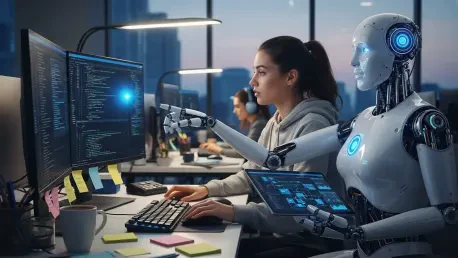
This augmentation model has a profound impact on talent development. By providing junior engineers with AI assistants, companies can dramatically compress the learning curve. Traditional roadblocks—such as getting oriented within a vast legacy codebase or dissecting complex requirements—are navigated much more quickly. AI becomes a copilot, helping new hires understand context and write test cases more efficiently, transforming what was once a period of slow onboarding into a phase of accelerated growth.
Consequently, junior developers begin delivering significant value far sooner than in a pre-AI environment. They are immersed in the full development lifecycle from day one, contributing to design, deployment, and maintenance while absorbing invaluable institutional knowledge from senior mentors. As Jassal notes, “The junior engineer of today is the senior engineer of tomorrow.” Investing in their accelerated development ensures a continuous and robust supply of future leaders who are fluent in both the company’s specific technologies and the latest AI-assisted workflows.
The Human Mandate A Case Study in AI Assisted Human Accountable Coding
Despite this enthusiastic adoption of AI tools, Egnyte operates on a non-negotiable principle: absolute human accountability. The directive from leadership is clear and unwavering. While AI can suggest and generate code, every single line must be reviewed, validated, and ultimately committed by a human developer. This “human in the loop” approach ensures that final responsibility for code quality, security, and functionality always rests with a person, not an algorithm.
This mandate is enforced through rigorous practical safeguards. All AI-generated code is subject to the same stringent review and security validation processes as human-written code, with any flagged issues escalated to senior engineers for deeper scrutiny. Developers are explicitly trained to avoid “autopilot mode,” recognizing that AI models have inherent limitations and lack awareness of the unique infrastructure and components specific to the company’s environment. This disciplined framework leverages AI’s power without ceding essential human control.
The New Apprenticeship A Framework for Accelerating Junior Talent with AI
The synthesis of these principles creates a powerful new paradigm: a modern apprenticeship where AI serves as the ultimate teaching assistant. Junior engineers, often more open to experimenting with new technologies, can drive the exploration and adoption of AI tools. Their enthusiasm, paired with AI’s ability to handle routine tasks, allows them to focus on understanding core architectural principles and business logic from the outset.
This dynamic is balanced by the critical role of senior engineers. Drawing on years of experience and having been “burnt multiple times” by previous tech fads, they provide a necessary layer of cautious skepticism and holistic oversight. They guide the juniors, ensure AI is implemented responsibly, and contribute the deep institutional knowledge that AI cannot replicate. This symbiotic relationship forges a resilient team where youthful energy is tempered by veteran wisdom, all amplified by intelligent tools.
Ultimately, the organizations that thrived in the age of AI-assisted development were not those that viewed technology as a means to replace their workforce. Instead, success was found by companies that recognized AI as a transformative tool for talent cultivation. They understood that the true competitive advantage came from investing in their people, using AI to accelerate the journey from novice to expert. This strategic focus on a human-centric, AI-augmented apprenticeship model proved to be the definitive framework for building the skilled, innovative, and resilient engineering teams of the future.