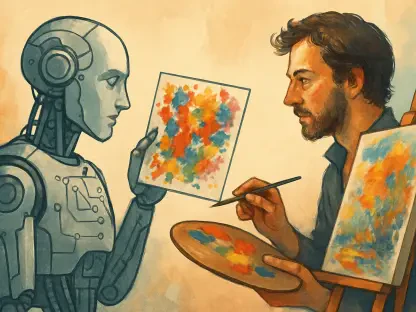

The most powerful artificial intelligence systems of our time are built upon a foundation that, according to decades of statistical theory, should crumble under its own complexity. These models, containing billions or even trillions of tunable parameters, possess a capacity so vast they could theoretically memorize their entire training dataset, including its random noise, and fail spectacularly at any new task. Yet, in practice, they demonstrate a profound ability to generalize, learn abstract concepts, and perform tasks far beyond the specific examples they were shown. This glaring contradiction has been one of the greatest puzzles in modern computer science, and its resolution is fundamentally reshaping our understanding of how intelligence emerges from data.
This is not merely an academic debate confined to university labs; it is the central question underpinning the reliability of technologies that are actively integrating into society. The efficacy of self-driving cars navigating unpredictable city streets, the accuracy of AI-powered medical diagnostic tools, and the coherence of generative models that write code and create art all depend on this mysterious ability to learn rather than just memorize. Understanding why these colossal models succeed where theory predicted failure is paramount to building safer, more efficient, and more trustworthy artificial intelligence for the future. The answer, it turns out, lies not in the size of the model itself, but in the intricate dance of its learning process over time.
The Modern AI Contradiction: A Genius That Should Be a Mimic
At the heart of the paradox lies the concept of overparameterization. In traditional statistics, a model is considered overparameterized if it has more internal variables, or parameters, than the number of data points it is trained on. Imagine trying to draw a perfectly straight line between only two dots; there is only one solution. But if you were allowed to draw a wildly complex, squiggly line, you could still connect the two dots while also encoding a huge amount of nonsensical information. The common wisdom has always been that a model with too much freedom, or “capacity,” will do the same: it will perfectly fit the training data but fail to capture the underlying trend, rendering it useless on new, unseen examples. This failure to generalize is known as overfitting.
However, the titans of modern AI, such as the large language models that power advanced chatbots, defy this logic entirely. With parameter counts that can exceed their training examples by orders of magnitude, they should be the ultimate overfitters. They should be brittle mimics, capable of regurgitating what they have seen but incapable of genuine insight. Instead, they exhibit startling creativity and problem-solving skills. They learn the rules of grammar, the principles of logic, and the nuances of context—all abstract features that are not explicitly present in the pixels and text they process. This empirical success created a chasm between theory and practice, forcing researchers to ask a difficult question: is our entire understanding of statistical learning incomplete?
A Theoretical Crisis in an Age of Digital Giants
The journey to this theoretical impasse began with a fundamental shift in how machines compute. For most of computing history, the dominant paradigm, inherited from pioneers like Alan Turing, involved a clear separation between hardware and software. A machine was designed to execute a precise set of human-written instructions to perform a task. This model is powerful but rigid; a programmer must anticipate every possible contingency. Machine learning, and specifically deep learning, upended this framework. Instead of being explicitly programmed, a neural network learns its own instructions by analyzing vast quantities of data. A self-driving car, for instance, isn’t coded with millions of “if-then” rules for traffic; it learns the complex function of safe driving by processing thousands of hours of real-world examples.
This new paradigm clashed directly with one of the most foundational principles in data science, a concept akin to Occam’s Razor: favor the simplest model that adequately explains the data. For decades, practitioners believed that a model’s complexity must be carefully constrained to prevent it from learning statistical noise. Deep neural networks, with their immense depth and sprawling number of connections, threw this principle out the window. Their very architecture is one of maximal complexity, giving them the theoretical power to fit not just the signal in the data but also every bit of random, irrelevant noise. This created a crisis for the field, as its most successful tools were operating in a way that its most trusted theories deemed impossible.
The Secret in the Schedule: How AI Learns in Three Distinct Acts
The resolution to this paradox came from a shift in perspective, focusing not on the static size of the network but on the dynamic, time-dependent process of training. Groundbreaking research revealed that learning in overparameterized models is not a monolithic event but a staged progression. This phenomenon, termed “dynamical decoupling,” shows that the different goals of learning—grasping general features versus memorizing specific data points—occur on entirely separate and predictable timescales. The model’s internal dynamics naturally prioritize meaningful learning first.
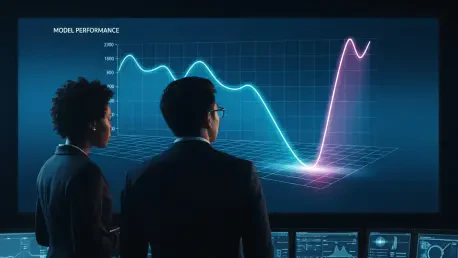
The training journey unfolds across three distinct phases. It begins with the Initial Descent, where the model’s weights are adjusted from a random state. During this early period, both the error on the training data and the error on new, unseen test data begin to fall together as the model takes its first steps toward making sense of the information. This is followed by the most critical period: the Feature Learning Regime. Here, the model experiences a rapid and sharp drop in its test error, a clear signal that it is grasping the true, generalizable patterns underlying the data. This is the “genius” window, where the model acquires the core knowledge that makes it useful.
If training continues past this point, the model enters the third and final stage: the Memorization Trap. The model, having already mastered the general patterns, begins to use its immense capacity to fit the noise and idiosyncrasies unique to the training set. This is reflected in the metrics: the training error continues to fall toward zero, but the test error begins to rise, indicating that the model is becoming worse at generalizing. Concurrently, measures of the model’s internal complexity begin to explode, showing that it is contorting itself in unnecessarily complicated ways to account for every last data point, a clear signature of overfitting.
A Breakthrough in Dynamics: The Research That Cracked the Code
This elegant explanation was rigorously solidified by the work of researchers Andrea Montanari of Stanford University and Pierfrancesco Urbani of IPhT. By applying advanced analytical tools derived from theoretical physics and statistical mechanics, they moved beyond observing this behavior and provided a mathematical foundation for it. Their work focused on the temporal evolution of the learning process, analyzing how the network’s parameters change from one moment to the next under the influence of the training algorithm.
Their core discovery was a rigorous demonstration that, for a broad class of neural networks, the speed of learning features is inherently faster than the speed of memorizing noise. This separation of timescales is not an occasional lucky break but an emergent property of the interplay between the network’s architecture and the gradient-based optimization methods used to train it. The model is naturally biased to first find the simple, recurring patterns because they account for the largest amount of error early on. Only after these broad strokes are captured does it have the incentive and the time to focus on the fine-grained, noisy details.
Harnessing the Timeline: New Rules for Building Smarter AI
This new understanding transforms overparameterization from a feared bug into a desirable feature. The research suggests that larger, more complex models do not just learn better; they may actually exhibit a more pronounced and extended separation between the feature-learning and overfitting phases. This creates a wider, more forgiving window for practitioners to train their models effectively. A bigger model, paradoxically, can make it easier to find the sweet spot of peak performance, as the transition from learning to memorizing becomes less of a knife’s edge and more of a gradual slope.
The most significant practical implication of this discovery is the validation of a technique known as “early stopping.” By tracking the model’s performance on a separate validation dataset during training, developers can identify the precise moment when the test error stops decreasing and begins to rise. Armed with the theoretical understanding of the three phases, they can confidently halt the training process within that optimal window, capturing the model after it has absorbed the generalizable features but before it has become corrupted by memorizing noise. This allows them to harness the power of massive models without falling victim to their theoretical pitfalls.
This insight into learning dynamics marked a pivotal moment in the development of artificial intelligence. The resolution of the overparameterization paradox provided a solid theoretical bedrock for the empirical successes that had defined the field for over a decade. It shifted the focus from a static view of model complexity toward a dynamic understanding of the training process itself. This deeper comprehension not only explained why current methods worked but also illuminated a path forward, suggesting new strategies for designing training protocols and architectures that could more effectively leverage this temporal separation. The mystery of the genius mimic was solved, and in its place stood a clearer and more powerful framework for building the intelligent systems of tomorrow.