
The personal computing landscape is undergoing a quiet yet monumental transformation, fundamentally redefining the relationship between users and artificial intelligence by shifting processing power from distant cloud servers directly onto the desktop. For the better part of a decade, interacting with AI has meant sending data across the internet to powerful, centralized data centers that handle everything from voice assistance to complex image editing. This established paradigm is now being systematically dismantled by the emergence of on-device AI, a decentralized approach where the computational heavy lifting is performed locally. This evolution is giving rise to a new “AI PC Era,” promising a future where our desktops are not merely conduits for accessing intelligence but are intelligent systems in their own right, capable of operating with unprecedented speed, privacy, and independence.
The Hardware Revolution What Makes an AI PC?
The Brains of the Operation Neural Processing Units
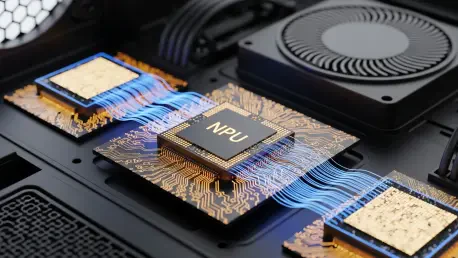
At the core of this technological shift are highly specialized neural network chips, commonly referred to as Neural Processing Units (NPUs) or AI accelerators. These components are not simply a rebranding of existing processors but represent a fundamentally different class of hardware meticulously engineered for a single purpose: to perform the complex matrix multiplication and other mathematical operations that form the bedrock of AI models. Their design is a masterclass in optimization, allowing them to execute machine learning tasks with a level of speed and power efficiency that traditional hardware cannot match. This purpose-built architecture is the key enabler for bringing sophisticated AI capabilities directly to the user’s machine, moving beyond the limitations of generalized processing.
To truly appreciate their impact, it is essential to contrast NPUs with conventional computer components. Central Processing Units (CPUs) have long been the versatile workhorses of computing, adept at handling a wide array of sequential tasks, but they lack the parallel processing architecture needed for efficient AI computation. Conversely, Graphics Processing Units (GPUs), with their highly parallelized structure, have been instrumental in training large AI models; however, their primary design is for rendering complex graphics, not native AI inference. NPUs are distinct from both. They are designed exclusively for AI workloads, allowing them to intelligently offload these specific functions from the CPU and GPU. This strategic division of labor ensures that each component operates at peak efficiency, which not only accelerates AI-driven features but also significantly boosts overall system responsiveness and performance.
From Smartphone to Desktop The Natural Progression
The journey of on-device AI began not on the desktop but in the palm of our hands, with smartphones serving as the initial proving ground for this technology. The strict constraints of mobile devices, particularly the need for extended battery life and always-on functionality, made power-efficient, local processing an absolute necessity. Desktops, historically unburdened by such power limitations and largely assumed to have constant, reliable internet connectivity, were slower to adopt this model. This dynamic is no longer the case. The increasing integration of AI into essential desktop workflows—spanning content creation, software development, scientific research, and advanced data analysis—has created a powerful demand for localized processing power that the cloud cannot always satisfy in terms of speed and privacy.
The desktop form factor possesses inherent advantages that make it the ideal platform for the next wave of advanced AI workloads. Unlike their mobile counterparts, desktops offer superior power delivery, which allows for more powerful and complex AI chips to operate without compromise. They also feature more sophisticated cooling solutions, a critical factor for managing the thermal output of intensive AI processing over extended periods. Furthermore, the greater physical space within a desktop chassis allows for the integration of larger, more capable components, including dedicated AI accelerator cards that provide a significant leap in performance. Current AI-focused desktop builds already feature a hybrid architecture where intelligent scheduling software dynamically directs tasks to the most efficient processor—be it the CPU, GPU, or a dedicated NPU—creating a system that is not only faster at AI tasks but also more responsive and efficient overall.
Tangible Benefits for the Everyday User
Redefining Speed Security and Reliability
The most immediate and palpable advantage of migrating AI processing to the desktop is the dramatic improvement in speed and the near-total elimination of latency. By processing data locally rather than engaging in a time-consuming round trip to a remote server, applications that leverage on-device AI feel remarkably instantaneous. Complex tasks that previously involved a noticeable delay, such as real-time language translation during a video call, applying sophisticated artistic filters to high-resolution video, or generating code suggestions as a developer types, can now be executed in the blink of an eye. This immediacy creates a seamless and fluid user experience, transforming AI from a feature you wait for into an integrated tool that keeps pace with your thoughts and actions, fundamentally altering the nature of human-computer interaction.
Beyond the sheer velocity of local processing, on-device AI delivers two other transformative benefits that address growing concerns in the digital age: enhanced privacy and greater reliability. In an environment where data security is a constant worry, keeping sensitive personal information—including private documents, family photos, voice recordings, and behavioral patterns—on your own machine provides a powerful and inherent safeguard. This model minimizes the risk of exposure to third-party servers, corporate data breaches, or unauthorized access, giving users true ownership and control over their digital lives. Furthermore, by decoupling core AI functionalities from the internet, these powerful features become consistently and dependably available. Whether your network connection is fast, slow, or completely offline, your tools will continue to work, transforming AI from a conditional, online luxury into a robust, always-available utility.
Who Truly Needs an AI Powerhouse?
While the potential of AI-powered PCs is vast, their immediate value is most apparent for specific, high-demand user groups whose workflows are significantly enhanced by local processing power. Content creators, artists, and video professionals stand to gain immensely from cloud-free tools capable of real-time video upscaling, intelligent background removal in complex scenes, and advanced audio noise reduction, all of which can drastically accelerate their production pipelines. Similarly, developers and AI researchers can run, test, and fine-tune complex models directly on their local machines. This capability speeds up the development cycle, facilitates rapid and cost-effective experimentation, and reduces a heavy reliance on expensive, subscription-based cloud computing resources, democratizing access to powerful development tools.
Even gamers, a community long focused on GPU performance, find new benefits in this emerging architecture. While GPUs remain central to rendering immersive worlds, NPUs can act as powerful co-processors, enhancing the gaming experience by powering smarter, more responsive non-player characters (NPCs), enabling real-time voice modification and translation, creating adaptive difficulty systems that learn from player behavior, and handling background tasks like streaming and recording with minimal impact on gaming performance. For these power users, the investment in AI-optimized hardware yields tangible returns in productivity, creativity, and entertainment. However, for casual users whose activities are largely confined to web browsing and light office work, the premium cost may be difficult to justify when existing cloud-based services are sufficient. The decision to upgrade, therefore, should be driven by a clear, workload-based need for the advanced capabilities these systems offer.
A New Era of Personal Computing
The integration of neural network chips into desktop computers marked more than just a hardware upgrade; it signaled a profound philosophical shift in the very concept of personal computing. After a period where devices became thinner and more reliant on external intelligence, the trend decisively reversed, bringing computational power back to the user. The software ecosystem, while still in a transitional phase, has been rapidly adapting to leverage the full potential of this new hardware. Operating systems and applications increasingly incorporate on-device modes and AI-aware schedulers, though universal support is still an ongoing process. This “hardware-leads, software-follows” dynamic is a familiar pattern in major technological transitions. The most significant implication of this shift, however, was the change in ownership. The move away from cloud-based AI, where users effectively rented intelligence from service providers, to local AI, where they owned the processing capability, fostered greater digital independence. This transition restored user control over their data, tools, and creative processes, fundamentally reshaping the personal computer into a smarter, more private, and more powerful tool that ushered in a new chapter in its history.