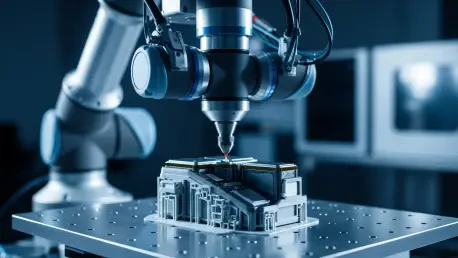

For decades, the relentless march of technological progress has been tethered to the bulky, unyielding geometry of the traditional battery, forcing product designers to build devices around the power source rather than for the user. This long-standing paradigm of designing within the rigid constraints of cylindrical and pouch cells has created inherent inefficiencies, wasting valuable internal volume and stifling true innovation in form and function. Now, a revolutionary manufacturing approach is fundamentally shattering this “industrial gravity” by introducing the concept of 3D-printed, “formless” energy storage that integrates seamlessly into the very structure of a product, promising a new era of design freedom.
The Dawn of Formless Energy
Redefining the Battery Itself
The core of this transformation lies in a novel platform that merges the precision of semiconductor fabrication with the versatility of advanced additive manufacturing. This hybrid system enables the creation of “conformal” batteries, custom-printed power sources that can be shaped to fill any unconventional cavity or be integrated directly into the structural components of a device. By treating electrical power as a fluid design element, engineers are no longer forced to accommodate a pre-shaped block of energy. Instead, they can reclaim previously unusable “dead space” within a product’s chassis, leading to slimmer profiles, lighter weights, and the capacity for additional features. This approach fundamentally shifts the design process from one of compromise to one of optimization, where the energy source conforms to the product’s ideal form, not the other way around. This innovation effectively makes the battery an invisible, integral part of the device itself.
This groundbreaking manufacturing method is deliberately chemistry-agnostic, a crucial distinction that sets it apart from traditional battery development. The primary innovation is not a new chemical formula for storing more ions, but rather a new physical method for constructing the entire battery stack—anode, cathode, separator, and all—in virtually any geometry imaginable. This adaptability ensures the technology remains relevant and can incorporate future breakthroughs in battery chemistry as they emerge. While the industry has been locked in an incremental race for higher chemical energy density, this platform leapfrogs that dynamic by focusing on volumetric efficiency. By eliminating wasted space and integrating the battery into the product’s load-bearing structure, the overall system-level energy density can be dramatically improved, even with existing, proven chemistries. It represents a paradigm shift from pure chemistry to a holistic, electromechanical design philosophy.
A New Performance Benchmark
The tangible benefits of this technology are being demonstrated in some of the most demanding environments, particularly within the aerospace and defense sectors. In a key validation project, custom-printed conformal batteries are being integrated directly into the airframes of Class I unmanned aerial systems (UAS). The projected outcomes are transformative: an increase in pack-level energy densities by over 50% and a concurrent reduction in the battery module’s weight by more than 22%. For a drone, such improvements are not merely incremental; they redefine the system’s entire operational envelope. This leap in performance is achieved by meticulously shaping the battery to fit perfectly within the drone’s structure, turning what was once a bulky, parasitic component into a streamlined, multi-functional element. This real-world application serves as powerful proof that a change in form factor can yield performance gains comparable to a major breakthrough in battery chemistry.
These substantial performance enhancements translate directly into expanded mission capabilities that were previously unattainable. A drone that can fly longer and carry more weight can conduct more persistent surveillance, deliver heavier payloads, or utilize more sophisticated sensor packages. This ability to “push endurance and payload limits further” is a game-changer for defense developers and commercial operators alike. The increased efficiency unlocked by conformal batteries allows for the design of more advanced, capable, and resilient systems without the penalties of increased size or weight. It demonstrates that the future of high-performance design lies not just in more powerful components, but in the intelligent and seamless integration of all systems, especially the power source. This shift proves that the physical arrangement of energy storage is as critical as its chemical composition.
From the Battlefield to Your Pocket
A New Manufacturing Paradigm
Beyond the immediate performance benefits, this additive manufacturing approach to batteries introduces profound strategic implications for national security and supply chain resilience. The ability to print mission-critical power supplies on-demand, using deployable and containerized manufacturing units, offers a powerful solution to the vulnerabilities of fragile global supply chains. This concept of “edge manufacturing” allows for the production of custom batteries at or near the point of need, drastically reducing logistical footprints and eliminating dependence on foreign suppliers for standardized cells. For the defense industrial base, this represents a crucial step toward “manufacturing sovereignty,” providing a decisive technological advantage by ensuring that advanced military hardware is never constrained by the availability of a foreign-produced component. This localized, adaptable production model is poised to become a cornerstone of modern defense strategy.
This new manufacturing capability directly addresses a critical vulnerability in current defense platforms, which are often “strangled by the geometry of commercial batteries.” Military systems frequently have unique power requirements and spatial constraints that are poorly served by off-the-shelf energy solutions, forcing engineers into design compromises that can impact performance and survivability. By enabling the creation of power sources tailored to the specific needs of a mission or a piece of hardware, this technology eliminates a key bottleneck in the development of next-generation defense equipment. It renders the traditional model of relying on established gigafactories obsolete for high-performance, specialized applications. Instead, it fosters a more agile and resilient industrial base capable of producing optimized components that enhance the capabilities of the U.S. and its allies on a fundamental level.
Catalyzing Commercial Innovation
While defense applications currently serve as a powerful proving ground, the potential for this technology extends into nearly every facet of the commercial world. Pilot programs are already underway across a diverse range of industries, including consumer electronics, mobility, robotics, and medical wearables. For consumer electronics, it promises smartphones and laptops that are not only thinner and lighter but also have longer battery life, as the power source can be molded to fill every spare millimeter of internal space. In robotics, custom-shaped batteries could lead to more agile and powerful drones and automated systems with better weight distribution and endurance. For wearables and medical implants, the ability to create ergonomic, biocompatible batteries that conform to the human body could unlock new possibilities in health monitoring and therapeutic devices, making them more comfortable and effective for the user.
Ultimately, the advent of 3D-printed conformal batteries marked a pivotal moment in technological design. The decoupling of energy storage from a fixed, rigid form factor had unlocked a wave of innovation that was previously unimaginable. Product engineers, freed from the long-standing constraint of designing around a standardized battery block, were able to create devices that were more efficient, ergonomic, and powerful. This shift confirmed that the most significant recent leap forward in energy storage was not driven by a breakthrough in chemistry, but by a fundamental revolution in manufacturing and physical form. The move toward integrated, formless power had not just improved existing products; it had enabled the creation of entirely new categories of technology, fundamentally reshaping the relationship between a device and its source of energy.