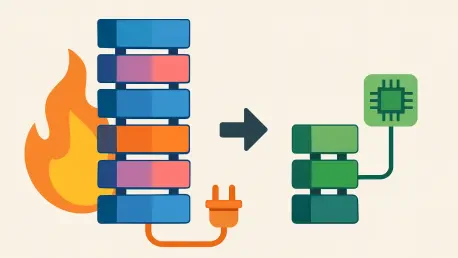

The relentless demand for computational power in generative AI has finally hit a mathematical ceiling where the energy costs of maintaining massive attention mechanisms are no longer sustainable for global enterprise scaling. For years, the industry remained tethered to the Transformer architecture, accepting its “computational gluttony” as a necessary tax for high-quality language modeling. However, the emergence of Mamba-3 signifies a departure from this acceptance, offering a streamlined alternative that prioritizes hardware efficiency and constant memory growth. This review explores how Mamba-3 transitions from a theoretical interest in State Space Models to a production-ready powerhouse that challenges the long-standing dominance of quadratic attention mechanisms.
Evolution of Sequence Modeling: From Transformers to Mamba-3
The transition from the Transformer to Mamba-3 represents a fundamental pivot in how machines process information over time. While the Transformer revolutionized the field through its multi-head attention mechanism, it introduced a significant bottleneck: the KV cache. As a conversation or document grows, the memory required to track relationships between every token grows quadratically, eventually overwhelming even the most advanced hardware. Mamba-3 addresses this by leveraging the mathematical framework of State Space Models (SSMs), which allow for linear scaling. This means that whether a model processes ten words or ten thousand, the memory footprint remains predictable and manageable.
Within the current technological landscape, the shift toward Mamba-3 is not merely an incremental update but a complete overhaul of the “inference-first” design philosophy. The focus has moved away from simply maximizing training throughput toward optimizing the total cost of ownership during deployment. This evolution is driven by the need for sustainable AI—systems that can run on existing data center infrastructures without requiring exponential increases in power consumption. Mamba-3 stands at the forefront of this movement, proving that high-throughput AI does not have to sacrifice the reasoning depth that made Transformers famous.
Core Technical Innovations and Architectural Pillars
The success of Mamba-3 is rooted in its ability to reconcile the efficiency of recurrent neural networks with the performance of attention-based systems. This was achieved through a series of specific architectural refinements that addressed the traditional weaknesses of linear models, particularly their inability to recall specific facts or perform complex logical deductions.
Exponential-Trapezoidal Discretization
The foundational math of Mamba-3 relies on how continuous-time signals are converted into discrete digital steps. Historically, SSMs utilized the Exponential-Euler method, a first-order approximation that often lost nuanced data patterns during the conversion process. Mamba-3 replaces this with a generalized trapezoidal rule, providing a second-order accurate mathematical approximation. This change is significant because it induces an implicit convolution within the model’s internal logic. By achieving higher accuracy in discretization, the architecture streamlines its internal flow, allowing researchers to remove traditional short causal convolution components that were previously necessary to stabilize the model.
This refinement serves as a mechanical simplification that paradoxically increases the model’s sophistication. The second-order accuracy ensures that the “digital twin” of the data sequence is far more faithful to the original input than in previous iterations. Consequently, Mamba-3 can maintain a much smaller internal state while capturing the same volume of information. This efficiency is the primary driver behind its ability to outperform larger, more cumbersome models on standard benchmarks, effectively doing more with less mathematical overhead.
Complex-Valued SSMs and the RoPE Trick
One of the most persistent criticisms of linear logic models was their struggle with state-tracking and parity tasks—simple logical tests that Transformers handle with ease. This limitation existed because earlier versions were restricted to real-valued numbers, which lacked the capacity to represent the “rotational” logic required for tracking shifting patterns over long sequences. Mamba-3 overcomes this by adopting complex-valued State Space Models. By operating in the complex plane, the model can utilize phase shifts to track data-dependent relationships, a capability that was previously the exclusive domain of attention mechanisms.
The implementation of the “RoPE trick” further bridges this gap by equating complex state updates to data-dependent rotary embeddings. This mathematical bridge allows Mamba-3 to simulate the positional awareness of a Transformer within a linear-time framework. The result is a model that no longer suffers from the reasoning gap that hindered its predecessors. It can now track the “state” of a bit sequence or a logical argument with precision, ensuring that its constant memory requirement does not lead to a loss of contextual fidelity or analytical rigor.
Multi-Input, Multi-Output (MIMO) Formulations
To maximize hardware utilization, Mamba-3 transitions to a Multi-Input, Multi-Output (MIMO) structure, specifically designed to solve the “cold GPU” problem. In traditional single-input systems, the processor often sits idle while waiting for data to move from the memory to the compute units. This memory-bound state is the primary cause of inefficiency in modern AI inference. By moving to a MIMO formulation, Mamba-3 increases its arithmetic intensity, meaning it performs more mathematical operations for every byte of data moved.
This transition allows the architecture to perform up to four times more parallel operations during the decoding phase. Instead of processing information in a strictly serial fashion, the matrix-multiplication-based update utilizes the latent power of existing GPU clusters to handle multiple data streams simultaneously. This does not just speed up the generation of text; it transforms the economic profile of AI deployment. Enterprises can now achieve significantly higher throughput on the same hardware, drastically reducing the cost per token and making high-volume AI applications more financially viable.
Emerging Trends in Linear Logic and Inference Efficiency
A broader industry shift is currently prioritizing the reduction of the “KV cache” burden, which has led to a renaissance in models that maintain a constant internal state size. As organizations move toward deploying AI on edge devices and decentralized networks, the ability to operate within a fixed memory budget is becoming a mandatory requirement rather than a luxury. Mamba-3 fits perfectly into this trend, providing a blueprint for models that can handle massive contexts without requiring a data center’s worth of RAM for a single user session.
Moreover, the rise of “inference-first” development is changing the criteria by which new architectures are judged. While training speed remains important, the industry is increasingly focused on the total cost of ownership (TCO) over the model’s lifecycle. Mamba-3 aligns with this trend by doubling throughput without sacrificing language modeling quality. This shift suggests that the next generation of AI development will be characterized by mathematical elegance and efficiency rather than a “brute force” approach of simply adding more parameters and more compute.
Real-World Applications and Deployment
The practical advantages of Mamba-3 are most visible in “agentic workflows,” where AI systems act as autonomous assistants in coding, legal research, or customer service. In these scenarios, the model must maintain a high-fidelity internal state over long periods, often processing thousands of lines of code or pages of documentation in a single session. Mamba-3’s constant memory requirement ensures that these agents do not slow down or become prohibitively expensive as the task complexity increases, allowing for real-time, low-latency interaction.
Beyond text, the architecture is proving revolutionary in fields like genomics and long-form legal analysis. Processing DNA strands, which can consist of millions of base pairs, was previously a challenge for Transformers due to the quadratic memory explosion. Mamba-3 handles these massive sequences with ease, maintaining a “digital snapshot” of the entire strand without losing detail. Its permissive Apache 2.0 license has further accelerated this adoption, allowing specialized industries to build proprietary, high-performance tools on top of the Mamba-3 foundation without the restrictive costs of closed-source alternatives.
Technical Hurdles and Adoption Challenges
Despite its theoretical and practical successes, Mamba-3 faces a significant uphill battle regarding the established infrastructure of the AI industry. For nearly a decade, both hardware and software have been hyper-optimized specifically for the attention mechanism. Specialized CUDA kernels, compiler optimizations, and even the physical design of modern AI chips are tailored to the Transformer. Transitioning to a new architecture like Mamba-3 requires substantial engineering effort to rebuild these software pipelines and ensure that the new models can actually leverage the hardware as intended.
Another challenge lies in the precision of data retrieval. While SSMs excel at maintaining a general context, they sometimes struggle with “needle-in-a-haystack” tasks where a single, specific fact must be retrieved from millions of tokens. Transformers, by their nature, look at everything at once, making them inherently better at this specific type of retrieval. Current development efforts are focused on refining hybrid models that combine the efficient memory of SSMs with the precise retrieval of attention layers, but finding the perfect balance remains a work in progress for the engineering community.
Future Outlook and Paradigm Shifts
The path forward for sequence modeling appears to be a hybrid one, where the strengths of different architectures are interleaved to create more robust systems. It is likely that Mamba-3 layers will be used to handle long-range context and state management, while occasional self-attention layers will be inserted to handle high-precision data retrieval. This “best of both worlds” approach could lead to models that are both incredibly fast and intellectually rigorous, potentially making the pure Transformer architecture obsolete for many general-purpose applications.
In the long term, Mamba-3 may redefine the physical requirements for AI hardware. As models become more efficient and rely less on massive memory caches, we might see a shift toward more decentralized and accessible high-performance AI. If a model can perform complex reasoning with half the state size, it becomes feasible to run sophisticated intelligence on consumer-grade hardware or smaller, local servers. This would democratize access to advanced AI, moving the center of gravity away from a few massive cloud providers and toward a more distributed ecosystem.
Final Assessment of the Mamba-3 Architecture
Mamba-3 successfully bridged the performance gap between State Space Models and Transformers, having achieved superior perplexity and reasoning with half the state size of previous iterations. The model moved past the limitations of first-generation SSMs by introducing complex-valued logic and second-order discretization, which allowed it to match the reasoning capabilities of attention-based systems. It effectively demonstrated that the “computational gluttony” once thought to be a requirement for intelligence was actually a byproduct of architectural inefficiency.
The model represented a pivotal shift in AI design, having proven that mathematical elegance could significantly reduce the environmental and financial costs of large-scale inference. By prioritizing hardware utilization through MIMO formulations and reducing the memory burden on GPUs, the architecture provided a viable path for the next generation of generative intelligence. Its overall impact on the AI sector was profound, as it offered an open-source alternative that combined the speed of linear logic with the predictive power of the world’s most advanced language models. Mamba-3 did not just offer a faster model; it offered a more sustainable vision for the future of artificial intelligence.