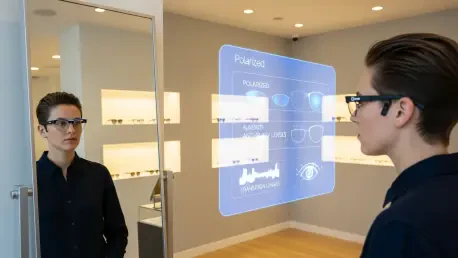

The sight of individuals engaging with invisible digital interfaces while walking through city streets has transitioned from a specialized novelty into a standard feature of modern urban life. As of mid-2026, augmented reality has successfully moved beyond the bulky headsets of the past, shedding its reputation as a niche gaming accessory to become a fundamental tool for productivity and communication. This transformation is not merely the result of one specific invention but rather a perfect storm of design refinement, cloud computing maturity, and a collective shift in consumer expectations regarding personal computing. Rather than pulling a slab of glass from a pocket to check directions or messages, users now rely on subtle, lightweight frames that overlay information directly onto their field of view. The normalization of these devices has effectively ended the era of looking down, replacing it with a heads-up interaction model that feels more natural and less intrusive to social environments.
Convergence of High Fashion and Intelligent Glassware
A significant factor in this widespread adoption is the strategic alliance between established eyewear giants and the architects of Silicon Valley. The collaboration between Warby Parker and Google stands as a primary example of how aesthetics have finally taken a front seat in the development of smart technology. By integrating high-resolution waveguides and miniature AI-driven sensors into frames that look identical to traditional prescription glasses, the industry has successfully mitigated the social friction that once plagued early prototypes. Consumers no longer feel like they are wearing a laboratory experiment on their faces; instead, they are selecting a style that reflects their personality while gaining access to real-time language translation and visual search. This move toward invisible tech has encouraged even the most hesitant demographics to embrace augmented reality, as the barrier between corrective lenses and sophisticated digital displays has essentially vanished.
This evolution in hardware aesthetics is mirrored by aggressive structural changes within the corporate landscape designed to accelerate the pace of product cycles. For instance, the recent decision by Snap to spin off its augmented reality division into an independent subsidiary highlights the urgent demand for specialized innovation and external venture capital. This restructuring allows the new entity to focus exclusively on refining spatial mapping and gesture recognition without the overhead of a social media conglomerate. By operating as a standalone pioneer, the company can form diverse partnerships with various hardware manufacturers, ensuring that its AR operating system becomes a universal layer for third-party developers. This competitive environment has forced rivals like Meta to diversify their offerings, leading to a broader range of price points and functional capabilities. The result is a market saturated with options that cater to every need, from high-end professional tools to budget-friendly models.
Solving Technical Bottlenecks Through Engineering Excellence
The technological landscape of 2026 has been defined by a series of breakthroughs presented during the recent Consumer Electronics Show, which addressed the historical limitations of wearable computing. Engineers have finally managed to overcome the persistent challenges of thermal management and battery density that previously limited devices to short bursts of activity. New silicon architectures specifically designed for low-power spatial processing now allow glasses to run for a full day on a single charge without generating uncomfortable levels of heat near the temples. Furthermore, manufacturers like Xreal have democratized access to these features by producing high-fidelity displays at a price point comparable to a mid-range smartphone. These advancements ensure that the immersive experience is consistent across various platforms, whether the user is viewing a complex 3D architectural model or simply following a persistent navigation arrow toward a nearby transit station.
While hardware stability has provided the foundation, the anticipated arrival of a premium device from Apple toward the end of 2026 has set a new standard for ecosystem integration. This looming presence has catalyzed the entire industry to refine user interfaces and ensure that cross-platform compatibility remains a priority for software developers. Meta has responded by expanding its mixed-reality prototypes into a comprehensive suite of devices that range from simple heads-up displays to fully immersive spatial workstations. This competition has pushed the boundaries of what is possible with hand-tracking and voice-driven commands, making the mouse and keyboard feel increasingly archaic in many professional settings. As these ecosystems become more entrenched, the choice of a device is becoming less about the internal specifications and more about how well the hardware integrates with one’s digital life. The focus has shifted from the novelty of the hardware to the practical utility.
Establishing a Permanent Presence in Global Markets
The shift toward mainstream status is perhaps most visible in the way these devices are now sold and supported through traditional retail and medical channels. By integrating smart glasses into physical storefronts and optical insurance networks, augmented reality has become a standard point-of-sale option alongside traditional eyewear. Major vision insurance providers have begun covering a portion of the cost for smart frames, recognizing their utility in assisting those with visual impairments or enhancing the capabilities of professionals in the field. This institutional support has removed the financial and logistical hurdles that once kept augmented reality as a hobby for early adopters. Now, a person visiting a local optician can walk out with a pair of glasses that not only correct their vision but also connect them to a global network of information. This ease of access, combined with a robust secondary market, has solidified the presence of these wearables in the daily routine.
Looking back at the rapid progression of this industry, it was clear that the groundwork for a more intuitive digital future was laid through a combination of engineering prowess and a keen understanding of human behavior. The industry successfully moved away from the idea of technology as a destination and toward the concept of technology as a companion. Businesses and consumers alike had to re-evaluate their relationship with the digital world as the boundaries between physical and virtual spaces became increasingly porous. As the market matured, the focus shifted toward creating sustainable ecosystems that prioritized user privacy and ergonomic comfort. These developments ensured that the adoption of wearable displays was not a fleeting trend but a fundamental shift in how human beings interacted with their environment. The transition was finalized through the establishment of global standards for spatial data, allowing for a seamless experience across different regions. The commitment provided a clear path for ongoing growth.