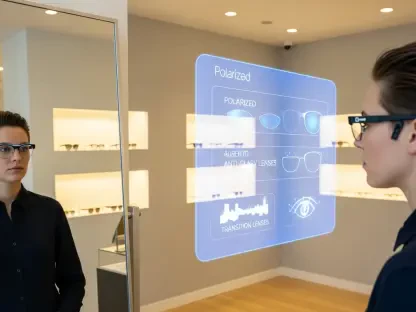

The landscape of wearable technology experienced a seismic shift this week following the surprising revelation of a partnership between Google and Warby Parker to launch AI-powered smart glasses in 2026. This announcement has effectively upended the industry’s projected timeline, transforming what was once a slow-moving platform battle into an urgent retail distribution race. With a firm launch year now on the calendar, the pressure is mounting for competitors, supply chain partners, and software developers who had anticipated a more gradual market evolution. The deal immediately shifts expectations for the entire augmented reality (AR) sector, forcing difficult trade-offs between features, price, and speed to market much sooner than anticipated. For tech firms and retailers, the timeline to deliver useful and accessible AR hardware before the next major holiday season cycle has been dramatically compressed, raising a critical question: will mainstream consumers finally be ready to adopt smart glasses as an everyday accessory?
1. The Strategic Pivot from Platform Wars to Retail Dominance
The collaboration’s true significance lies not just in the technology but in its go-to-market strategy, which leverages an established retail partner to overcome historical barriers to adoption. By planning to sell the glasses through Warby Parker’s extensive network of stores and opticians, the partnership directly addresses practical consumer hurdles like prescription lens integration, personalized fitting, and simplified returns. This model starkly contrasts with the tech-first rollouts of the past, which often targeted developers and early adopters through online-only channels, leaving mainstream buyers hesitant. Framing the device as an optical product first and a tech gadget second could be the key to demystifying AR for the average person. This practical distribution angle provides a tangible advantage that sophisticated platform demonstrations alone cannot match, potentially pressuring rivals like Meta to urgently clarify their own retail strategies and 2026 product roadmaps to avoid being left behind in the race for consumer accessibility and trust.
This newly established 2026 deadline reverberates throughout the entire wearables ecosystem, acting as a powerful catalyst that compresses development and investment timelines. Venture capital firms and supply chain manufacturers, which had previously based their forecasts on a slower, more deliberate rollout of AR technology, are now forced to accelerate their operations and capital expenditures to meet the impending market demand. The timing is particularly critical when viewed against the backdrop of competitor movements. Meta’s decision to delay its own advanced AR glasses, codenamed Phoenix, to 2027 suddenly appears less like a strategic pause and more like a significant setback. This staggered timeline provides the Google-Warby Parker alliance a crucial, uncontested window to capture market share and establish its product as the industry standard. Competitors face a difficult choice: either rush their own hardware to market, potentially compromising on quality, or double down on building a superior developer ecosystem in the hopes of luring customers away later.
2. A New Era of Consumer Expectations
The unexpected announcement was met with a mix of surprise and pragmatic approval from industry insiders, who have long cited mainstream distribution as the missing link for widespread AR adoption. Financial analysts and retail investors reacted positively to the establishment of a concrete launch year, as it injects a dose of certainty into a market that has been characterized by speculative timelines and lab-based demonstrations. This development signals a tangible shift for AR, moving it from the conceptual phase to the commercial floor. However, this optimism is tempered by words of caution from hardware engineers, who warn that an accelerated shipping schedule could force compromises on essential features like battery longevity, processing efficiency, or the overall durability of the device. Consequently, as the 2axunch approaches, the industry’s focus will inevitably shift toward emerging pricing signals and early product reviews, which will be instrumental in shaping consumer demand forecasts and setting a competitive benchmark for all subsequent entries into the market.
3. The Dawn of a New Wearable Paradigm
The formal announcement of a 2026 launch marked a definitive turning point for the wearable technology sector, fundamentally altering the perceived trajectory of augmented reality. The collaboration between a technology giant and an established optical retailer reframed the challenge of AR adoption, shifting the focus from purely technological innovation to practical consumer accessibility. It became clear that the path to the mainstream market was not paved solely with advanced spatial computing features but with tangible considerations like prescription integration, physical comfort, and a trusted sales and support network. This strategic pivot forced competitors to immediately re-evaluate their long-term roadmaps, accelerating the entire industry’s focus on user-centric design and real-world utility. Ultimately, the market had been shown a viable blueprint for transforming AR glasses from a futuristic concept into an everyday consumer electronic.