
A groundbreaking new study analyzing billions of artificial intelligence interactions has revealed a stark and fascinating disconnect between the industry’s productivity-focused narrative and how people are actually engaging with this transformative technology. By examining metadata from over 100 trillion tokens processed across more than 300 large language models, the research offers an unprecedented, globally representative view of AI usage that challenges long-held assumptions. The findings, which preserve user privacy by analyzing only interaction patterns and not content, indicate that the AI revolution is far more nuanced, diverse, and surprising than commonly believed. Rather than a world dominated solely by business efficiency, the data paints a picture of a vibrant ecosystem driven by creativity, complex problem-solving, and a rapidly shifting global landscape that is redefining the future of artificial intelligence.
The Surprising Dominance of Creative Play
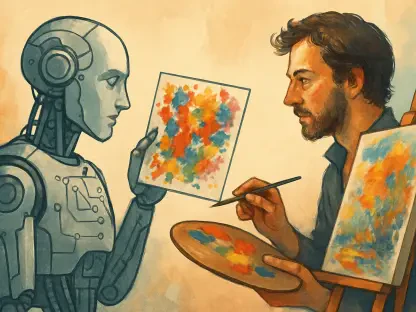
Perhaps the most startling discovery from the extensive data analysis is that the majority of open-source AI model usage is not for professional productivity but for creative and entertainment purposes, specifically roleplay and interactive storytelling. This category accounts for over half of all interactions with these models, a figure that significantly overshadows more conventional business applications like writing emails or summarizing documents. This finding directly contradicts the widespread industry assumption that AI’s primary function in the public sphere is to serve as a professional assistant. The sheer scale of this usage pattern suggests a fundamental misunderstanding of what a large segment of users truly seeks from AI, pointing toward a massive and largely untapped market for AI-driven entertainment and creative expression.
This engagement is far from simple or casual; the data indicates a highly structured and sophisticated form of interaction. Users are treating these AI models as advanced roleplaying engines, with an estimated 60% of these creative sessions occurring within specific gaming scenarios and imaginative writing contexts. This trend reveals a powerful, underlying demand for AI as a tool for companionship, narrative exploration, and personal creativity. For AI companies, this massive and largely unpublicized use case is a critical insight, forcing a reconsideration of product strategies to acknowledge a powerful market that extends far beyond the corporate world and into the deeply personal realms of play and imagination. It signals that the human need for connection and storytelling is a potent driver of technological adoption.
The Professional Powerhouse of Programming
While roleplay dominates the open-source sphere, the single fastest-growing category across all AI models—both open-source and proprietary—is programming assistance. The data reveals a dramatic surge in this use case throughout 2025, a year that saw coding-related queries skyrocket from a modest 11% of total AI usage to an astonishing 50% by the year’s end. This exponential growth demonstrates AI’s rapid and profound integration into the software development lifecycle, transforming it from a niche tool into an indispensable partner for developers worldwide. The speed of this adoption suggests that AI is not just augmenting the work of programmers but is fundamentally reshaping the practices and workflows of the entire software industry, accelerating development cycles and enabling new levels of complexity.
The sophistication of these developer interactions has also evolved significantly. The average prompt length for programming tasks grew fourfold over the year, with some advanced requests exceeding 20,000 tokens—equivalent to feeding an entire codebase to the AI for comprehensive analysis. This indicates a clear transition from developers asking for simple code snippets to engaging in highly complex, multi-step tasks such as advanced debugging, architectural reviews, and sophisticated problem-solving. In this specialized domain, Anthropic’s Claude models have emerged as a dominant force, capturing over 60% of programming-related usage for most of 2025 and setting a high bar for performance in complex technical reasoning and code generation.
A Shifting Global and Technological Landscape
The research highlights a fundamental realignment of the global AI landscape, with Chinese models rapidly gaining substantial market share. At the start of 2025, these models accounted for 13% of global usage; by the end of the study period, their share had nearly tripled to approximately 30%. Models from companies like DeepSeek, Qwen, and Moonshot AI have seen remarkable traction, signaling that the era of unchallenged dominance by Western AI companies is coming to a close. This geopolitical shift is further reflected in linguistic data, with Simplified Chinese becoming the second-most common language for AI interactions globally. In a related development, Asia’s overall share of AI spending more than doubled, and Singapore has notably emerged as the second-largest country by AI usage, trailing only the United States.
A core technological trend identified by the study is the rise of “agentic inference,” which describes a fundamental shift in how AI models function. These systems are moving beyond being passive text generators that answer single questions to become autonomous agents capable of executing complex, multi-step tasks. An agentic AI can reason through problems, call upon external tools like APIs or databases, and maintain context across extended interactions to achieve a specific goal. The data supporting this trend is compelling: the share of AI interactions classified as “reasoning-optimized” surged from nearly zero at the start of 2025 to over 50% by the year’s end. This transforms the utility of AI from simply “writing a function” to being able to “debug this entire codebase and implement a solution.”
Recalibrating Our View of the AI Market
The study’s deep dive into user behavior offered fascinating insights into market dynamics, challenging the notion that the AI space is becoming a simple commodity. It found that user loyalty is not primarily driven by price but by performance on high-value tasks. This “Cinderella ‘Glass Slipper’ Effect” described a powerful mechanism for user retention: when a new model was the first to solve a critical need for a user, it created exceptionally strong and lasting loyalty. Furthermore, the analysis concluded that the market was relatively price-inelastic, with a 10% price decrease yielding only a minor increase in usage. This reality allowed a diverse market to flourish, where premium models from providers like Anthropic and OpenAI coexisted with budget-friendly, high-scale alternatives, proving that users made calculated trade-offs between cost and quality. This nuanced understanding of user choice provided a vital correction to the mainstream narrative, revealing a market driven by tangible results rather than a race to the bottom on price.