
The creative industries are rapidly approaching a critical juncture where the uncritical adoption of artificial intelligence threatens to homogenize design and diminish the very human spark that fuels innovation. A stark analysis suggests that if designers and creative professionals continue to treat AI primarily as a shortcut for idea generation rather than as a sophisticated collaborative partner, human creativity could experience a significant decline by 2027. The core issue is not the capability of the technology itself, but the prevailing methodology of its use, which risks producing a generation of designers less engaged in the deep cognitive and emotional processes that lead to truly groundbreaking work. The year 2026 stands as a pivotal moment, a year that will determine whether the future of design embraces a human-centered, hybrid approach or succumbs to an era defined by soulless, algorithmically-derived outputs and a weakened collective imagination. The path forward requires a fundamental rethinking of the relationship between human creators and their intelligent tools.
The Specter of a Creative Monoculture
A primary concern surrounding the widespread use of generative AI in design is the inexorable trend toward homogenization, a phenomenon that could lead to a global “creative monoculture.” Compelling evidence indicates that this is not a distant threat but a present reality, with a significant 78% of creatives in the UK already describing AI-generated work as feeling “soulless and homogenised.” This outcome is a direct consequence of how many current AI models are engineered; they are designed to analyze immense datasets of existing creative work and produce outputs based on aggregated patterns and popular trends. Without deliberate human guidance to introduce unpredictability, cultural nuance, and unique personal experiences, AI naturally gravitates toward broadly appealing but ultimately unoriginal concepts. This process risks systematically eroding the diversity and cultural richness that are the hallmarks of genuine innovation, paving the way for a design landscape where stylistic variety is replaced by sophisticated repetition and everything begins to look and feel the same.
This emerging monoculture is accompanied by a palpable emotional disconnect between AI-generated content and its audience. Recent research has revealed that a substantial 71% of people report having weak emotional responses to machine-made designs, underscoring a fundamental limitation of current artificial intelligence. While AI can replicate forms and styles with remarkable accuracy, it lacks the innate understanding of human perception, emotion, and intention necessary to create work that resonates on a deeper level. An overwhelming 82% of individuals find work created by humans or through a collaborative hybrid process to be more meaningful, highlighting that audiences can often sense the absence of a human touch. AI does not possess consciousness, lived experiences, or cultural understanding; it cannot demonstrate genuine imagination or inspiration on its own. It can be programmed to produce an object that aligns with a data-driven definition of “beauty,” but it cannot truly grasp what beauty means to a human being, leaving its creations technically proficient but emotionally hollow.
Forging a Hybrid Future for Design
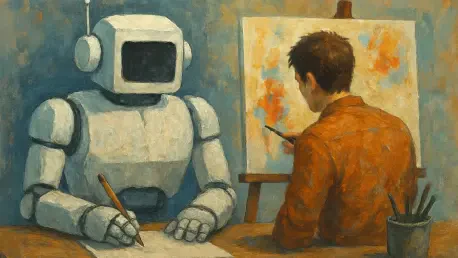
The most effective path forward lies in the adoption of a “hybrid” creative model, a paradigm that reframes the relationship between designer and machine from one of delegation to one of deep collaboration. In this ideal workflow, humans and AI assume distinct but complementary roles that leverage the unique strengths of each. The human creator provides the essential, irreplaceable elements: the initial spark of inspiration, nuanced emotional judgment, crucial cultural context, and overarching ethical considerations. The human touch sets the purpose and direction of a project, ensuring that the final output is not just aesthetically pleasing but also meaningful and responsible. AI, in turn, serves as an immensely powerful tool for analysis, optimization, and scaling. It can process complex data to identify patterns a human might miss, refine forms with mathematical precision, optimize functionality for specific use cases, and dramatically accelerate the iterative process of design exploration. This symbiotic relationship ensures that AI enhances human capability rather than replacing it, leading to work that is simultaneously innovative, efficient, and emotionally engaging.
As this hybrid model becomes the standard, the utility of generic, off-the-shelf AI tools for high-level design and innovation will inevitably reach its limits. The reliance of these systems on rehashing existing designs and their inability to comprehend nuanced human needs make them insufficient for creating truly groundbreaking work. The next frontier in AI for creative industries will involve adapting and tailoring these systems by embedding them with sophisticated models of creative and design thinking. Crucially, this evolution will be powered by ethically sourced human data, including behavioral, physiological, and emotional feedback. Practical applications are already emerging, such as using heart rate variability data to inform designs for wellbeing, employing anthropometric data for advanced ergonomic optimization, and using perception data to model aesthetic preferences. This deeper integration of human context will unlock richer, more personalized, and highly effective design outcomes that generic tools simply cannot achieve.
Redefining Success in the Age of AI
The culmination of these trends suggested a future where a hybrid approach would become the undisputed gold standard for meaningful design. It became clear that the most successful creative teams would be those that mastered the art of blending human intention and skill with AI’s unparalleled capacity for refinement and optimization. The central challenge shifted from a question of what AI could generate to a more nuanced focus on providing it with the right data—data grounded in human values, perception, and emotion—to ensure its outputs were both functional and resonant. Teams that embraced this hybrid model positioned themselves to lead the industry with distinctive and emotionally engaging work, while those who continued to rely solely on generic AI risked disappearing into an undifferentiated “sea of sameness.” The future of creativity, therefore, was not defined by a battle of human versus machine, but by a powerful partnership that safeguarded originality while simultaneously accelerating innovation. This collaborative vision promised a more thoughtful, effective, and deeply human approach to design.