
Modern medical centers are currently facing an unprecedented deluge of data, with diagnostic imaging departments generating vast quantities of high-resolution images daily from modalities like CT scans, MRIs, and X-rays. This surge in information, while essential for patient care, has created a significant challenge for medical professionals who must meticulously analyze each image in a time-consuming and complex process that is inherently subject to human variability and fatigue. The sheer volume of this data stream threatens to overwhelm even the most experienced specialists, creating bottlenecks that can delay diagnoses and impact patient outcomes. In response to this critical need, artificial intelligence has emerged not as a replacement for human expertise but as a powerful and indispensable ally, poised to revolutionize how medical images are interpreted and leveraged for clinical decision-making, thereby ushering in a new era of efficiency and precision in healthcare delivery.
Enhancing Diagnostic Acuity and Efficiency
The Power of Algorithmic Pattern Recognition
At the heart of AI’s diagnostic capability lies the sophisticated architecture of machine learning and deep learning neural networks, which are meticulously trained on immense, curated datasets of clinical and imaging data. These algorithms learn to identify and classify intricate patterns, subtle anomalies, and early indicators of disease with a level of precision that can rival, and in some cases surpass, that of the human eye. By processing thousands of images in a fraction of the time it would take a human specialist, these systems can dramatically accelerate diagnostic workflows. This computational power not only alleviates the significant workload placed on radiologists and other medical professionals but also enables a more efficient allocation of resources within healthcare facilities. The result is a faster diagnostic response time, which is often critical for effective treatment, and a more streamlined process that allows specialists to dedicate their valuable time to the most complex and ambiguous cases, ultimately elevating the standard of care.
A Symbiotic Partnership in Clinical Practice
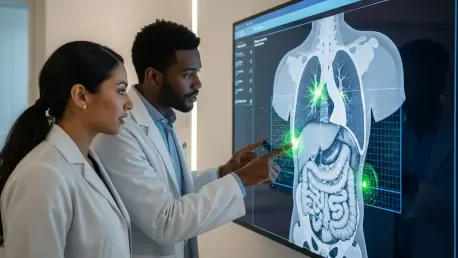
The integration of artificial intelligence into clinical workflows is fostering a symbiotic relationship between technology and medical specialists, where AI functions as an advanced assistant rather than an autonomous decision-maker. These intelligent systems are designed to augment the capabilities of clinicians by performing preliminary analyses, highlighting regions of interest, and flagging potential abnormalities that require further investigation. For instance, an AI tool might automatically segment a tumor, calculate its volume, and compare its characteristics to a vast database of similar cases, providing the oncologist with quantitative data to inform their diagnosis and treatment plan. This collaborative model ensures that the final interpretation and clinical judgment remain firmly in the hands of the trained medical expert, who can leverage the AI’s insights while considering the broader context of the patient’s history and symptoms. This synergy minimizes the risk of diagnostic error, enhances consistency, and empowers physicians to make more informed decisions with greater confidence.
Paving the Way for Personalized Healthcare
From Reactive Diagnosis to Proactive Prediction
The transformative potential of AI extends far beyond the realm of initial diagnosis, promising to redefine the landscape of personalized and preventive medicine. By analyzing and synthesizing disparate data streams—including medical images, electronic health records, genomic information, and other omics data—AI algorithms can uncover complex correlations and predictive biomarkers that are not discernible through conventional analysis. This capability allows for the development of sophisticated predictive models that can forecast disease progression, estimate a patient’s risk for developing certain conditions, and predict their likely response to various treatment options. This shift from a reactive to a proactive healthcare model enables the creation of highly tailored treatment plans, moving away from a one-size-fits-all approach. For patients, this means receiving therapies optimized for their unique biological profile, leading to better outcomes, reduced side effects, and an enhanced quality of life, while also contributing to a more sustainable and cost-effective healthcare system.
Navigating the Implementation and Ethical Landscape
Despite its immense promise, the widespread integration of artificial intelligence into routine clinical practice is a progressive journey fraught with significant challenges that must be carefully navigated. Ensuring the security, privacy, and ethical use of sensitive patient data is of paramount importance, requiring the development of robust governance frameworks and advanced cybersecurity measures. Furthermore, every AI algorithm intended for clinical use must undergo rigorous and transparent validation through extensive clinical trials to prove its safety, accuracy, and efficacy before it can be deployed. Equally crucial is the adequate training of healthcare professionals, who must learn to use these powerful new tools effectively and judiciously, understanding their capabilities as well as their limitations to avoid over-reliance or misinterpretation. Addressing these technical, ethical, and educational hurdles through collaborative effort is essential for the responsible and successful adoption of AI in healthcare, ensuring it serves to enhance, not compromise, the quality of patient care.
A Fundamental Shift in Medical Paradigms
The responsible and collaborative adoption of artificial intelligence initiated a profound transformation in diagnostic imaging and the broader healthcare system. This technological evolution has not only addressed the critical challenges of data overload and diagnostic complexity but also paved the way for unprecedented advancements in personalized medicine. By augmenting the capabilities of medical specialists, these systems fostered new avenues of research and significantly elevated the efficiency and quality of the entire care continuum. Ultimately, the integration of AI has marked a pivotal moment, steering the practice of medicine toward a more predictive, personalized, and preventive model that has enhanced patient outcomes and redefined the standards of clinical excellence.