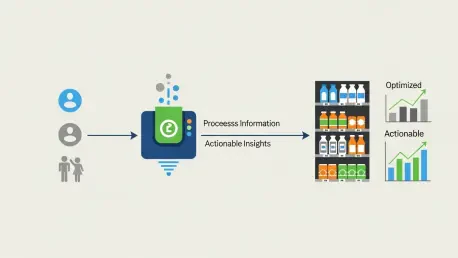

The vast oceans of consumer data collected by retailers have long promised a competitive edge, yet many organizations find themselves drowning in information while thirsting for actionable wisdom. A fundamental transformation is underway, moving beyond the static limitations of traditional data presentation toward a dynamic, conversational paradigm where artificial intelligence serves not as a mere reporting tool but as an active partner in commercial decision-making. This evolution aims to dissolve the costly delay between insight and execution, embedding predictive analytics directly into the daily workflow of the people who need it most.
Bridging the Critical Gap Between Data and Decisions
From Passive Dashboards to Active Dialogue
For decades, the standard for delivering business intelligence has been the dashboard, a visual but passive medium that often requires specialized analysts to decipher charts and tables before insights can be passed to business leaders. This process inherently creates a bottleneck, extending decision cycles from minutes to days or even weeks. The emerging paradigm of conversational AI fundamentally alters this dynamic by transforming data consumption into an active dialogue. It empowers merchandisers, pricing teams, and senior executives to pose direct, natural-language questions about product performance, consumer demand, and market trends, receiving immediate, data-backed answers. This shift drastically compresses the timeline from inquiry to action, allowing teams to iterate on strategy in real time and align their choices with predictive models rather than historical guesswork or intuition alone.
This technological evolution directly targets the persistent “insight-to-execution” gap, a challenge where valuable customer data is collected but fails to translate into timely, impactful business actions. Research has consistently shown that the commercial value of AI is unlocked not merely by generating profound insights but by shortening the distance between having that insight and executing a decision based on it. Conversational AI platforms serve as a bridge across this gap by integrating predictive analytics into the most crucial phases of the retail calendar, such as line reviews, initial concept development, and pricing strategy meetings. By making data immediately accessible and relevant at these pivotal moments, the technology moves analytics from a retrospective reporting function to a proactive, strategic asset that informs decisions from their inception, ensuring they are grounded in forward-looking consumer intelligence.
Empowering the Entire Organization
A central objective of this technological pivot is the democratization of sophisticated data analytics, making powerful insights accessible far beyond dedicated data science teams. By enabling users to interact with complex models through simple, natural-language queries, companies can empower non-technical staff and leadership to engage directly with the data that drives their business. This broader accessibility removes the friction and delay associated with traditional reporting requests, fostering a more agile and data-literate culture throughout the organization. This trend toward democratization is a recurring industry theme, as it leads to significantly higher tool adoption rates and, consequently, a more substantial return on investment in analytics platforms by ensuring that their capabilities are leveraged by a wider array of decision-makers.
However, the widespread distribution of powerful analytical tools necessitates a robust framework of governance to prevent misinterpretation and ensure the integrity of business decisions. While empowering users is critical, it must be balanced with controls that guarantee the outputs from these systems are based on high-quality, methodologically sound data. Leading conversational AI platforms address this challenge by retaining the rigorous analytical engine and validated data models of their underlying platforms while presenting the information through a simplified, intuitive interface. This approach maintains scientific discipline behind the scenes, ensuring that even as access is broadened, the insights delivered are reliable and contextually accurate. This careful balance allows retailers to harness the speed of conversational AI without sacrificing the precision and trustworthiness required for high-stakes commercial planning.
The New Frontier of Retail AI Usability and Precision
Focusing on High-Impact Commercial Applications
The application of this new wave of AI is not arbitrary; it is strategically focused on areas with the highest potential for commercial impact, moving beyond generalized analytics to solve specific, pressing retail challenges. These systems are engineered to answer critical questions related to price optimization, assortment planning, predicted sales rates for new items, and the nuanced preferences of different consumer segments. This targeted approach aligns with extensive research showing that data-driven pricing and assortment models significantly outperform traditional methods based on historical performance or gut instinct. Furthermore, the ability to perform sophisticated competitive benchmarking is a key function, as these platforms can consolidate vast amounts of internal, consumer, and market data into a single, queryable layer, providing a distinct advantage in a crowded and fast-moving marketplace.
The true innovation propelling this evolution forward is less about the underlying predictive techniques—which have been in use by major retailers for some time—and more about the interface and user experience. While established retailers have long leveraged predictive analytics to refine assortments, optimize pricing, and reduce markdown risk, the latest market offerings are differentiating themselves on usability, speed, and intuitiveness. Recent market analyses confirm this direction, observing that conversational interfaces are increasingly being layered atop established analytics platforms to meet escalating user demand for more direct and fluid data interaction. This focus on user-centric design makes complex analytical power accessible and practical for everyday use, effectively embedding advanced data science into the fabric of routine commercial operations without requiring users to become data scientists themselves.
Innovation in Interface, Not Just Intelligence
The core technology powering these next-generation tools is often a “predictive retail large language model,” a specialized form of AI trained on immense, proprietary datasets of consumer response data, product attributes, and market signals. This industry-specific training allows the model to understand the unique context and nuances of retail queries, providing highly relevant answers to complex questions that a general-purpose AI could not. For instance, it can accurately assess whether a six-item or a nine-item assortment would perform better in a specific region or predict how substituting a product’s material might affect its consumer appeal and price elasticity. This level of granular, predictive insight gives retailers a powerful tool for de-risking new product introductions and optimizing their offerings before committing to costly inventory investments.
Ultimately, the goal of this technological progression from static reports to dynamic conversations is to bring predictive insight directly into the moment when critical business decisions are being made. Whether in a boardroom debating seasonal strategy, during a line review finalizing a collection, or in the initial stages of concept development, the aim is to make data an immediate and responsive participant in the commercial planning process. This evolution represents a fundamental effort to make data analytics a more integrated and valuable component of retail operations. By doing so, it helps companies navigate volatile consumer demand and an intensely competitive landscape with greater speed, confidence, and precision, fundamentally changing how they translate information into strategic action.