
In an era where artificial intelligence is rapidly permeating every facet of professional life, the creative industries stand at a particularly charged crossroads, grappling with a question that strikes at the heart of human identity: can a machine truly be creative? This very question formed the centerpiece of a recent high-profile debate in Melbourne, where over 130 professionals from advertising, media, and technology gathered to witness a compelling intellectual showdown. The event, hosted by The Open Table, uniquely pitted human ingenuity against machine logic, featuring a direct debate between Matt Lawson, Co-founder and Chief Creative Officer at ATime&Place, and the large language model ChatGPT. The core of their discussion revolved around whether AI, with its vast processing power and access to immense datasets, could genuinely supplant the nuanced, intuitive, and often unpredictable spark of human creativity. The dialogue that unfolded moved beyond simple technological forecasting, delving into the philosophical underpinnings of originality and the future of creative work in an increasingly automated world.
The Human Argument Against Derivative AI
The primary case for the enduring supremacy of human creativity was powerfully articulated by Matt Lawson, who argued that artificial intelligence, by its very nature, is a master of recombination rather than true invention. He contended that AI’s creative output is fundamentally derivative, an elaborate collage assembled from the centuries of human art, literature, and culture it has been trained on. According to Lawson, the machine lacks the capacity for what he termed “lateral leaps”—the non-linear, intuitive jumps in logic and perspective that are the hallmarks of groundbreaking ideas. This limitation, he warned, poses a significant risk. An over-reliance on AI for creative generation could precipitate a “hellish blandscape,” a future saturated with content that is technically proficient but ultimately uninspired, repetitive, and devoid of a genuine soul. This perspective challenges the notion of AI as a creator, repositioning it as a sophisticated synthesizer that can mimic but not originate, reflecting past human achievements without the ability to forge a truly new path forward.
Further developing his argument, Lawson emphasized that the most resonant and profound ideas are inextricably linked to the messy, beautiful complexity of lived human experience. He drew a stark contrast between an AI, whose existence is confined to “trawling through a near infinite amount of data” within its digital confines, and a human being, whose creativity is nurtured by relationships, emotions, setbacks, and triumphs. This experiential dimension, he asserted, is a wellspring of insight that an algorithm simply cannot access or replicate. While readily acknowledging AI’s immense utility as an accelerator for mundane processes and a tool for rapid iteration, Lawson maintained that its role must remain supportive. For ideas to possess real meaning, purpose, and the ability to connect with an audience on a deeper level, he concluded that humans must remain firmly at the helm, guiding the technology and infusing its output with the very humanity it lacks. The core of creativity, in this view, is not data processing but a uniquely human form of alchemy.
A Collaborative Future with AI as a Tool
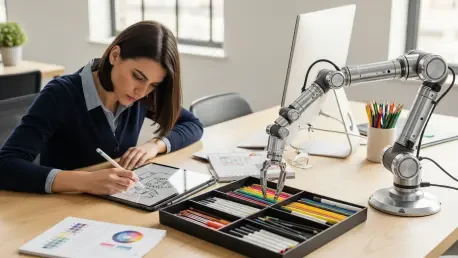
Despite the confrontational setup of the debate, a powerful consensus emerged that painted a future of collaboration rather than replacement. This viewpoint positions artificial intelligence not as a rival to human talent but as an indispensable and powerful tool. Interestingly, even the AI participant, ChatGPT, conceded that it could not wholly usurp creative roles. The large language model suggested that any job fully replaceable by its capabilities was likely already repetitive and lacking the critical creative judgment that makes professional work meaningful and fulfilling. It advocated for a strategic division of labor where its capabilities are leveraged to handle monotonous, time-consuming tasks. This approach would, in turn, liberate human creatives—especially junior talent who often bear the brunt of such work—to dedicate more of their time and energy to experimentation, conceptual development, learning, and the inevitable, yet crucial, process of making mistakes and growing from them. This reframes AI’s integration from a threat into an opportunity for empowerment.
This vision of a human-AI partnership carries significant implications for professional development and the very definition of creative craft in the modern workplace. Deanne Constantine, the event’s founder, highlighted that in this new paradigm, the role of mentorship becomes critically important. As AI automates routine tasks, the focus must shift to nurturing the uniquely human skills of strategic thinking, emotional intelligence, and nuanced execution. Her conclusion that “the craft becomes more important, not less” resonated throughout the discussion, suggesting a future where technical mastery is enhanced, not overshadowed, by technology. This sentiment was echoed by Sarah McGregor, National Executive Creative Director of AKQA, who urged the industry to approach this technological shift with a sense of curiosity instead of fear. She drew historical parallels, noting that fear has always accompanied creative innovation, but so has immense opportunity. As she aptly put it, “Every new technology looks scary until someone makes something beautiful with it,” a statement that captures the optimistic and proactive spirit required to navigate the road ahead.
Reaffirming the Human Spark
Ultimately, the dialogue and its surrounding discussions culminated in a strong reaffirmation of human-led creativity. The event underscored a collective belief that while AI will undoubtedly reshape workflows and expand the toolkit available to creators, the fundamental drivers of compelling and original work would remain anchored in the human experience. Core elements like instinct, community, humor, and shared emotional understanding were identified as irreplaceable assets that AI can simulate but not genuinely possess. The debate moved the conversation beyond a simple binary of human versus machine, instead fostering a more sophisticated understanding of a future where technology serves as a powerful assistant. This envisioned partnership would be one where AI handles the computational heavy lifting and enhances efficiency, but the essential spark of originality, the emotional resonance, and the capacity for meaningful connection remained the exclusive and cherished domain of humanity.