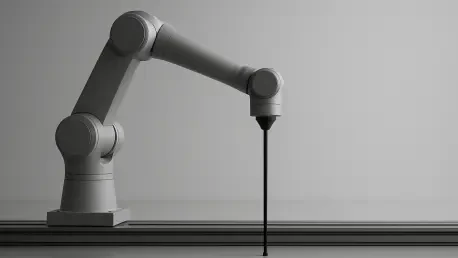

Traditional fixed-base robot arms often fail to reach every necessary measurement point on large automotive components, forcing engineers to manually reposition hardware mid-test. This persistent challenge has grown more acute as the automotive sector accelerates its transition to highly integrated electronic platforms. In the current landscape of 2026, vehicles are increasingly defined by their software and sensor arrays, necessitating a more rigorous approach to electromagnetic compatibility testing. The traditional laboratory setup often struggles with the sheer scale and complexity of modern electric vehicle drivetrains and infotainment systems. To address these inefficiencies, the Eretec ERE-PT130 has been introduced as a sophisticated robotic solution specifically engineered to automate the radiated immunity testing process. By integrating high-precision motion with intelligent control systems, this platform eliminates technical bottlenecks, ensuring a faster time-to-market for next-generation vehicle technologies.
Physical Challenges: Moving Beyond Fixed-Base Limitations
Mobile Base Engineering: Expanding Robotic Reach
The primary innovation of the ERE-PT130 lies in its mobile base architecture, which allows the robot to traverse the length of the test table rather than remaining tethered to a single spot. This design philosophy focuses on moving the measurement equipment around the device under test, a method that significantly enhances the accessibility of complex geometric configurations. By mounting a high-precision robot arm onto a motorized linear rail, the system provides an expansive working envelope that covers the entirety of large vehicle modules without requiring the physical movement of the components themselves.
The robot’s ability to maintain a constant distance and orientation relative to the device is essential for the accuracy of radiated immunity trials. Traditional setups often suffer from inconsistent signal strength because the antenna position cannot be perfectly replicated across different points. The ERE-PT130 solves this by using advanced motion mapping, ensuring that every measurement point receives the exact field intensity required. This automated mobility reduces the total time required for a complete test sweep while maintaining strict adherence to laboratory standards.
Data Integrity: The Advantage of Automated Positioning
By automating the spatial movement of antennas, the system effectively removes the possibility of human error during the repositioning phase. In many conventional testing scenarios, the technician must enter the shielded chamber to adjust the equipment, which not only disrupts the electromagnetic environment but also consumes valuable time. The ERE-PT130 eliminates this need for manual intervention by executing pre-programmed paths that have been verified for safety and precision. This seamless transition between test points allows for continuous operation, maximizing the utilization of expensive chamber time.
Furthermore, the automation of these movements ensures a level of scientific integrity that is difficult to achieve manually. Every test run can be replicated with millimeter precision, allowing engineers to compare data sets across different development stages with high confidence. This level of consistency is particularly beneficial for identifying intermittent electromagnetic issues that might be missed if the antenna placement varies even slightly between sessions. As a result, the laboratory environment becomes a much more predictable and efficient workspace for verifying high-density electronic systems.
Precision Engineering: Meeting Strict Motion Tolerances
Geometric Adaptability: Precision in Three Dimensions
Precision engineering is at the core of the ERE-PT130, which features a motion control tolerance of plus or minus 0.05mm. This degree of accuracy is vital for high-frequency testing where even a tiny deviation in antenna placement can significantly alter the measurement results. The robot arm itself is designed to support a high payload, enabling it to carry a variety of heavy antennas used for different frequency ranges. This versatility means that a single robotic system can handle multiple stages of the EMC testing process, from low-frequency immunity to high-bandwidth emission monitoring.
In addition to its raw precision, the robot is equipped with specialized 3D curved surface scanning software. Modern automotive components are rarely flat; they feature aerodynamic curves and complex internal geometries that require the antenna to follow a non-linear path. The ERE-PT130 can be programmed to trace these surfaces precisely, maintaining a uniform distance throughout the scan. This capability ensures that the electromagnetic field remains uniform across the entire surface of the component, providing more accurate data for parts that will be integrated into vehicles from 2026 to 2030.
Interference Management: Achieving Electromagnetic Silence
One of the most significant hurdles in using robotics for EMC testing is the electromagnetic noise generated by the robot’s own motors and controllers. Eretec has implemented a clever noise mitigation strategy that involves cutting power to the moving components once the robot has reached its target coordinates. This quiet positioning technique ensures that no stray signals from the robot interfere with the measurement of the device under test. By eliminating this source of potential error, the system provides a clean electromagnetic environment for capturing highly sensitive data.
This focus on data integrity is further bolstered by the use of fiber-optic communication lines and high-quality shielding throughout the robotic structure. These measures prevent the robot’s internal signals from leaking out and affecting the test results. Furthermore, the ERE-PT130 features safety sensors that detect potential collisions with the test object or chamber walls. If an obstruction is detected, the system immediately halts all movement, protecting both the expensive antenna hardware and the vehicle components being tested. This combination of silence and safety makes it an ideal tool for high-stakes automotive validation.
Integrated Workflows: Software and Safety Synergy
Unified Control Systems: Streamlining Laboratory Operations
Efficiency in the modern laboratory is not just about physical movement but also about software integration. The ERE-PT130 is designed to be fully compatible with TOYO measurement software, which is a global standard in the EMC industry. This integration allows for a unified workflow where the robot’s movements are synchronized with the signal generators and spectrum analyzers. Engineers can define the entire testing sequence within a single software interface, from the initial positioning of the robot to the final data logging and report generation.
This deep software synergy significantly reduces the administrative burden on laboratory staff. Instead of managing multiple disparate systems, technicians can monitor the entire automated process from a central console. The software also allows for the storage of complex test profiles, which can be instantly recalled for future testing of similar components. This capability is essential for automotive manufacturers who need to validate dozens of different modules across a wide range of vehicle models. By streamlining the digital workflow, the system allows laboratories to handle a much higher volume of work.
Industry Outcomes: Enhancing Throughput and Reliability
The ERE-PT130 proved to be a transformative asset for laboratories tasked with measuring long wiring harnesses and large-scale vehicle arrays. Historically, these components required multiple manual setups that were both time-consuming and prone to inconsistency. By automating the entire process, the robotic system allowed for single-pass measurements that captured the full range of electromagnetic interactions along the entire length of the harness. This transition to full automation was a critical step in supporting the rapid development cycles seen in the electric vehicle market.
The adoption of such high-precision robotic systems established a new baseline for data reliability and laboratory throughput. Moving forward, facilities were encouraged to expand these automated protocols to include fully autonomous chamber management and AI-driven data analysis. These advancements ensured that the industry could keep pace with the increasing complexity of vehicle electronics while maintaining the highest safety standards. Ultimately, the shift toward robotic EMC testing provided a more robust and scalable solution for the challenges of 2026 and beyond, securing the reliability of the electronic systems that define the modern driving experience.